Introduction
Home Automation Hubs act as the central control unit of a smart home, connecting and coordinating multiple smart devices such as lights, thermostats, locks, cameras, and sensors. These hubs enable devices from different brands and protocols (Zigbee, Z-Wave, Wi-Fi, Matter) to communicate and work together seamlessly.
As smart homes become more complex, relying on separate apps for each device becomes inefficient. Home automation hubs simplify this by offering centralized control, automation routines, and real-time monitoring. They also enhance security, improve energy efficiency, and provide a better user experience.
Real-world use cases
- Centralized smart home control – Manage all devices from one platform
- Automation routines – Schedule lighting, climate, and appliances
- Home security management – Integrate cameras, alarms, and locks
- Energy efficiency optimization – Control HVAC and lighting usage
- Remote home monitoring – Access and control devices from anywhere
What buyers should evaluate
- Protocol support (Zigbee, Z-Wave, Wi-Fi, Matter)
- Device compatibility and ecosystem size
- Local vs cloud processing
- Automation capabilities
- Mobile app usability
- Integration with voice assistants
- Security and privacy features
- Scalability and performance
- Total cost of ownership
Best for: Homeowners, smart home enthusiasts, families, and tech-savvy users looking for centralized automation and control.
Not ideal for: Users without smart devices or those needing only basic automation with minimal integration.
Key Trends in Home Automation Hubs
- Matter protocol adoption for cross-device compatibility
- Local processing for faster and more secure automation
- AI-based automation routines and smart suggestions
- Hybrid cloud + local control models
- Integration with energy management systems
- Voice-first smart home control ecosystems
- Edge computing for low-latency automation
- Expansion of IoT device ecosystems
- Privacy-focused smart home solutions
- Mobile-first smart home management apps
How We Selected These Tools (Methodology)
- Market adoption and ecosystem size
- Compatibility across devices and protocols
- Automation and feature depth
- Performance and reliability
- Security and privacy capabilities
- Integration ecosystem strength
- Ease of use and onboarding
- Value for cost and scalability
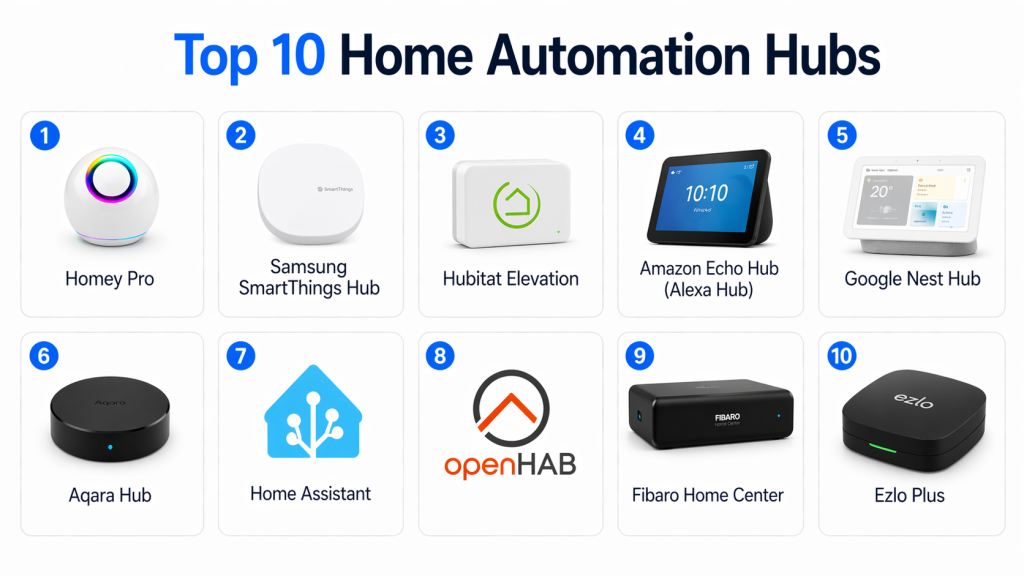
Top 10 Home Automation Hubs
#1 — Homey Pro
Short description: Homey Pro is an advanced multi-protocol smart home hub that supports a wide range of devices and offers powerful automation capabilities for complex setups.
Key Features
- Multi-protocol support (Zigbee, Z-Wave, Wi-Fi)
- Advanced automation flows
- Energy monitoring
- Mobile control app
- Dashboard insights
- App marketplace
Pros
- Highly customizable
- Supports many devices
Cons
- Expensive
- Best suited for advanced users
Platforms / Deployment
Local / Cloud
Security & Compliance
Not publicly stated
Integrations & Ecosystem
Supports a wide range of smart home ecosystems.
- IoT devices
- APIs
- Third-party integrations
Support & Community
Strong documentation and active community.
#2 — Samsung SmartThings Hub
Short description: SmartThings is a widely adopted hub that connects and automates smart home devices across multiple protocols and brands.
Key Features
- Multi-device support
- Automation routines
- Real-time monitoring
- Mobile app control
- Smart home dashboards
Pros
- Easy setup
- Large ecosystem
Cons
- Partial cloud dependency
- Limited advanced automation
Platforms / Deployment
Cloud / Hybrid
Security & Compliance
Not publicly stated
Integrations & Ecosystem
- Smart devices
- Samsung ecosystem
- APIs
Support & Community
Large user community and strong support.
#3 — Hubitat Elevation
Short description: Hubitat Elevation focuses on local processing, enabling faster automation and better privacy without relying heavily on cloud services.
Key Features
- Local automation
- Rule engine
- Multi-protocol support
- Fast execution
- Device integration
Pros
- No cloud dependency
- High performance
Cons
- Basic user interface
- Learning curve
Platforms / Deployment
Local
Security & Compliance
Local processing
Integrations & Ecosystem
- IoT devices
- APIs
Support & Community
Active user-driven community.
#4 — Amazon Echo Hub (Alexa Hub)
Short description: Amazon Echo Hub provides voice-based smart home control with seamless integration across Alexa-enabled devices.
Key Features
- Voice control
- Automation routines
- Device integration
- Mobile app support
- Cloud-based control
Pros
- Easy to use
- Extensive device compatibility
Cons
- Cloud dependency
- Privacy concerns
Platforms / Deployment
Cloud
Security & Compliance
Not publicly stated
Integrations & Ecosystem
- Alexa ecosystem
- Smart home devices
Support & Community
Very strong ecosystem support.
#5 — Google Nest Hub
Short description: Google Nest Hub combines a smart display with home automation capabilities powered by Google Assistant.
Key Features
- Voice assistant integration
- Smart display
- Automation routines
- Device control
- AI-based suggestions
Pros
- User-friendly
- Strong AI capabilities
Cons
- Limited local control
- Cloud dependency
Platforms / Deployment
Cloud
Security & Compliance
Not publicly stated
Integrations & Ecosystem
- Google ecosystem
- Smart devices
Support & Community
Large user base and support.
#6 — Aqara Hub M2
Short description: Aqara Hub M2 is a Zigbee-based smart home hub offering reliable automation and integration with major ecosystems.
Key Features
- Zigbee support
- Automation routines
- Sensor ecosystem
- Mobile app control
- Smart home integration
Pros
- Affordable
- Easy to use
Cons
- Limited third-party compatibility
- Requires Aqara ecosystem
Platforms / Deployment
Cloud
Security & Compliance
Not publicly stated
Integrations & Ecosystem
- IoT devices
- APIs
Support & Community
Growing ecosystem.
#7 — Home Assistant
Short description: Home Assistant is an open-source home automation hub offering full customization and privacy-focused local control.
Key Features
- Local automation
- Open-source flexibility
- Custom dashboards
- Device integrations
- Advanced automation
Pros
- Highly customizable
- Privacy-focused
Cons
- Requires technical knowledge
- Setup complexity
Platforms / Deployment
Self-hosted
Security & Compliance
Local control
Integrations & Ecosystem
- APIs
- IoT devices
Support & Community
Very strong community support.
#8 — openHAB
Short description: openHAB is a flexible open-source automation hub designed for advanced users and developers.
Key Features
- Automation rules
- Device integrations
- Custom dashboards
- Local processing
- Open-source platform
Pros
- Flexible
- No vendor lock-in
Cons
- Complex setup
- Requires technical skills
Platforms / Deployment
Self-hosted
Security & Compliance
Not publicly stated
Integrations & Ecosystem
- APIs
- IoT devices
Support & Community
Active community.
#9 — Fibaro Home Center
Short description: Fibaro Home Center is a premium hub focused on Z-Wave automation with advanced control and security features.
Key Features
- Z-Wave support
- Automation engine
- Smart home control
- Security features
- Dashboard
Pros
- Reliable performance
- Advanced automation
Cons
- Expensive
- Limited compatibility
Platforms / Deployment
Local / Hybrid
Security & Compliance
Not publicly stated
Integrations & Ecosystem
- Z-Wave devices
- APIs
Support & Community
Professional support.
#10 — Ezlo Plus
Short description: Ezlo Plus is an affordable smart home hub offering basic automation and device connectivity.
Key Features
- Multi-protocol support
- Automation routines
- Device control
- Mobile app
- Integration support
Pros
- Affordable
- Easy setup
Cons
- Limited advanced features
- Smaller ecosystem
Platforms / Deployment
Cloud
Security & Compliance
Not publicly stated
Integrations & Ecosystem
- IoT devices
- APIs
Support & Community
Moderate support.
Comparison Table (Top 10)
| Tool Name | Best For | Platform(s) Supported | Deployment | Standout Feature | Public Rating |
|---|---|---|---|---|---|
| Homey Pro | Advanced users | Web/Mobile | Hybrid | Multi-protocol support | N/A |
| SmartThings | Beginners | Web/Mobile | Cloud | Easy setup | N/A |
| Hubitat | Privacy users | Local | Local | Local automation | N/A |
| Alexa Hub | Voice control | Mobile | Cloud | Voice integration | N/A |
| Google Nest | Smart display | Mobile | Cloud | AI assistant | N/A |
| Aqara | Budget users | Mobile | Cloud | Zigbee ecosystem | N/A |
| Home Assistant | Power users | Self-hosted | Local | Customization | N/A |
| openHAB | Developers | Self-hosted | Local | Open-source | N/A |
| Fibaro | Premium users | Local | Hybrid | Z-Wave automation | N/A |
| Ezlo | Budget users | Mobile | Cloud | Easy setup | N/A |
Evaluation & Scoring of Home Automation Hubs
| Tool Name | Core (25%) | Ease (15%) | Integrations (15%) | Security (10%) | Performance (10%) | Support (10%) | Value (15%) | Weighted Total |
|---|---|---|---|---|---|---|---|---|
| Homey Pro | 9 | 7 | 9 | 8 | 9 | 8 | 7 | 8.3 |
| SmartThings | 8 | 9 | 8 | 7 | 8 | 8 | 8 | 8.1 |
| Hubitat | 8 | 7 | 7 | 8 | 9 | 7 | 8 | 7.9 |
| Alexa | 7 | 9 | 9 | 6 | 8 | 9 | 9 | 8.2 |
| Google Nest | 7 | 9 | 8 | 6 | 8 | 9 | 9 | 8.1 |
| Aqara | 7 | 9 | 7 | 6 | 7 | 7 | 9 | 7.8 |
| Home Assistant | 9 | 6 | 9 | 9 | 9 | 9 | 8 | 8.6 |
| openHAB | 8 | 6 | 8 | 8 | 8 | 7 | 8 | 7.8 |
| Fibaro | 8 | 6 | 7 | 7 | 8 | 7 | 6 | 7.2 |
| Ezlo | 7 | 8 | 6 | 6 | 7 | 7 | 8 | 7.3 |
How to interpret scores:
These scores are comparative and highlight differences across features, usability, and value. Higher scores indicate stronger overall capability, but the best choice depends on your needs such as simplicity, customization, or scalability.
Which Home Automation Hub Is Right for You?
Solo / Beginner
Amazon Alexa or Google Nest Hub for easy setup and voice control.
SMB / Home Users
SmartThings and Aqara Hub for balanced features and affordability.
Mid-Market
Hubitat and Fibaro for better control and performance.
Enterprise / Large Homes
Homey Pro and Home Assistant for advanced automation and scalability.
Budget vs Premium
- Budget: Aqara, Ezlo
- Premium: Homey Pro, Fibaro
Feature Depth vs Ease of Use
- Advanced: Home Assistant
- Easy: Alexa
Integrations & Scalability
SmartThings and Home Assistant offer the best integration flexibility.
Security & Compliance Needs
Local hubs like Hubitat and Home Assistant provide better privacy control.
Frequently Asked Questions (FAQs)
1. What is a home automation hub?
A home automation hub is a central device that connects and controls multiple smart devices in a home from one platform.
2. Do I need a hub for smart home devices?
Not always, but a hub improves compatibility and enables advanced automation.
3. What protocols do hubs support?
Most hubs support Zigbee, Z-Wave, Wi-Fi, and newer standards like Matter.
4. Which hub is best for beginners?
Amazon Alexa and Google Nest Hub are the easiest to start with.
5. What is local vs cloud automation?
Local automation runs on the hub itself, while cloud automation depends on internet connectivity.
6. Are smart home hubs secure?
Security depends on the platform, but local hubs generally offer better privacy.
7. Can I use devices from different brands?
Yes, if the hub supports multiple protocols and integrations.
8. Do hubs require internet?
Cloud-based hubs do, while local hubs can work offline for some features.
9. What is the cost of a hub?
Costs vary based on features, ecosystem, and hardware requirements.
10. Is setup difficult?
Basic hubs are easy to set up, but advanced systems may require technical knowledge.
Conclusion
Home Automation Hubs are essential for building a connected and efficient smart home ecosystem. They bring together multiple devices into a single control system, enabling automation, security, and improved energy efficiency. However, the right hub depends on your specific needs. Beginners may prefer simple, voice-enabled platforms, while advanced users may choose customizable and locally controlled solutions. Before making a decision, evaluate device compatibility, ease of use, automation capabilities, and long-term scalability. Testing a hub with a few devices can help ensure it meets your expectations. With the right hub in place, you can transform your home into a smarter, more convenient, and highly automated living environment.