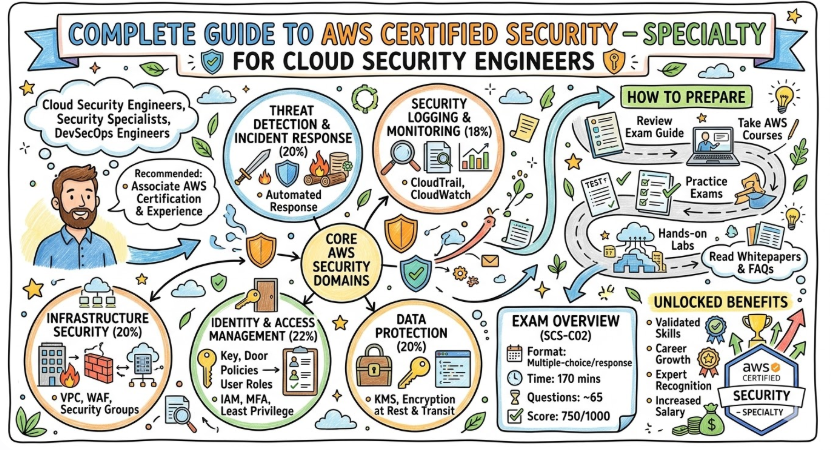
Introduction
In the world of cloud computing, security is no longer an afterthought. It is the foundation of every stable system. AWS Certified Security – Specialty is a professional-level validation that confirms a person’s ability to secure data and workloads in the Amazon Web Services environment. This certification is designed to prove that an engineer can handle complex security challenges, from encryption to incident response.
As the cloud ecosystem grows, the risks also increase. For software engineers and managers, understanding security is vital. It is not just about passing an exam; it is about protecting the business. Certifications are important because they provide a structured way to learn. They act as a benchmark for skills in a competitive global market. Whether you are based in India or working for a global firm, having this credential shows that you are serious about cloud safety and automation.
Certification Overview
| Track | Level | Who it’s for | Prerequisites | Skills Covered | Recommended Order |
| Security | Specialty | Security Professionals, DevOps Engineers | Cloud Practitioner or Associate level recommended | Encryption, Logging, Monitoring, Infrastructure Security | After AWS Associate Certifications |
Why Choose DevOpsSchool?
DevOpsSchool is chosen by many professionals because the training is handled by people with deep industry knowledge. The courses are designed to be practical. Real-world scenarios are used so that learners do not just memorize theory. Support is provided throughout the learning journey to ensure that the certification is achieved successfully.
Certification Deep-Dive: AWS Certified Security – Specialty
What is this certification?
This is a technical certification that validates your expertise in securing the AWS platform. It covers specialized areas like data protection, identity management, and automated security responses.
Who should take this certification?
It is intended for individuals who perform a security role. Cloud engineers, security architects, and DevOps specialists who want to master AWS security tools should aim for this.
Skills you will gain
- Deep understanding of specialized data classifications and AWS data protection mechanisms.
- Mastery of data encryption methods and the tools to implement them.
- Knowledge of secure internet protocols and how to implement them.
- Ability to make trade-off decisions regarding cost, security, and complexity.
- Expertise in automated security monitoring and alerting.
Real-world projects you should be able to do
- Design a multi-account security strategy using AWS Organizations.
- Implement automated remediation for non-compliant resources.
- Configure advanced Web Application Firewalls (WAF) to protect against common attacks.
- Manage complex Key Management Service (KMS) policies for global data encryption.
Preparation Plan
7–14 Days Plan (The Sprint)
- Days 1-4: Focus on Identity and Access Management (IAM) and KMS.
- Days 5-10: Study Logging, Monitoring, and Incident Response.
- Days 11-14: Take multiple practice exams and review weak areas.
30 Days Plan (The Standard)
- Week 1: Master IAM, Policies, and multi-factor authentication.
- Week 2: Deep dive into Infrastructure Security (VPC, Security Groups, WAF).
- Week 3: Focus on Data Protection (KMS, CloudHSM, Encryption).
- Week 4: Mock exams and final review of whitepapers.
60 Days Plan (The Deep Dive)
- Month 1: Detailed study of every AWS security service. Build lab environments for each.
- Month 2: Focus on advanced scenarios, troubleshooting, and extensive practice testing.
Common mistakes to avoid
- Neglecting the importance of KMS and how keys are managed.
- Ignoring the “shared responsibility model” details.
- Not spending enough time on logging tools like CloudTrail and Config.
- Overlooking the specific details of network security in a VPC.
Best next certification after this
- Same track: None (This is the top-tier security specialty).
- Cross-track: AWS Certified Solutions Architect – Professional.
- Leadership / management: Certified Information Systems Security Professional (CISSP).
Choose Your Learning Path
1. DevOps Path
This path is best for those who automate software delivery. It focuses on integrating security into the CI/CD pipeline.
2. DevSecOps Path
This is ideal for security-focused engineers. It shifts security to the left, ensuring that safety checks are performed early in the development cycle.
3. Site Reliability Engineering (SRE) Path
Best for those focused on uptime and reliability. It combines security with system health to ensure that attacks do not cause downtime.
4. AIOps / MLOps Path
This path is for data scientists and AI engineers. It focuses on securing machine learning models and using AI to detect security threats.
5. DataOps Path
Best for data engineers. It ensures that data pipelines are secure and that sensitive information is encrypted at all times.
6. FinOps Path
Ideal for cloud financial managers. It focuses on the cost of security and ensuring that security tools are used efficiently without wasting budget.
Role → Recommended Certifications Mapping
- DevOps Engineer: AWS DevOps Engineer Professional, AWS Security Specialty.
- Site Reliability Engineer (SRE): AWS SysOps Administrator, AWS Security Specialty.
- Platform Engineer: AWS Solutions Architect Professional, AWS Security Specialty.
- Cloud Engineer: AWS Associate (Any), AWS Security Specialty.
- Security Engineer: AWS Security Specialty, CISSP.
- Data Engineer: AWS Data Engineer Associate, AWS Security Specialty.
- FinOps Practitioner: AWS Cloud Practitioner, FinOps Certified Practitioner.
- Engineering Manager: AWS Solutions Architect Associate, PMP.
Next Certifications to Take
For DevOps Learners
- Same-track: AWS Certified DevOps Engineer – Professional.
- Cross-track: Certified Kubernetes Administrator (CKA).
- Leadership: TOGAF Certification.
For Security Learners
- Same-track: CISM (Certified Information Security Manager).
- Cross-track: AWS Certified Advanced Networking – Specialty.
- Leadership: CISO Training Programs.
Training & Certification Support Institutions
DevOpsSchool
Comprehensive training is provided here for all major cloud and DevOps tracks. The focus is kept on job-ready skills and hands-on lab work.
Cotocus
Expert-led sessions are offered to help professionals transition into cloud roles. Customized learning paths are created for corporate teams and individuals.
ScmGalaxy
A vast community resource is maintained here for software configuration management. Technical guides and certification support are provided for various engineering roles.
BestDevOps
The latest industry trends are taught by experienced mentors. This institution focuses on high-level certifications and advanced platform engineering.
devsecopsschool.com
A specialized platform for learning how to integrate security into DevOps. Detailed courses on automated security testing are provided.
sreschool.com
This site focuses on reliability and performance. Training is given on how to manage large-scale systems with high availability.
aiopsschool.com
Modern operations using artificial intelligence are explored here. Courses cover how to use AI to improve system monitoring and security.
dataopsschool.com
The focus is kept on data management and pipeline security. Learning is centered on how to handle big data in a secure cloud environment.
finopsschool.com
Cloud cost management is the primary focus. Strategies for optimizing cloud spend while maintaining security are taught here.
FAQs Section
1. Is the AWS Security Specialty exam difficult?
Yes, it is considered a professional-level exam that requires a deep understanding of AWS services.
2. How much time is required for preparation?
Usually, 1 to 3 months are needed, depending on your prior experience with AWS.
3. Are there any prerequisites?
There are no formal prerequisites, but an associate-level certification is highly recommended.
4. What is the sequence of certifications?
It is best to complete the Solutions Architect Associate before attempting the Security Specialty.
5. Does this certification help in career growth?
Yes, it is highly valued by employers and often leads to higher-paying security roles.
6. Which job roles can I apply for?
You can apply for roles like Cloud Security Architect, Security Engineer, or DevSecOps Lead.
7. Is this certification valid globally?
Yes, AWS certifications are recognized by companies all over the world.
8. How long is the certification valid?
The certification is valid for three years, after which recertification is required.
9. Can an Engineering Manager benefit from this?
Yes, it helps managers understand the risks and security needs of their technical teams.
10. Is hands-on experience necessary?
Yes, practical experience with AWS tools is vital for passing the exam.
11. What is the format of the exam?
The exam consists of multiple-choice and multiple-response questions.
12. Can I take the exam online?
Yes, AWS offers the option to take the exam from home via online proctoring.
AWS Certified Security – Specialty Specific FAQs
1. What is the focus of the SCS-C02 exam?
The focus is on incident response, logging, monitoring, infrastructure security, and data protection.
2. Does the exam cover third-party security tools?
The primary focus is on native AWS services, but general security concepts are also tested.
3. How important is KMS in this exam?
KMS is a major part of the exam; understanding key rotation and policies is essential.
4. Are networking concepts tested?
Yes, a strong grasp of VPC security, including NACLs and Security Groups, is required.
5. What is the passing score?
The passing score is 750 out of 1000.
6. How much does the exam cost?
The exam fee is 300 USD.
7. Are there labs in the exam?
Currently, the exam is question-based and does not include live labs.
8. What resources should be used for study?
Official AWS whitepapers, documentation, and expert-led training from sites like DevOpsSchool are recommended.
Testimonials
Aarav
The training helped me understand how to secure my company’s data properly. My confidence in managing cloud risks has grown significantly.
Sanya
The real-world scenarios shared during the sessions were very helpful. I can now implement automated security checks in my DevOps pipeline.
John
The path to certification was made very clear. It has helped me transition from a general cloud role into a specialized security position.
Vikram
As a manager, this knowledge allows me to lead my team more effectively. I now understand the security trade-offs we face every day.
Elena
The skills gained are immediately applicable to my projects. I feel much more prepared to handle security incidents on AWS.
Conclusion
The AWS Certified Security – Specialty certification is a powerful tool for any engineer. It provides the skills needed to protect complex cloud environments. By following a structured learning path, career growth is almost certain. Long-term benefits include higher salary potential and the ability to lead security initiatives. Strategic planning and the right training are the keys to success in this journey.