Introduction
In the current world of software and cloud computing, managing applications has changed completely. Kubernetes has become the standard for running these applications at scale. If you are working in IT today, you have likely heard of it. However, knowing about it and being able to manage it professionally are two different things. This is where the Certified Kubernetes Administrator (CKA) comes into play.
The CKA certification is designed to prove that an engineer can handle the day-to-day responsibilities of a Kubernetes administrator. It is not just a theoretical exam; it is a performance-based test. This means you have to solve real problems in a command-line interface. For engineers and managers, this certification acts as a badge of trust. it shows that the person holding it understands how to build, configure, and manage production-ready clusters.
In a competitive job market, certifications provide a clear path for growth. They help managers identify skilled talent and help engineers stay updated with modern automation tools. Whether you are looking to move into a DevOps role or want to strengthen your current SRE position, the CKA is a vital milestone in that journey.
Certification Overview Table
| Track | Level | Who it’s for | Prerequisites | Skills Covered | Recommended Order |
| Kubernetes Administration | Intermediate / Professional | DevOps, Cloud, & SysAdmins | Basic Linux & Docker knowledge | Installation, Networking, Storage, Troubleshooting | After KCNA, Before CKS |
Provider: DevOpsSchool
Why Choose DevOpsSchool?
Choosing the right place to learn is as important as the certification itself. DevOpsSchool is highly regarded because the training is handled by people who work in the industry. The focus here is not just on passing the exam but on gaining deep technical knowledge.
The curriculum is updated regularly to match the latest exam versions. Students are provided with hands-on labs that mimic real-world production environments. This ensures that when you sit for the CKA exam, the terminal feels familiar. Support is also provided to help clear doubts, which is crucial when dealing with complex networking or security topics in Kubernetes.
Certification Deep-Dive: Certified Kubernetes Administrator (CKA)
What is this certification?
The CKA certification is a hands-on exam that verifies your ability to install, configure, and manage Kubernetes clusters. It focuses on the core skills needed to be a successful Kubernetes administrator in a real-world setting.
Who should take this certification?
- System Administrators and Operations teams.
- DevOps and Site Reliability Engineers.
- Cloud Architects looking to master container orchestration.
- Software Engineers who want to understand the infrastructure their code runs on.
Skills you will gain
- Setting up a complete Kubernetes cluster from scratch.
- Managing cluster security and user permissions (RBAC).
- Configuring persistent storage for applications.
- Troubleshooting broken nodes and networking issues.
- Performing zero-downtime application updates.
Real-world projects you should be able to do
- Build a high-availability Kubernetes cluster for a microservices app.
- Automate the scaling of applications based on traffic.
- Set up complex networking rules to secure communication between pods.
- Implement backup and recovery strategies for cluster data.
Preparation Plan
7–14 Days Plan (Express)
- Days 1-4: Focus on core concepts like Pods, Deployments, and Services.
- Days 5-10: Practice heavy command-line work (Imperative commands).
- Days 11-14: Run through mock exams and focus on time management.
30 Days Plan (Standard)
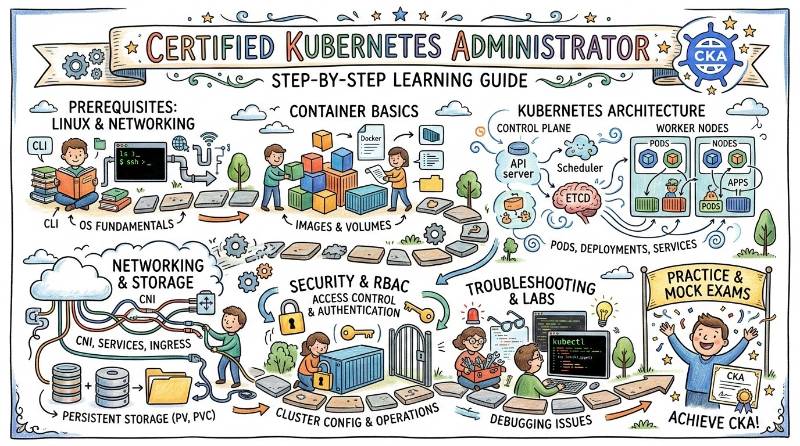
- Week 1: Master Linux basics and container fundamentals.
- Week 2: Deep dive into Kubernetes architecture and installation.
- Week 3: Focus on Storage, Networking, and Scheduling.
- Week 4: Intensive troubleshooting labs and practice exams.
60 Days Plan (Deep Learning)
- Month 1: Study each component of the Control Plane in detail. Build clusters manually multiple times.
- Month 2: Apply Kubernetes to real-world app scenarios. Spend the final two weeks perfecting speed and accuracy in the terminal.
Common mistakes to avoid
- Spending too much time on a single hard question.
- Not being comfortable with the Vim or Nano text editors.
- Forgetting to switch the context (cluster environment) between questions.
- Relying too much on the official documentation during the exam.
Best next certification after this
- Same track: Certified Kubernetes Security Specialist (CKS).
- Cross-track: Certified Kubernetes Application Developer (CKAD).
- Leadership / management: Certified Cloud Practitioner or DevOps Leader programs.
Choose Your Learning Path
1. DevOps Path
This path is best for those who want to bridge the gap between code and infrastructure. It focuses on CI/CD pipelines and automation.
2. DevSecOps Path
Ideal for security-focused engineers. The focus is shifted toward securing the container images and the Kubernetes API.
3. Site Reliability Engineering (SRE) Path
Best for those interested in high availability and performance. It emphasizes monitoring, logging, and keeping the cluster running smoothly.
4. AIOps / MLOps Path
Designed for data scientists and engineers who need to run machine learning models at scale using Kubernetes.
5. DataOps Path
Perfect for database administrators and data engineers managing large-scale data pipelines within containers.
6. FinOps Path
Focused on cloud cost management. It helps engineers understand how to optimize Kubernetes resources to save money.
Role → Recommended Certifications Mapping
- DevOps Engineer: CKA + CKAD + Jenkins Certification.
- Site Reliability Engineer (SRE): CKA + Prometheus/Grafana specialized training.
- Platform Engineer: CKA + Terraform + CKS.
- Cloud Engineer: CKA + AWS/Azure Solution Architect.
- Security Engineer: CKA + CKS + HashiCorp Vault.
- Data Engineer: CKA + Kafka or Spark specialized certs.
- FinOps Practitioner: CKA + FinOps Certified Practitioner.
- Engineering Manager: CKA + DevOps Leader + PMP.
Next Certifications to Take
For the Technical Learner
- Same-track: Certified Kubernetes Security Specialist (CKS) is recommended.
- Cross-track: Terraform Associate is a great addition for Infrastructure as Code.
- Leadership: Certified DevOps Leader (CDL) is suggested for those moving to management.
For the Management Learner
- Same-track: Kubernetes and Cloud Native Associate (KCNA) for high-level understanding.
- Cross-track: AWS Certified Solutions Architect.
- Leadership: Digital Transformation Officer (DTO) certification.
Training & Certification Support Institutions
DevOpsSchool
Comprehensive training is provided by DevOpsSchool for various cloud and automation tools. It is known for its detailed lab sessions and expert mentorship. Large groups and individuals are both supported.
Cotocus
Specialized consulting and training are offered by Cotocus. The focus is placed on real-world implementation of Kubernetes and DevOps practices. It is a great choice for corporate teams.
ScmGalaxy
A vast community and resource hub is maintained by ScmGalaxy. It provides free tutorials and paid certifications for SCM and DevOps professionals. It has been a trusted source for many years.
BestDevOps
In-depth courses on modern engineering practices are delivered by BestDevOps. The training is designed to be practical and easy to follow for beginners. It helps in building a strong foundation.
devsecopsschool.com
Specialized training in security for DevOps is provided here. The integration of security into the Kubernetes lifecycle is taught. It is essential for those looking to master DevSecOps.
sreschool.com
Reliability and performance are the core focuses at sreschool.com. Engineers are trained on how to manage large-scale systems with minimal downtime. It is a dedicated platform for SRE aspirants.
aiopsschool.com
The intersection of Artificial Intelligence and IT Operations is explored here. Training is provided on using AI to automate and improve infrastructure management. It is a forward-looking institution.
dataopsschool.com
Data management and pipeline automation are taught at dataopsschool.com. It is tailored for data professionals who want to use DevOps tools. It fills a crucial gap in the market.
finopsschool.com
The financial side of the cloud is the main topic at finopsschool.com. Training is given on how to manage and reduce cloud spending effectively. It is highly valued by management.
FAQs Section
1. Is the CKA exam very difficult?
It is considered a moderately difficult exam because it is performance-based. Practical knowledge is tested rather than just memory.
2. How much time is needed to prepare for CKA?
For someone with basic container knowledge, 4 to 6 weeks of consistent study is usually enough.
3. Are there any prerequisites for taking the CKA?
There are no official prerequisites, but a good understanding of Linux and Docker is highly recommended.
4. What is the validity of the CKA certificate?
The certification is currently valid for two years from the date it is earned.
5. Is the exam open-book?
Yes, access to the official Kubernetes documentation is allowed during the exam.
6. What is a passing score for the CKA?
A score of 66% or higher is required to pass the examination.
7. Can the exam be taken from home?
Yes, the CKA is an online proctored exam that can be taken from any quiet location.
8. Does CKA help in getting a higher salary?
Kubernetes skills are in high demand, and certified professionals often see a significant increase in salary offers.
9. What happens if I fail the first attempt?
One free retake is usually included with the purchase of the exam.
10. Which version of Kubernetes is used in the exam?
The exam is updated regularly to reflect one of the most recent stable versions of Kubernetes.
11. Is CKA better than CKAD?
CKA is for those managing the cluster (Administrators), while CKAD is for those building apps on it (Developers). Both are valuable.
12. Is the CKA certification recognized globally?
Yes, it is recognized by the Cloud Native Computing Foundation (CNCF) and major tech companies worldwide.
CKA Specific FAQs
13. What terminal is used in the CKA exam?
A standard Linux terminal is provided within the browser for all tasks.
14. Are multiple-choice questions included?
No, there are no multiple-choice questions. All tasks must be completed in the command line.
15. How long is the CKA exam duration?
The exam lasts for exactly two hours.
16. Can I use my own bookmarks during the exam?
No, only a single tab with official documentation is permitted.
17. What are the main topics covered in the exam?
Cluster architecture, installation, configuration, services, networking, and troubleshooting are the main pillars.
18. Is “Kubernetes the Hard Way” necessary for CKA?
While not mandatory, completing it helps in understanding the underlying components of a cluster.
19. Are the questions the same for everyone?
Questions are pulled from a large pool, so the exact set of tasks varies between candidates.
20. How long does it take to get the results?
Results are typically sent via email within 24 to 48 hours after the exam is completed.
Testimonials
“The CKA course helped me gain a lot of confidence. I am now able to manage our production clusters without any fear. My skills have improved significantly.”
— Animesh
“Before this, I only knew the theory of Kubernetes. The hands-on practice gave me real-world application knowledge. It was a great career move.”
— Suresh
“Everything became much clearer after I started the CKA preparation. I now have total career clarity on where I want to go in the cloud space.”
— Priya
“A lot of growth was seen in my technical ability. Troubleshooting networking issues used to be hard, but now it feels very simple and logical.”
— Vikram
“The training was very practical. I can now guide my team better on architectural decisions. It has been a very rewarding journey for me.”
— Kavita
Conclusion
The Certified Kubernetes Administrator (CKA) certification is more than just a piece of paper. It is a journey that transforms an engineer into a specialist who can handle modern infrastructure. As more companies move to the cloud, the need for skilled administrators will only grow.
Long-term career benefits include better job opportunities, higher pay, and the ability to work on cutting-edge technology. Strategic learning is encouraged for everyone in the IT field. By planning your certification path today, you are securing your professional future for years to come.