Introduction
Search Engine Optimization (SEO) tools are software platforms that help businesses improve their visibility in search engines, drive organic traffic, and optimize website performance. These tools simplify complex SEO tasks such as keyword research, technical audits, backlink analysis, and content optimization, making it easier to rank higher in search results.
SEO is no longer just about keywords—it involves technical performance, user experience, and content relevance. Modern SEO tools bring all these elements together, helping businesses make data-driven decisions and stay competitive in search rankings.
Common Use Cases
- Keyword research and tracking
- Website audits and technical SEO fixes
- Competitor analysis
- Backlink monitoring and link building
- Content optimization and planning
What Buyers Should Evaluate
- Keyword database size and accuracy
- Backlink analysis capabilities
- Technical SEO audit features
- Content optimization tools
- Ease of use
- Integration with analytics and CMS tools
- Reporting and automation
- Scalability
- Pricing and value
SEO tools are essential because managing SEO manually is not scalable and requires continuous optimization and monitoring
Best for: SEO professionals, marketers, agencies, bloggers, and businesses focused on organic growth.
Not ideal for: Businesses relying only on paid ads or those with no long-term content strategy.
Key Trends in SEO Tools
- AI-driven keyword research and content optimization
- Integration with AI search and answer engines
- Focus on first-party data and privacy
- Real-time performance tracking
- Automated SEO audits and recommendations
- Content scoring and optimization tools
- API-first ecosystems
- Multi-location and multilingual SEO support
- Predictive SEO analytics
- Integration with marketing and analytics platforms
How We Selected These Tools (Methodology)
- Industry popularity and adoption
- Feature completeness (keyword, backlink, audit, content)
- Data accuracy and reliability
- Integration ecosystem
- Ease of use across skill levels
- Scalability for different business sizes
- Support and documentation quality
- Innovation in AI and automation
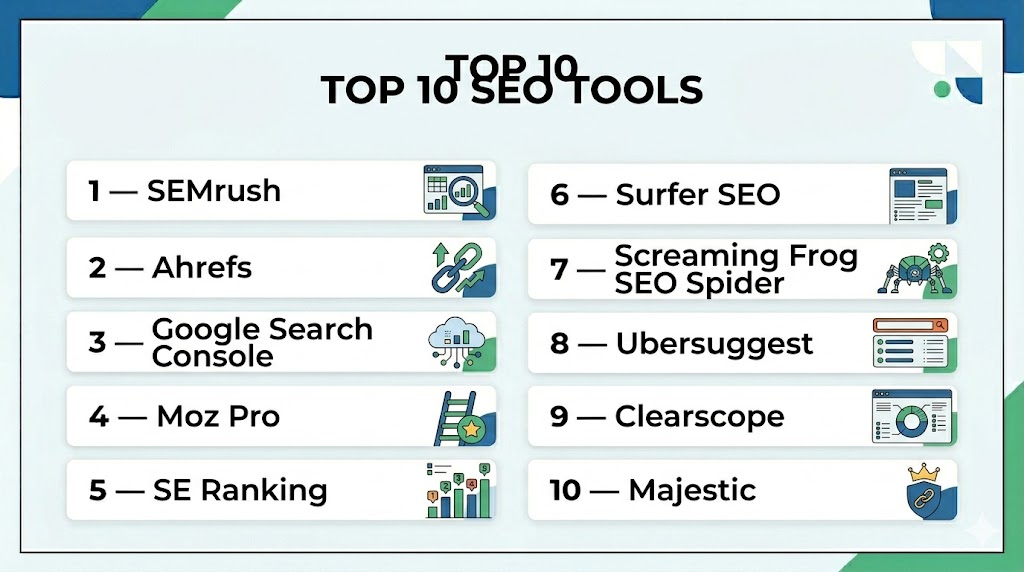
Top 10 SEO Tools
#1 — SEMrush
Short description: A comprehensive all-in-one SEO platform for keyword research, competitor analysis, and site optimization.
Key Features
- Keyword research and tracking
- Competitive analysis
- Site audit tools
- Backlink analysis
- Content marketing tools
- Rank tracking
Pros
- All-in-one platform
- Strong competitor insights
Cons
- Expensive
- Learning curve
Platforms / Deployment
- Web
- Cloud
Security & Compliance
- Not publicly stated
Integrations & Ecosystem
Extensive integrations with marketing tools.
- Analytics platforms
- APIs
- CRM tools
Support & Community
Strong documentation and large user base.
#2 — Ahrefs
Short description: A powerful SEO tool focused on backlink analysis and competitor research.
Key Features
- Backlink analysis
- Keyword research
- Site audit
- Rank tracking
- Content explorer
Pros
- Industry-leading backlink data
- Strong analytics
Cons
- Premium pricing
- No desktop app
Platforms / Deployment
- Web
- Cloud
Security & Compliance
- Not publicly stated
Integrations & Ecosystem
- APIs
- Data integrations
Support & Community
Active community and detailed guides.
#3 — Google Search Console
Short description: A free tool for monitoring website performance in search results.
Key Features
- Search performance tracking
- Indexing insights
- Error detection
- Keyword performance
- Site health monitoring
Pros
- Free to use
- Direct data from search engine
Cons
- Limited advanced features
- Basic reporting
Platforms / Deployment
- Web
- Cloud
Security & Compliance
- Not publicly stated
Integrations & Ecosystem
- Analytics tools
- APIs
Support & Community
Extensive documentation.
#4 — Moz Pro
Short description: A user-friendly SEO platform for keyword research and link analysis.
Key Features
- Keyword research
- Site audits
- Rank tracking
- Link analysis
- Domain authority metrics
Pros
- Easy to use
- Strong community
Cons
- Limited data compared to competitors
- Slower updates
Platforms / Deployment
- Web
- Cloud
Security & Compliance
- Not publicly stated
Integrations & Ecosystem
- APIs
- Analytics tools
Support & Community
Strong community support.
#5 — SE Ranking
Short description: A cost-effective SEO platform with a wide range of features for agencies and businesses.
Key Features
- Rank tracking
- Website audit
- Keyword research
- Backlink analysis
- Competitor analysis
Pros
- Affordable
- Feature-rich
Cons
- Smaller database
- UI limitations
Platforms / Deployment
- Web
- Cloud
Security & Compliance
- Not publicly stated
Integrations & Ecosystem
- APIs
- CRM integrations
Support & Community
Good support and onboarding.
#6 — Surfer SEO
Short description: A content optimization tool focused on improving on-page SEO performance.
Key Features
- Content optimization
- Keyword suggestions
- SERP analysis
- Content editor
- AI writing support
Pros
- Strong content insights
- Easy to use
Cons
- Limited technical SEO features
- Requires other tools
Platforms / Deployment
- Web
- Cloud
Security & Compliance
- Not publicly stated
Integrations & Ecosystem
- Content tools
- APIs
Support & Community
Good documentation and support.
#7 — Screaming Frog SEO Spider
Short description: A technical SEO tool for website crawling and auditing.
Key Features
- Website crawling
- Technical audits
- Broken link detection
- Metadata analysis
- Site structure insights
Pros
- Powerful technical analysis
- Detailed reports
Cons
- Desktop-based
- Learning curve
Platforms / Deployment
- Windows / macOS / Linux
- Local deployment
Security & Compliance
- Not publicly stated
Integrations & Ecosystem
- Analytics integrations
- APIs
Support & Community
Strong community and documentation.
#8 — Ubersuggest
Short description: A beginner-friendly SEO tool for keyword research and site analysis.
Key Features
- Keyword research
- Site audit
- Competitor analysis
- Traffic insights
- Content ideas
Pros
- Affordable
- Easy to use
Cons
- Limited advanced features
- Smaller dataset
Platforms / Deployment
- Web
- Cloud
Security & Compliance
- Not publicly stated
Integrations & Ecosystem
- APIs
- Basic integrations
Support & Community
Beginner-friendly support resources.
#9 — Clearscope
Short description: A content-focused SEO tool for optimizing articles and improving rankings.
Key Features
- Content scoring
- Keyword recommendations
- SERP analysis
- Topic suggestions
- AI content support
Pros
- Strong content optimization
- Accurate recommendations
Cons
- Expensive
- Limited technical SEO features
Platforms / Deployment
- Web
- Cloud
Security & Compliance
- Not publicly stated
Integrations & Ecosystem
- Content tools
- CMS integrations
Support & Community
Professional support available.
#10 — Majestic
Short description: A specialized SEO tool focused on backlink analysis and link intelligence.
Key Features
- Backlink analysis
- Link tracking
- Domain metrics
- Competitive analysis
- Historical data
Pros
- Strong backlink database
- Detailed link insights
Cons
- Limited all-in-one features
- Complex UI
Platforms / Deployment
- Web
- Cloud
Security & Compliance
- Not publicly stated
Integrations & Ecosystem
- APIs
- Data tools
Support & Community
Moderate support and documentation.
Comparison Table (Top 10)
| Tool Name | Best For | Platform(s) Supported | Deployment | Standout Feature | Public Rating |
|---|---|---|---|---|---|
| SEMrush | All-in-one SEO | Web | Cloud | Complete SEO suite | N/A |
| Ahrefs | Backlinks | Web | Cloud | Backlink analysis | N/A |
| Google Console | Free tracking | Web | Cloud | Search data | N/A |
| Moz Pro | Beginners | Web | Cloud | Domain authority metrics | N/A |
| SE Ranking | Agencies | Web | Cloud | Affordable full features | N/A |
| Surfer SEO | Content SEO | Web | Cloud | Content optimization | N/A |
| Screaming Frog | Technical SEO | Desktop | Local | Site crawling | N/A |
| Ubersuggest | Beginners | Web | Cloud | Keyword research | N/A |
| Clearscope | Content teams | Web | Cloud | Content scoring | N/A |
| Majestic | Backlinks | Web | Cloud | Link intelligence | N/A |
Evaluation & Scoring of SEO Tools
| Tool Name | Core | Ease | Integrations | Security | Performance | Support | Value | Weighted Total |
|---|---|---|---|---|---|---|---|---|
| SEMrush | 9 | 7 | 9 | 7 | 9 | 8 | 7 | 8.1 |
| Ahrefs | 9 | 6 | 8 | 7 | 9 | 8 | 7 | 8.0 |
| Google Console | 7 | 9 | 7 | 7 | 8 | 7 | 9 | 7.8 |
| Moz Pro | 7 | 8 | 7 | 6 | 7 | 8 | 7 | 7.4 |
| SE Ranking | 8 | 8 | 7 | 6 | 8 | 7 | 8 | 7.7 |
| Surfer SEO | 7 | 8 | 6 | 6 | 7 | 7 | 7 | 7.1 |
| Screaming Frog | 8 | 6 | 7 | 6 | 8 | 7 | 7 | 7.2 |
| Ubersuggest | 6 | 9 | 6 | 5 | 6 | 7 | 8 | 7.0 |
| Clearscope | 8 | 7 | 6 | 6 | 8 | 7 | 6 | 7.2 |
| Majestic | 8 | 6 | 6 | 6 | 8 | 7 | 6 | 7.1 |
How to interpret scores:
- Scores are relative comparisons
- Higher scores indicate stronger capabilities
- Enterprise tools offer depth but require expertise
- Beginner tools prioritize ease and affordability
- Choose based on your SEO goals
Which SEO Tool Is Right for You?
Solo / Freelancer
Use Ubersuggest or Google Search Console for simplicity and cost-effectiveness.
SMB
SE Ranking or Moz Pro provide a balance of features and usability.
Mid-Market
Ahrefs or SEMrush offer deeper analytics and insights.
Enterprise
SEMrush and Ahrefs are ideal for large-scale SEO operations.
Budget vs Premium
- Budget: Ubersuggest, Google Search Console
- Premium: SEMrush, Ahrefs
Feature Depth vs Ease of Use
- Deep features: Ahrefs, SEMrush
- Easy to use: Moz, Ubersuggest
Integrations & Scalability
- Strong integrations: SEMrush, Ahrefs
- Moderate: Ubersuggest
Security & Compliance Needs
Focus on tools with secure access and data protection features.
Frequently Asked Questions (FAQs)
What are SEO tools?
They help improve website visibility in search engines.
Are SEO tools necessary?
Yes, they simplify and scale SEO efforts effectively.
Are free tools enough?
They are useful but limited compared to paid tools.
How do SEO tools help rankings?
They provide insights for optimization and strategy.
Can beginners use SEO tools?
Yes, many tools are beginner-friendly.
Do they support automation?
Many tools offer automation and reporting features.
Are SEO tools accurate?
Accuracy varies but is generally reliable.
Can I switch tools later?
Yes, but data migration may be needed.
Do they integrate with other tools?
Most tools offer integrations and APIs.
Are SEO tools secure?
Security varies by platform.
Conclusion
SEO tools are essential for improving search visibility and driving organic traffic. The right tool depends on your goals, budget, and level of expertise. Advanced platforms offer deep analytics and automation, while simpler tools focus on ease of use. It’s important to evaluate features like keyword research, technical audits, and integrations. No single tool fits all needs, so choosing based on your workflow is key. Start by testing a few tools and selecting the one that delivers consistent results.