Introduction
Document Management Systems (DMS) are software platforms designed to store, organize, manage, and track digital documents in a centralized and secure environment. Instead of relying on scattered files, emails, or physical paperwork, a DMS provides a structured system for managing the entire document lifecycle—from creation to archiving.
As organizations handle increasing volumes of data and shift toward digital-first operations, document management has become critical for efficiency, compliance, and collaboration. Modern DMS platforms go beyond storage by offering workflow automation, version control, and secure sharing capabilities.
Common use cases include:
- Centralized document storage and retrieval
- Workflow automation (approvals, reviews)
- Compliance and audit tracking
- Contract and legal document management
- Remote collaboration and file sharing
Key evaluation criteria:
- Document organization and search capabilities
- Version control and audit trails
- Workflow automation features
- Security and compliance controls
- Integration with business tools
- Scalability and performance
- Ease of use and onboarding
- Access control and permissions
- AI-powered document processing
- Deployment flexibility (cloud vs on-premise)
Best for: Enterprises, legal firms, finance teams, healthcare organizations, and any business managing large volumes of structured documents.
Not ideal for: Individuals or small teams needing simple file storage or note-taking—basic cloud storage tools may be sufficient.
Key Trends in Document Management Systems
- AI-driven document processing: Automated tagging, OCR, and content extraction
- Metadata-first organization: Moving beyond folders to intelligent classification
- Workflow automation: Approval routing and document lifecycle automation
- Compliance-first architecture: Built-in audit trails and retention policies
- Cloud-native platforms: Increasing shift toward SaaS-based solutions
- Hybrid deployment models: Combining on-premise and cloud storage
- Integration-first design: Deep connections with CRM, ERP, and productivity tools
- Real-time collaboration: Co-editing and commenting on documents
- Security enhancements: Zero-trust access, encryption, and granular permissions
- Paperless transformation: Digitization and OCR replacing physical documents
How We Selected These Tools (Methodology)
- Evaluated industry adoption and enterprise usage
- Assessed core document management capabilities (storage, indexing, retrieval)
- Compared workflow automation and collaboration features
- Reviewed security posture and compliance readiness
- Analyzed integration ecosystems (CRM, ERP, productivity tools)
- Considered scalability across SMB to enterprise
- Evaluated ease of onboarding and usability
- Included cloud, hybrid, and open-source options
- Assessed innovation in AI and automation
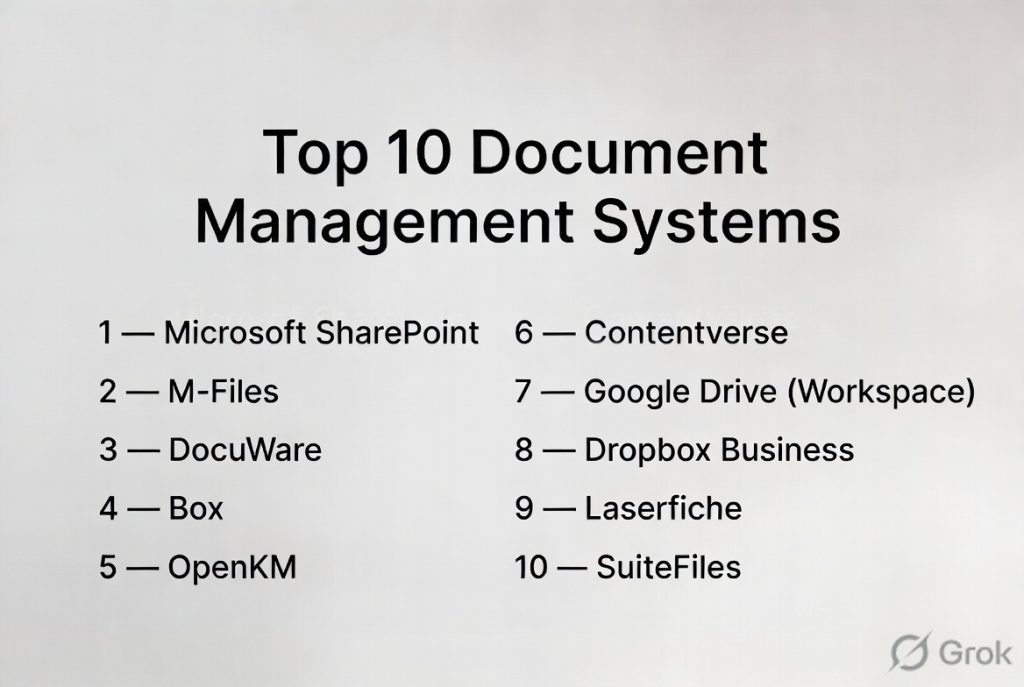
Top 10 Document Management Systems
#1 — Microsoft SharePoint
Short description: A widely used enterprise document management platform integrated with Microsoft 365 for collaboration and content management.
Key Features
- Document libraries and structured storage
- Real-time collaboration with Office apps
- Workflow automation via Power Automate
- Advanced permissions and access control
- Version history and audit logs
- Metadata tagging
- Integration with Microsoft ecosystem
Pros
- Deep integration with Microsoft tools
- Highly scalable for enterprises
Cons
- Requires proper setup and governance
- Can become complex to manage
Platforms / Deployment
Web / Windows / macOS / Mobile
Cloud / Hybrid
Security & Compliance
SSO, MFA, encryption, RBAC
GDPR, ISO standards
Integrations & Ecosystem
- Microsoft Teams
- Outlook
- Power Automate
- OneDrive
Support & Community
Extensive enterprise support and global community.
#2 — M-Files
Short description: A metadata-driven document management system focused on automation and intelligent information organization.
Key Features
- Metadata-based organization
- Workflow automation
- Version control
- AI-powered document classification
- Advanced search
- Compliance tracking
Pros
- Eliminates folder-based complexity
- Strong automation capabilities
Cons
- Learning curve for new users
- Pricing not publicly transparent
Platforms / Deployment
Web / Windows / Mobile
Cloud / On-premise / Hybrid
Security & Compliance
SSO, encryption, audit logs
Other certifications not publicly stated
Integrations & Ecosystem
- Microsoft Office
- Salesforce
- APIs
Support & Community
Strong enterprise support with onboarding resources.
#3 — DocuWare
Short description: A cloud-based document management and workflow automation platform for businesses.
Key Features
- Cloud document storage
- Workflow automation
- Electronic signatures
- Document indexing
- Mobile access
- Secure sharing
Pros
- Scalable SaaS solution
- Strong workflow automation
Cons
- Implementation can be complex
- Pricing varies
Platforms / Deployment
Web / Mobile
Cloud
Security & Compliance
Encryption, access controls
Other certifications not publicly stated
Integrations & Ecosystem
- ERP systems
- CRM tools
- APIs
Support & Community
Enterprise-grade support and onboarding.
#4 — Box
Short description: A cloud content management platform focused on secure file sharing and collaboration.
Key Features
- Cloud storage and sharing
- File versioning
- Collaboration tools
- Security controls
- Workflow automation
- API integrations
Pros
- Strong cloud infrastructure
- Easy sharing and collaboration
Cons
- Limited advanced DMS features compared to enterprise tools
- Costs scale with usage
Platforms / Deployment
Web / Windows / macOS / iOS / Android
Cloud
Security & Compliance
SSO, encryption, compliance tools
SOC 2, GDPR
Integrations & Ecosystem
- Google Workspace
- Microsoft 365
- Salesforce
- APIs
Support & Community
Large ecosystem and enterprise support.
#5 — OpenKM
Short description: An open-source document management system with workflow and automation capabilities.
Key Features
- Document repository
- Workflow engine
- Metadata indexing
- Version control
- Role-based access
- Automation tools
Pros
- Open-source flexibility
- Customizable
Cons
- Requires technical expertise
- UI less modern
Platforms / Deployment
Web
Cloud / Self-hosted
Security & Compliance
Role-based access
Other details not publicly stated
Integrations & Ecosystem
- APIs
- Custom integrations
Support & Community
Open-source community support.
#6 — Contentverse
Short description: A document management platform designed for enterprise content organization and control.
Key Features
- Document capture and scanning
- Metadata tagging
- Access control
- Workflow automation
- File versioning
Pros
- Strong document control
- Multi-format support
Cons
- Less modern interface
- Limited ecosystem
Platforms / Deployment
Windows / Linux / Android
Cloud / On-premise
Security & Compliance
Access control systems
Other details not publicly stated
Integrations & Ecosystem
- Enterprise integrations
- APIs
Support & Community
Enterprise-focused support.
#7 — Google Drive (Workspace)
Short description: A widely used cloud storage platform with basic document management capabilities.
Key Features
- Cloud storage
- Real-time collaboration
- File sharing and permissions
- Search functionality
- Version history
Pros
- Easy to use
- Strong collaboration
Cons
- Limited advanced DMS features
- Less structured document control
Platforms / Deployment
Web / Mobile / Desktop
Cloud
Security & Compliance
Encryption, access controls
GDPR
Integrations & Ecosystem
- Google Docs
- Gmail
- Workspace apps
Support & Community
Strong global support ecosystem.
#8 — Dropbox Business
Short description: A cloud-based file storage and document management solution with collaboration features.
Key Features
- File storage and sync
- Version history
- Sharing controls
- Workflow tools
- Smart sync
Pros
- Easy adoption
- Reliable sync
Cons
- Limited enterprise DMS features
- Pricing scales with storage
Platforms / Deployment
Web / Desktop / Mobile
Cloud
Security & Compliance
Encryption, access controls
Other certifications not publicly stated
Integrations & Ecosystem
- Slack
- Zoom
- APIs
Support & Community
Strong support and documentation.
#9 — Laserfiche
Short description: An enterprise content management and document automation platform.
Key Features
- Workflow automation
- Document indexing
- Records management
- Analytics
- AI-powered classification
Pros
- Strong enterprise features
- Automation capabilities
Cons
- Complex setup
- Higher cost
Platforms / Deployment
Web / Windows / Mobile
Cloud / On-premise
Security & Compliance
Audit trails, access controls
Other certifications not publicly stated
Integrations & Ecosystem
- ERP systems
- CRM tools
Support & Community
Enterprise-level support.
#10 — SuiteFiles
Short description: A document management platform tailored for professional service firms.
Key Features
- Document storage and search
- Email integration
- Client portals
- Templates and automation
- E-signatures
Pros
- Designed for professional workflows
- Strong integrations
Cons
- Niche focus
- Limited enterprise scalability
Platforms / Deployment
Web
Cloud
Security & Compliance
Not publicly stated
Integrations & Ecosystem
- Microsoft 365
- Accounting tools
Support & Community
Focused support for professional firms.
Comparison Table (Top 10)
| Tool Name | Best For | Platform(s) Supported | Deployment | Standout Feature | Public Rating |
|---|---|---|---|---|---|
| SharePoint | Enterprises | Web, Desktop, Mobile | Cloud/Hybrid | Microsoft integration | N/A |
| M-Files | Automation | Web, Desktop | Hybrid | Metadata system | N/A |
| DocuWare | Workflow automation | Web, Mobile | Cloud | Automation | N/A |
| Box | Cloud collaboration | All platforms | Cloud | Secure sharing | N/A |
| OpenKM | Open-source users | Web | Self-hosted | Customization | N/A |
| Contentverse | Enterprise control | Desktop, Mobile | Hybrid | Document capture | N/A |
| Google Drive | SMBs | All platforms | Cloud | Ease of use | N/A |
| Dropbox Business | File sharing | All platforms | Cloud | Sync | N/A |
| Laserfiche | Enterprises | Web, Desktop | Hybrid | Automation | N/A |
| SuiteFiles | Professional services | Web | Cloud | Email integration | N/A |
Evaluation & Scoring of Document Management Systems
| Tool Name | Core (25%) | Ease (15%) | Integrations (15%) | Security (10%) | Performance (10%) | Support (10%) | Value (15%) | Weighted Total |
|---|---|---|---|---|---|---|---|---|
| SharePoint | 9 | 7 | 9 | 9 | 8 | 9 | 8 | 8.5 |
| M-Files | 9 | 7 | 8 | 8 | 8 | 8 | 7 | 8.1 |
| DocuWare | 8 | 7 | 8 | 8 | 8 | 8 | 7 | 7.9 |
| Box | 7 | 9 | 9 | 8 | 8 | 8 | 7 | 8.1 |
| OpenKM | 7 | 6 | 6 | 6 | 7 | 6 | 9 | 6.9 |
| Contentverse | 7 | 6 | 6 | 7 | 7 | 7 | 7 | 7.0 |
| Google Drive | 6 | 10 | 8 | 7 | 8 | 8 | 9 | 8.0 |
| Dropbox Business | 6 | 9 | 8 | 7 | 8 | 8 | 8 | 7.8 |
| Laserfiche | 9 | 6 | 7 | 8 | 8 | 8 | 7 | 7.9 |
| SuiteFiles | 7 | 8 | 7 | 7 | 7 | 7 | 7 | 7.2 |
How to interpret the scores:
- Scores are comparative across tools
- Higher totals indicate broader capabilities
- Lower scores may still fit niche needs
- Always align with your workflow and compliance requirements
Which Document Management Systems Tool Is Right for You?
Solo / Freelancer
Best options: Google Drive, Dropbox
Focus on simplicity and low cost.
SMB
Best options: Box, SuiteFiles
Balance collaboration and structure.
Mid-Market
Best options: M-Files, DocuWare
Need automation and scalability.
Enterprise
Best options: SharePoint, Laserfiche
Focus on compliance, security, and control.
Budget vs Premium
- Budget: Google Drive, OpenKM
- Premium: SharePoint, M-Files
Feature Depth vs Ease of Use
- Feature-rich: SharePoint, Laserfiche
- Easy-to-use: Google Drive, Dropbox
Integrations & Scalability
- Strong: SharePoint, Box
- Limited: OpenKM, Contentverse
Security & Compliance Needs
- Strong: SharePoint, M-Files
- Basic: Google Drive, Dropbox
Frequently Asked Questions (FAQs)
What is a Document Management System?
A software platform used to store, organize, and manage digital documents efficiently.
Why do businesses need a DMS?
To improve productivity, ensure compliance, and centralize document access.
Are DMS tools secure?
Most offer encryption, access control, and audit logs.
Can DMS replace paper files?
Yes, many systems support full digital transformation.
Do they support workflows?
Yes, many include automation for approvals and processes.
Are they cloud-based?
Many are cloud-first, but some offer hybrid or on-premise options.
Can teams collaborate?
Yes, real-time collaboration is a core feature.
What industries use DMS?
Legal, finance, healthcare, construction, and enterprises.
Is AI used in DMS?
Yes, for tagging, search, and automation.
What are alternatives?
Cloud storage tools and content management systems.
Conclusion
Document Management Systems are essential for organizations dealing with large volumes of data and compliance requirements. They transform how businesses store, access, and manage information, enabling better productivity and control.