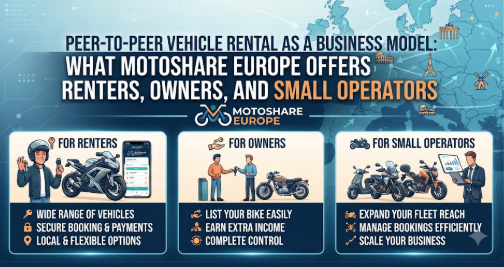
For many people, the practical question is no longer whether to own a vehicle but how to get one for the days it is needed. That shift affects three groups at once. Travelers and residents want flexible access to motorcycles, scooters, bikes, and cars. Owners see vehicles that spend long periods unused. Small rental businesses want to run their operations with less paperwork and more clarity.
Peer-to-peer marketplaces try to serve all three by connecting people who need a vehicle with people who can provide one. MotoShare Europe is one example. It describes itself as a peer-to-peer vehicle rental marketplace across Europe, and it also advertises management tools for independent rental shops and fleet operators.
This article looks at the platform the way a business reader would. It covers the model, the demand and supply sides, the operational tools, and the points that need checking before anyone relies on them. One caution applies throughout. The software features are advertised by the platform, and their full functionality has not been independently verified.
The Business Model in Brief
A marketplace earns its place by making it easier for two sides to find each other. On one side are renters who want a vehicle for a particular period. On the other are owners and providers who have vehicles to offer. The platform sits between them, with a search by location and travel dates, vehicle listings that can be compared, and a way to request a booking. Collection is then arranged with the rental partner shown in the listing.
This differs from a conventional rental company in one important way. A conventional company buys and maintains its own fleet and sets a single policy for every vehicle. A marketplace carries listings from different sources, and each provider can set its own price, conditions, and handover method. For that reason, MotoShare Europe should not be described as the owner of every listed vehicle, and a reader should not assume that every listing comes from a private person, because rental businesses may take part as well.
The platform presents itself as serving Europe as a whole, but the vehicles visible today are fewer than that scope suggests. In business terms, that is a question of liquidity: a marketplace is useful where it has enough listings to give renters real choice, and a reader should check whether that is true for their own destination.
The Demand Side: Who Rents Vehicles
Riders Looking for a Motorcycle
A person looking for motorcycle rental Europe options typically begins with a place and travel dates. They read each listing, compare the offers, check the rental period, and look at how collection works. Details about the provider matter as much as details about the vehicle. Models, prices, countries, and availability come from live listings, not from general claims.
Visitors and Residents Needing Scooters, Bikes, or Cars
Scooters suit short distances and crowded city streets. Bikes offer simple temporary access to a two-wheeled vehicle. Cars, listed in the same marketplace, may suit tourists, local residents, and business travelers who need more space or range. The platform does not describe specific scooter models, bike types, car categories, prices, or stock, so those details must be read in each listing.
Customers Who Prefer a Local Owner
Many travelers search for peer to peer motorcycle rental Europe options because they prefer a local owner to a large company. The booking is straightforward. The renter finds a motorcycle, reads its details, selects a rental period, and requests a booking. The owner or provider reviews the request and replies.
Up to three parties may be involved. The owner provides and describes the vehicle, the renter makes the request, and a rental partner, where one is named, may handle the booking or the handover. A quick look at who the provider actually is can prevent confusion later.
Pricing and Cost Drivers for Renters
There is no single, reliable figure for motorcycle rental cost Europe wide. The price depends on the type of motorcycle, the length of the rental, the location, the time of year, and the provider’s own rates. Collection and return arrangements can add to the cost.
Conditions matter just as much as the headline number. The platform’s description does not confirm any standard insurance cover, damage protection, or cancellation rule, so these belong to each provider. A careful renter asks what the price includes, what it excludes, and what remains the renter’s responsibility. Comparing two or three listings on that basis usually reveals more than comparing the prices alone.
The Supply Side: Owners and Providers
Motorcycle Owners Considering Sharing
An owner who rides only in certain months may ask, “Could I rent out my motorcycle for the rest of the year?” A peer-to-peer marketplace is one place to explore that. The work is mostly preparation: accurate details, clear photographs, written conditions, up-to-date availability, and prompt replies to enquiries. No platform can promise bookings, demand, or income, since interest depends on the motorcycle, the place, the season, and the quality of the listing.
Car Owners Weighing the Same Question
A car owner who thinks, “I might list my car for rent,” follows a similar path. The listing needs correct car details, honest photographs, defined periods of availability, and clear conditions. Booking requests should be read carefully, and the listing updated whenever something changes. Payouts, insurance arrangements, and approval rules are not confirmed in the supplied description, so an owner should ask about each before publishing.
The Operations Side: Records a Small Business Must Keep
What the Advertised Software Covers
MotoShare Europe advertises free vehicle rental management software for independent shops and fleet operators. According to the platform, it covers vehicle listings, reservations, customer records, fleet availability, payment management, revenue information, and operational reports. For a small operator, the appeal is a single view of the fleet, the bookings, and the history of rentals.
These are the platform’s own claims. A business that is interested should try the tools with a small set of real records and read the terms of use before changing how it works.
Why Small Car Businesses Watch Costs
A small car rental business usually needs to organize reservations, track each vehicle, store customer details, and review past rentals. Budgets are often tight, and software costs matter, which explains the interest in free car rental software. MotoShare Europe presents part of its offering this way. What “free” includes, whether accounts have limits, and whether upgrades cost money are not stated, so each is a reasonable question to ask at the start.
How Booking Records Prevent Conflicts
A vehicle rental booking system connects vehicles, dates, and customers. It should show whether a vehicle is available, who reserved it, and where each booking stands, so two customers are never promised the same vehicle. The platform describes reservation and availability management, but it does not describe automated workflows or outside integrations, so a business should not plan around them.
Where Bike and Scooter Operators Fit
Operators who rent bikes and scooters handle many short rentals, each with its own small record. Bike rental software could keep vehicle details, reservations, and customer contacts in one place, and scooter rental software could do the same for operators serving city visitors. Which types, models, locations, and functions are offered has not been confirmed.
Risk and Due Diligence Before Relying on Any Tool
Any platform deserves a short period of verification before it becomes part of a routine, and the same applies here. Four checks come up repeatedly.
First, confirm that the platform has real listings for the place and dates that matter, since the visible inventory is smaller than the stated reach. Second, read each provider’s terms, including insurance, conditions, and handover, because the platform’s description sets no universal rule. Third, ask about payouts, approval, and limits before listing a vehicle, since these are not confirmed. Fourth, test the software on real records before relying on it, because its functionality has not been independently verified.
None of these steps is difficult. Together, they turn a general description into specific knowledge.
Why a Marketplace Suits Independent European Travel
Independent travel produces short and flexible needs: a motorcycle for a scenic route, a scooter for a compact city, a car for a longer trip or a day of meetings. A marketplace lets renters compare several vehicle types and local providers in one search, and it gives independent owners and small businesses a way to reach people who are already looking. The limit is that prices, availability, and conditions belong to each provider, and a marketplace cannot promise a particular vehicle in a particular place on particular dates.
A Phased Roadmap for Each Participant
The phases are general. Details can vary with the vehicle and the provider.
For Renters
- Decide which type of vehicle suits the trip.
- Enter a place and travel dates.
- Open several listings and compare them.
- Read the details, the price, and the conditions closely.
- Send the request and follow the collection instructions.
For Rental Businesses
- Gather accurate details about each vehicle and about the business.
- Create or tidy the vehicle listings.
- Record each reservation along with the customer’s details.
- Review availability and past activity at regular intervals.
- Update the records whenever something changes.
These phases follow the advertised management features, but exact dashboard instructions and automated actions are not confirmed.
For Owners
- Select the motorcycle or car to offer.
- Prepare accurate details and clear photographs.
- Submit the listing through the platform’s process.
- Read and answer enquiries and booking requests.
- Keep dates and conditions up to date.
Approval and bookings are not guaranteed.
Operational Errors Grouped by What They Cost
Errors That Cost a Booking
An owner who posts a thin description, uses old photographs, leaves availability out of date, or replies slowly gives renters a reason to move on. A renter who sends a request without reading the conditions may also see a booking fall apart later. The fix is the same on both sides: complete information and prompt, clear communication.
Errors That Cost Trust
A listing that does not match the real vehicle, or a renter who assumes a listed city has vehicles, can damage confidence quickly. Honest details and a check of real availability before planning help prevent it.
Errors That Cost Time
Rental businesses lose hours when records are thin or stale. Incomplete customer details, outdated availability, unreviewed reservations, old fleet information, and untested software functions all lead to rework. Regular comparisons of the records against the real fleet, and a quick test of each tool, keep the work moving.
A Hypothetical Scenario on Both Sides of the Marketplace
Imagine a small operator with five vehicles who wants to understand a quarter of activity. The operator keeps each vehicle’s details current, logs every reservation with the customer’s information, and then reviews which vehicles were rented most and which sat idle. That review informs a simple decision about which vehicles to keep available and which listings need better photographs or clearer conditions.
Now imagine a visitor choosing between two motorcycle listings for a long weekend. The visitor reads both, compares what each price includes, notes the collection arrangements, and sends a request to the provider whose terms are clearer.
What really happens in each case depends on the live listings and on how the platform’s tools work in practice.
Reader Questions on the Model, Costs, and Tools
What type of business is MotoShare Europe?
It is an online marketplace where people can look for motorcycles, bikes, scooters, and cars from participating owners and providers, and it advertises tools for rental businesses.
Does it operate its own fleet?
No such claim is made. It is described as a marketplace, and vehicles come from participating owners and providers.
How does a renter begin?
With a place and travel dates, followed by a careful reading of the listings.
Why do prices differ between listings?
Providers set their own rates, and prices depend on the vehicle, the length of rental, the location, the season, and the conditions.
Is the software free?
The platform advertises it as free. Conditions and limits are not stated, so ask before relying on it.
What belongs in a booking record?
Availability, rental dates, reservation details, and customer information.
Can an owner offer a vehicle?
The peer-to-peer model includes owner listings. Check the process first, because approval and bookings are not guaranteed.
Is a very small business a good fit for the tools?
They are advertised for independent shops and fleet operators. A small business should test them against its own daily work.
Is all of Europe covered?
That cannot be claimed. The visible inventory is smaller than the advertised reach.
Closing Perspective
A peer-to-peer rental platform will be judged by the quality of what it connects. For MotoShare Europe, that means how many vehicles are listed where renters want them, how clearly providers describe their prices and conditions, and how well the advertised tools hold up when a small business uses them every day. Those are practical measures, and none of them can be read off a description.
The model itself is easy to understand and speaks to real needs on all sides. Renters want flexible access, owners want a way to use idle vehicles, and small operators want order in their records. A reader who looks at actual listings, asks direct questions about conditions, and tests the software before relying on it will be able to judge how well the platform meets those needs.