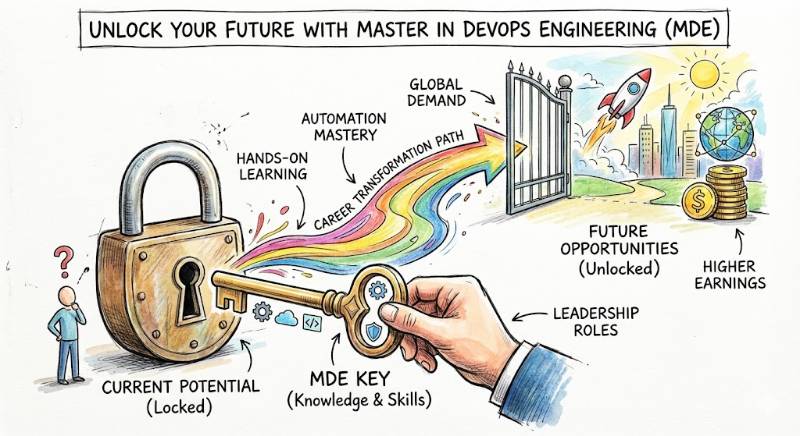
Introduction
The Master in DevOps Engineering (MDE) certification is a game-changer for professionals looking to thrive in the rapidly evolving world of DevOps, cloud automation, and continuous integration. As software companies globally shift to faster release cycles, better collaboration, and seamless integrations, DevOps is becoming the backbone of modern software delivery.
What is MDE and Why Does it Matter?
The MDE certification is designed to provide professionals with a comprehensive understanding of DevOps principles, tools, and practices. It focuses on automating workflows, enhancing collaboration between development and operations, and ensuring continuous delivery. The certification covers important tools such as Jenkins, Docker, Kubernetes, and Terraform to help individuals streamline software delivery pipelines, optimize cloud platforms, and monitor system health.
In today’s competitive tech industry, understanding and mastering DevOps principles is essential. DevOps practices enable quicker releases, reduce development cycles, and improve collaboration, which ultimately leads to higher-quality software. The MDE certification is your ticket to mastering these essential skills.
Why is This Certification Crucial for Engineers and Managers?
The MDE certification serves as an essential qualification for professionals seeking to advance their careers in DevOps, cloud engineering, and software automation. It validates the skills needed to build and manage CI/CD pipelines, automate deployment processes, and monitor cloud-based infrastructure. For engineering managers, the certification helps in driving team collaboration, improving release cycles, and ensuring that DevOps practices are well-implemented within teams.
The benefits of pursuing MDE include:
- Enhanced career opportunities: Become eligible for senior DevOps and cloud roles.
- Increased earning potential: Professionals with MDE certification often command higher salaries.
- Skill validation: Showcase your expertise in DevOps and automation processes to employers.
Certification Overview Table
| Track | Level | Who it’s for | Prerequisites | Skills Covered | Recommended Order |
|---|---|---|---|---|---|
| Master in DevOps Engineering (MDE) | Advanced | DevOps Engineers, Cloud Engineers, Managers | Basic knowledge of software development, IT infrastructure, and cloud computing | CI/CD, cloud automation, Kubernetes, Docker, Jenkins, Terraform | Basic DevOps knowledge or equivalent |
Why Choose DevOpsSchool?
DevOpsSchool offers top-notch training in DevOps engineering with a hands-on approach that prepares professionals for real-world challenges. The certification is globally recognized and backed by a comprehensive learning structure that ensures each student understands both the theory and practical application of DevOps concepts. With lifetime access to course materials and expert-led guidance, DevOpsSchool is one of the best choices for anyone looking to earn an MDE certification.
Deep Dive into the MDE Certification
What is the Master in DevOps Engineering (MDE) Certification?
The MDE is an advanced-level certification that goes beyond basic DevOps principles to cover topics such as continuous integration, continuous delivery (CI/CD), cloud automation, containerization, and performance monitoring. The certification teaches professionals to manage and scale systems using DevOps tools and practices to deliver software at speed while maintaining high quality.
Who Should Take the MDE Certification?
The MDE certification is ideal for professionals working in the following roles:
- DevOps Engineers: Those looking to streamline development and operations workflows and enhance their technical skills.
- Cloud Engineers: Professionals interested in managing cloud infrastructure with a DevOps approach.
- Engineering Managers: Managers looking to lead teams effectively by implementing DevOps methodologies.
- Platform Engineers: Engineers who are focused on designing, building, and optimizing platforms using DevOps principles.
- IT Operations Professionals: Those seeking to improve infrastructure management and operational efficiency.
Skills You Will Gain
After completing the MDE certification, you will have expertise in the following areas:
- Building and managing CI/CD pipelines: Automating the software delivery process using tools like Jenkins and GitLab.
- Cloud platform management: Using AWS, Azure, and GCP to build, deploy, and maintain scalable cloud infrastructure.
- Automation with Infrastructure as Code (IaC): Using Terraform, Ansible, and similar tools to automate infrastructure provisioning.
- Containerization with Docker & Kubernetes: Deploying, managing, and scaling applications in containerized environments.
- System monitoring and troubleshooting: Implementing monitoring solutions and proactively identifying and resolving system issues.
Real-World Projects You Should Be Able to Do After This Certification
With the knowledge gained from the MDE certification, professionals will be able to:
- Build a fully automated CI/CD pipeline for a multi-tier application.
- Set up and manage cloud-based infrastructures with continuous integration.
- Automate deployments using tools like Jenkins, Docker, and Kubernetes.
- Monitor application performance using Prometheus and Grafana.
Preparation Plan: Step-by-Step Roadmap to Success
7-14 Days Plan:
- Focus on understanding the basic concepts of DevOps tools such as Jenkins, Docker, and Kubernetes.
- Take introductory tutorials on cloud computing concepts, such as AWS or Azure.
30 Days Plan:
- Set up CI/CD pipelines with Jenkins or GitLab.
- Experiment with cloud automation and containerized applications using Docker and Kubernetes.
- Participate in online discussions and communities to share experiences.
60 Days Plan:
- Develop a complete DevOps pipeline that integrates CI/CD, cloud platforms, and container orchestration.
- Explore advanced topics such as performance monitoring, incident management, and security in DevOps.
- Showcase your work with real projects in a portfolio.
Common Mistakes to Avoid
- Skipping hands-on practice: It’s vital to gain practical experience with DevOps tools like Jenkins, Docker, and Terraform.
- Neglecting security practices: DevSecOps is crucial, and security should not be an afterthought in your workflow.
- Lack of collaboration: DevOps thrives on collaboration. Make sure to focus on communication between teams, not just automation.
Best Next Certification After This
Once you complete the MDE certification, consider advancing with one of these options:
- Same Track: Certified DevOps Architect (CDA) for a deeper dive into system design and architecture.
- Cross-track: Certified Kubernetes Administrator (CKA) for expertise in container orchestration.
- Leadership/Management: Certified DevOps Manager (CDM) for professionals seeking management roles.
Choose Your Learning Path
Whether you’re new to DevOps or looking to specialize further, here are six structured paths to choose from:
1. DevOps Path
For professionals who want to gain comprehensive knowledge of DevOps tools and practices for enhancing software delivery and collaboration across teams.
2. DevSecOps Path
For security professionals who want to integrate security into every stage of the DevOps lifecycle, ensuring secure software development.
3. Site Reliability Engineering (SRE) Path
Best suited for professionals focused on improving system reliability, uptime, and performance in cloud environments.
4. AIOps / MLOps Path
For professionals interested in applying machine learning and AI to automate IT operations and enhance monitoring and performance optimization.
5. DataOps Path
Aimed at data engineers who wish to implement DevOps practices in data management, ensuring data flows smoothly and securely across systems.
6. FinOps Path
For professionals in finance who need to optimize cloud spending and manage costs in cloud environments through best DevOps practices.
Role → Recommended Certifications Mapping
Here’s a clear mapping of the recommended certifications based on your role:
| Role | Recommended Certifications |
|---|---|
| DevOps Engineer | Master in DevOps Engineering (MDE), Certified Kubernetes Administrator (CKA) |
| Site Reliability Engineer | Site Reliability Engineering (SRE), Master in DevOps Engineering |
| Cloud Engineer | Cloud certifications, Master in DevOps Engineering |
| Security Engineer | DevSecOps certifications, CISSP |
| Data Engineer | DataOps certifications, AWS Certified Data Analytics |
| FinOps Practitioner | FinOps certifications, Cloud Cost Management Certifications |
| Engineering Manager | Certified DevOps Manager (CDM), Leadership in Cloud Computing |
Next Certifications to Take
For learners completing MDE, the next steps would include:
- Same-track certification: A deeper dive into advanced topics within DevOps or cloud systems, such as Certified Kubernetes Administrator (CKA).
- Cross-track certification: Exploring adjacent fields like Site Reliability Engineering (SRE) or DataOps.
- Leadership-focused certification: Moving into management with certifications such as Certified DevOps Manager (CDM).
Training & Certification Support Institutions
DevOpsSchool
Training is provided with a practical approach where real tools and real workflows are covered step by step. Live guidance is usually included so doubts are cleared quickly during learning. Hands-on assignments are often used so concepts are not left only in theory. Certification preparation is supported with structured plans so the exam flow is understood clearly.
Cotocus
Industry-style learning is usually supported where DevOps and cloud concepts are explained with real project thinking. A learning path is often followed so the journey is not felt confusing for beginners. Practice is encouraged through tasks so confidence is built gradually. Support is generally kept active so learners are not stuck for long.
ScmGalaxy
DevOps learning is delivered in a way where fundamentals are strengthened first and advanced topics are added later. Tool-based practice is normally included so working knowledge is improved. Real case discussions are often shared so mistakes are avoided early. Certification guidance is usually aligned with skill-building, not only exam clearing.
BestDevOps
DevOps concepts are explained in a structured manner so a clear foundation is formed. CI/CD pipelines, automation, and cloud workflows are usually covered with examples. Practice tasks are often included so learning gets converted into execution. Career direction is generally supported through role-based preparation.
devsecopsschool.com
Security-first DevOps learning is usually provided so secure delivery habits are formed early. Topics like secure pipelines, scanning, and compliance thinking are often introduced in a simple way. Practical use cases are generally included so security is not treated as theory. Certification readiness is supported through guided preparation topics.
sreschool.com
Reliability and production stability skills are focused on so systems are handled with more control. Concepts like monitoring, incident response, SLIs/SLOs, and performance thinking are usually covered. Practice-based understanding is encouraged so production situations are not feared. A strong focus is kept on repeatable operations and reduced downtime.
aiopsschool.com
Automation using data and intelligence is introduced so operational noise is reduced. Concepts like alert correlation, anomaly detection, and faster troubleshooting are usually explained in a beginner-friendly style. Use cases are often included so real value is seen clearly. Learning is structured so AIOps understanding is built step by step.
dataopsschool.com
Data delivery workflows are covered where pipelines, quality, governance, and automation are treated seriously. Practical ideas are shared so data systems are handled like software systems. Best practices are usually explained to avoid common pipeline failures. Learning is kept structured so working professionals can follow it without confusion.
finopsschool.com
Cloud cost control and optimization thinking are usually taught in a practical way. Topics like budgeting, cost visibility, unit economics, tagging, and governance are often covered. A shared responsibility mindset is encouraged so finance and engineering are aligned. Certification support is generally provided with clear guidance on key concepts and use cases.
FAQs Section
General FAQs
- What is the difficulty level of MDE?
- The MDE certification is intermediate to advanced, designed for those with prior knowledge in IT and software development.
- How much time is required to complete MDE certification?
- It can take anywhere between 7 days (for basic preparation) to 60 days depending on your familiarity with DevOps concepts.
- What are the prerequisites for MDE certification?
- A basic understanding of software development, cloud computing, and IT infrastructure is recommended.
- What is the certification sequence?
- Begin with foundational DevOps courses, then progress to MDE, followed by advanced certifications like CDA.
- What career value does MDE certification offer?
- MDE helps professionals move into senior technical and managerial roles with increased responsibilities and better compensation.
- Which job roles benefit from MDE?
- DevOps Engineers, Cloud Engineers, Platform Engineers, and IT Operations professionals benefit greatly from MDE.
- How does MDE help in career growth?
- The certification enhances career prospects by providing expertise in essential DevOps skills, increasing job stability, and advancing earning potential.
- What are the common mistakes to avoid in DevOps?
- Common mistakes include neglecting hands-on practice, ignoring security in workflows, and not collaborating effectively across teams.
- Can MDE help in career transitions?
- Yes, it is a great option for transitioning into DevOps roles from software engineering or IT operations.
- What makes DevOpsSchool’s MDE certification unique?
- DevOpsSchool combines live, instructor-led training with hands-on labs and real-world examples, ensuring students gain practical expertise.
- Does MDE require hands-on practice?
- Yes, hands-on practice is crucial to solidify theoretical knowledge and apply it to real-world projects.
- How long does it take to prepare for MDE?
Preparation time can range from a few weeks to a couple of months, depending on prior experience and learning pace.
FAQs on Master in DevOps Engineering (MDE)
1. What is covered in the Master in DevOps Engineering (MDE) certification course?
The MDE course covers essential DevOps practices such as continuous integration (CI), continuous delivery (CD), automation of workflows, cloud platform management, containerization with Docker and Kubernetes, and system monitoring. You will gain practical skills to implement these tools and techniques in real-world projects.
2. How will MDE enhance my career?
The MDE certification will provide you with in-demand skills that are essential for handling modern DevOps workflows. By mastering cloud automation, CI/CD pipelines, and monitoring systems, you can secure advanced roles in DevOps, cloud engineering, and IT operations, increasing your job prospects and salary potential.
3. Is MDE suitable for beginners in DevOps?
While MDE is an advanced-level certification, it is suitable for professionals who already have a basic understanding of software engineering, IT infrastructure, and cloud computing. Beginners with the right foundational knowledge can successfully pursue this certification with a structured preparation plan.
4. What tools will I learn during the MDE certification?
You will work with a wide range of tools that are essential for DevOps professionals, including Jenkins, Docker, Kubernetes, Terraform, GitLab, Prometheus, and Grafana. These tools are key to automating deployment, managing cloud infrastructure, and monitoring system performance.
5. How long does it take to complete the MDE certification?
The completion time varies depending on your prior experience and the time you can dedicate to learning. On average, it may take anywhere from a few weeks to two months. A structured study plan can help ensure that you complete the certification efficiently.
6. Are there any prerequisites for enrolling in the MDE course?
While there are no strict prerequisites, a basic understanding of software development, cloud computing, and IT infrastructure is recommended. It’s beneficial to have some hands-on experience with programming and cloud platforms before starting the course.
7. Can I pursue MDE if I am already working as a DevOps engineer?
Yes, the MDE certification is ideal for professionals already working in the DevOps field. It helps deepen your knowledge, refine your existing skills, and enable you to implement more advanced DevOps practices, such as building scalable infrastructure, automating deployments, and managing cloud resources efficiently.
8. What is the certification exam like for MDE?
The certification exam typically consists of multiple-choice questions and practical assignments. It evaluates your understanding of DevOps practices, your ability to apply tools in real-world scenarios, and your grasp of automation, cloud management, and monitoring techniques. You’ll need to demonstrate your ability to manage and implement DevOps pipelines effectively.
Testimonials: Hear From Our Graduates
- Rajeev K.: “I never thought I could understand such complex DevOps systems so clearly, but DevOpsSchool’s MDE program broke everything down into manageable parts. It gave me the skills to start leading automation projects in my team.”
- Priya S.: “The hands-on experience with Docker and Kubernetes was invaluable. The course helped me transition from a developer to a full-fledged DevOps engineer.”
- Manoj T.: “Completing the MDE program was a game-changer for me. I’m now confidently managing cloud deployments and CI/CD pipelines, thanks to the practical approach of DevOpsSchool.”
- Ankit R.: “The course material was clear, and the support from instructors was top-notch. I now feel capable of leading complex automation initiatives and improving team collaboration.”
- Nisha M.: “I was initially hesitant about diving into DevOps, but the MDE course at DevOpsSchool made it all so accessible. Now I’m ready for more challenging roles in cloud and automation management.”
Conclusion: Empower Your DevOps Career with MDE Certification
The Master in DevOps Engineering (MDE) certification offers professionals an opportunity to gain expertise in one of the most critical areas of modern IT. With the growing demand for DevOps and cloud engineering professionals, the MDE certification can set you apart and give you the practical skills necessary for success.
By acquiring this certification, you not only boost your knowledge but also make a strategic investment in your future career. Whether you aim to automate workflows, manage cloud platforms, or lead DevOps teams, the MDE certification opens numerous doors for growth. Start your journey today with DevOpsSchool and secure a successful career in the ever-evolving field of DevOps engineering.