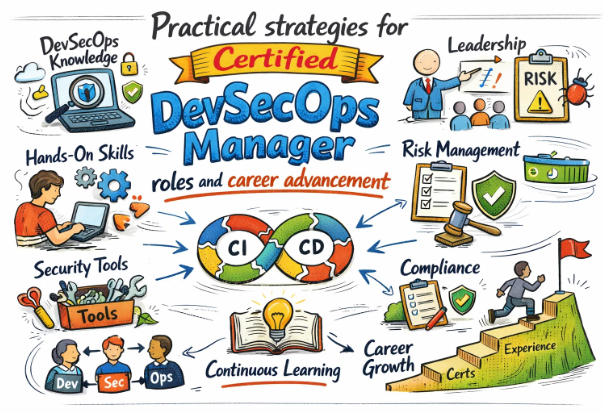
Introduction
The protection of digital assets is now considered a core part of every technical leadership role. It is no longer enough to simply deliver software quickly. The speed of delivery must be balanced with the safety of the data and the stability of the infrastructure. For those who are tasked with overseeing these complex environments, a new approach is required. This guide is designed to explain how a specialized management path can be taken to ensure that security is not just an addition but a fundamental part of the development lifecycle.
What is Certified DevSecOps Manager
The Certified DevSecOps Manager is a professional designation for individuals who are expected to lead the integration of security into the development and operations process. It is a program that focuses on the governance, management, and strategic oversight of automated security practices. It is not limited to technical implementation. Instead, it covers the broad scope of how teams, tools, and processes are aligned to create a secure culture within an organization. A deep understanding of how to manage risks while maintaining a fast-paced delivery schedule is provided through this certification.
Why it Matters Today
Great weight is placed on security management because vulnerabilities are being discovered at an increasing rate. When development teams work in silos from security teams, friction is created and progress is slowed down. It is believed that a manager with specialized knowledge can bridge this gap. By having a leader who understands both the technical needs of a DevOps team and the strict requirements of security, a more resilient organization is built. This role is vital for preventing data breaches and ensuring that compliance standards are met without human intervention slowing down the build process.
Why Certified DevSecOps Manager Certifications are Important
A benchmark for professional expertise is provided by a formal certification. It is often found that while many managers understand the basics of technology, they lack a structured framework for managing automated security at scale. A certification proves that a standardized set of best practices has been mastered. It gives stakeholders confidence that the person in charge of their systems has been trained to handle modern threats. Furthermore, a certification helps in establishing a common language between developers and security professionals, which leads to better communication and fewer errors.
Why Choose Devsecopsschool?
The decision to choose Devsecopsschool is often made because of the practical and deep-rooted knowledge that is shared through their programs. The curriculum is not just based on theory but is built upon real-world scenarios that are encountered in large enterprises. Support is provided by trainers who have spent decades in the industry, ensuring that the guidance given is relevant to the challenges faced by modern engineering managers.
A comprehensive learning environment is offered where complex concepts are broken down into simple, manageable modules. This institution is selected by many because the focus is kept on the outcome of the learning, not just the completion of a course. A variety of resources, including documentation, lab environments, and community support, are made available to every student. This ensures that the transition from a technical lead to a security-focused manager is handled with care and precision.
Certification Deep-Dive: Certified DevSecOps Manager
What is this certification?
This is a professional leadership program that focuses on the management of security within the DevOps lifecycle. It is designed to prepare individuals to oversee security transformations and lead cross-functional teams.
Who should take this certification?
It is recommended that this program be taken by engineering managers, senior DevOps engineers, and security leads. Professionals who are moving from a purely technical role into a leadership position will find it particularly valuable. It is also suited for those who are responsible for compliance and risk management in a cloud-native environment.
Certification Overview Table
| Track | Level | Who it’s for | Prerequisites | Skills Covered | Recommended Order |
| DevOps | Foundation | Engineers | Basic IT | Automation | 1 |
| DevSecOps | Management | Managers | DevOps Basics | Security Governance | 2 |
| SRE | Professional | Ops Leads | System Admin | Reliability | 3 |
| AIOps/MLOps | Expert | Data Scientists | Math/Coding | AI Automation | 4 |
| DataOps | Professional | Data Leads | Data Management | Pipeline Security | 5 |
| FinOps | Professional | Cost Managers | Cloud Basics | Cost Control | 6 |
Skills You Will Gain
- Governance and Compliance: The ability to implement automated security policies across an entire department is acquired.
- Risk Assessment: Methods for identifying and prioritizing security threats in the software pipeline are mastered.
- Team Leadership: Skills for managing hybrid teams of developers and security experts are developed.
- Strategic Planning: Long-term roadmaps for security integration are created.
- Incident Response Management: Procedures for overseeing a team’s reaction to a security event are learned.
- Tool Orchestration: Knowledge of how to manage a suite of security tools without creating bottlenecks is gained.
Real-World Projects Post-Certification
- Automated Security Governance: A system where all security rules are applied automatically to every new piece of code is designed.
- Organization-Wide Risk Audit: A comprehensive review of the security posture of multiple teams is conducted.
- Vulnerability Management Pipeline: A process where discovered bugs are automatically tracked and assigned for fixing is established.
- Compliance Dashboard: A visual tool that shows the real-time safety status of all infrastructure is built.
Preparation Plan
14-Day Plan (Accelerated)
The first week is spent on the core concepts of security management and governance. The second week is used for reviewing the specific tools and frameworks mentioned in the official curriculum.
30-Day Plan (Standard)
The first two weeks are dedicated to understanding the shift from traditional security to DevSecOps. The third week is used for exploring management strategies, and the final week is focused on practice exams and review.
60-Day Plan (Comprehensive)
The first month is spent building a deep foundation in DevOps and automation. The second month is used to master the security management aspects, with plenty of time for hands-on labs and reading supplementary materials.
Common Mistakes to Avoid
- Focusing Only on Technical Tools: It is often forgotten that management is about people and processes.
- Ignoring Team Culture: Security cannot be forced; it must be built into the culture.
- Over-Automating Too Early: Systems should be understood manually before they are automated.
- Neglecting Continuous Updates: The security landscape changes daily, so a manager must keep their knowledge fresh.
Best Next Certification After This
- Same Track: DevSecOps Professional
- Cross-Track: SRE Foundation
- Leadership / Management: Certified DevOps Manager
Choose Your Learning Path
DevOps Path
This path is best for those who want to focus on the speed of delivery and the automation of infrastructure. It is suited for engineers who love building pipelines and improving developer productivity.
DevSecOps Path
This route is recommended for those who believe that security is the most important part of any project. It is best for individuals who want to lead the charge in making software safer for everyone.
Site Reliability Engineering (SRE) Path
This path is focused on the uptime and performance of systems. It is intended for professionals who enjoy solving complex stability problems and ensuring that websites never go down.
AIOps / MLOps Path
This path is designed for those who are interested in the intersection of artificial intelligence and operations. It is best for data-driven professionals who want to automate the management of machine learning models.
DataOps Path
This direction is for people who handle large volumes of data. It focuses on the reliability, quality, and security of data pipelines as they move through a company.
FinOps Path
This path is suited for those who want to manage the financial side of the cloud. It is recommended for professionals who want to help their companies save money while using the best technology available.
Role → Recommended Certifications Mapping
| Role | Primary Cert | Secondary Cert | Leadership Cert |
| DevOps Engineer | DevOps Professional | SRE Foundation | DevOps Manager |
| SRE | SRE Professional | Cloud Architect | SRE Leader |
| Platform Engineer | DevOps Expert | Cloud Security | Infrastructure Lead |
| Cloud Engineer | Cloud Security | FinOps Foundation | Cloud Manager |
| Security Engineer | DevSecOps Prof. | SRE Foundation | DevSecOps Manager |
| Data Engineer | DataOps Prof. | MLOps Foundation | Data Manager |
| FinOps Practitioner | FinOps Prof. | Cloud Economics | Finance Lead |
| Engineering Manager | DevSecOps Manager | SRE Leader | CTO Program |
Next Certifications to Take
- For the DevOps Engineer:
- Same-track: DevOps Expert
- Cross-track: SRE Foundation
- Leadership: Certified DevOps Manager
- For the Security Lead:
- Same-track: DevSecOps Professional
- Cross-track: SRE Professional
- Leadership: Certified DevSecOps Manager
- For the Engineering Manager:
- Same-track: Certified DevOps Manager
- Cross-track: FinOps Professional
- Leadership: Executive Management in IT
Training & Certification Support Institutions
DevOpsSchool
A wide range of training is provided for all major certifications in the DevOps and security tracks. A focus is kept on interactive learning and real-world application. Students are supported throughout their entire journey by a dedicated team of experts.
Cotocus
Specialized training and consulting services are offered by Cotocus. They are known for their deep technical expertise and their ability to help corporate teams implement complex security frameworks. Their programs are designed to be practical and efficient.
ScmGalaxy
A significant amount of community content and professional guidance is managed by ScmGalaxy. It is a place where professionals go to find resources, tutorials, and support for their certification goals. A strong emphasis is placed on sharing knowledge through community interaction.
BestDevOps
Simplified and effective training programs are provided by BestDevOps. They focus on the most important skills needed to succeed in the industry. Their courses are built for busy professionals who need to learn quickly without sacrificing quality.
devsecopsschool.com
A deep focus on the leadership of security within the development lifecycle is provided at this site. Practical guidance on how to manage automated protection at scale is shared through specialized modules.
sreschool.com
The principles of system reliability and maximum uptime are taught to those who manage complex infrastructure. Strategies for monitoring and incident management are offered to ensure that services remain available at all times.
aiopsschool.com
The intersection of artificial intelligence and technical operations is explored to help professionals automate decision-making. Insights into how machine learning is used to predict and prevent system failures are provided to every student.
dataopsschool.com
The safe and efficient flow of information across an organization is centered upon at this learning platform. Methods for maintaining data quality and security during the entire lifecycle are explained in great detail.
finopsschool.com
The financial management of cloud resources is simplified so that engineering and finance teams work together effectively. Instructions on how to optimize costs without sacrificing performance are shared with every learner.
FAQs Section
- Is a high level of effort required for this program?
A significant commitment is expected from those who wish to master the management of security. The material is designed to be challenging but fair for anyone with a background in technology. - How much time is typically set aside for this study?
A period of approximately four to six weeks is usually allocated by most working professionals. This allows for a deep understanding of the frameworks without a need to rush through the lessons. - What knowledge is considered a necessary foundation?
A basic understanding of how software is delivered and managed is expected. It is found that those who have spent time in development or operations roles gain the most from the curriculum. - What is the suggested order for these certifications?
A progressive path is recommended where a general DevOps foundation is achieved before specialized management levels are pursued. This ensures that the core principles are well understood first. - How is professional standing affected by this credential?
The certification is viewed by the industry as a mark of a leader who can navigate complex safety requirements. It is often used as a benchmark when candidates for senior leadership roles are being evaluated. - Who are the most suitable candidates for this course?
Individuals who are expected to oversee team transitions and security transformations are considered the best fit. This includes current team leads and those who aspire to become engineering directors. - Is the program recognized within the Indian technology market?
The curriculum has been widely adopted by major technology hubs across India. It is recognized by leading firms as a standard for modern security leadership and governance. - Does the certification hold weight in international markets?
Universal management principles are taught, which makes the credential highly relevant across borders. It is respected by international organizations that prioritize automated security. - What long-term career trajectory can be expected?
A path toward more strategic organizational roles is opened once the certification is obtained. Many professionals find themselves moving toward positions where they influence company-wide safety policies. - How are theoretical concepts reinforced?
Practical exercises are provided to ensure that every concept can be applied to a real-world scenario. This method ensures that the knowledge is not just remembered but is ready to be used in a production environment. - For how long is the certification considered current?
The credential remains valid for a standard period, after which a refresh of the latest industry practices is suggested. This ensures that the leader remains updated on new threats and technologies. - Is any post-certification engagement provided?
A network of peers and mentors is made available to every professional who completes the program. This allows for continuous exchange of ideas and collective problem-solving.
Additional Inquiries for Certified DevSecOps Manager
- How is the perspective of a manager different from that of an engineer?
A manager is expected to look at the broad organizational impact and team culture, while an engineer focuses on the technical details. This program helps in shifting the focus toward strategic oversight. - What is the role of a manager in security automation?
The manager is responsible for ensuring that the right processes are in place so that automation can happen without friction. Guidance is provided on how to choose the right points for security gates. - Is an extensive background in coding required?
Deep coding skills are not the primary focus of this management track. However, a clear understanding of the development workflow is needed so that security policies can be effectively managed. - How are different cloud platforms handled in the curriculum?
A platform-neutral approach is taken so that the management principles can be applied to any cloud environment. This ensures that the leader is prepared regardless of the specific tools used by the company. - Is crisis management covered in the program?
A structured response framework is provided to help leaders manage their teams during a security incident. The focus is kept on clear communication and organized decision-making. - How is regulatory alignment addressed?
Knowledge of how to align daily operations with international safety standards is shared. This helps the manager ensure that the team remains compliant without manual effort. - Are the assessment options flexible for working professionals?
The final assessment is designed to be accessible, with options for online completion provided by most institutions. This allows the learner to choose a time and place that is convenient. - How is competency measured in the final assessment?
A mix of theoretical questions and scenario-based problems is used to ensure that the candidate can handle the realities of a management role. A standard passing score must be achieved to earn the credential.
Testimonials
A much better understanding of how to lead a security-first team was gained. The career path is now much clearer.
— Aryan
Confidence in managing complex cloud environments was built. The practical projects were very helpful for my daily work.
— Ishani
The skills needed to move into an engineering manager role were developed. The support from the instructors was excellent.
— Kabir
A lot of clarity was provided on how to automate compliance. This has saved our team a significant amount of time.
— Sana
The certification has helped in achieving a more senior position. The curriculum was very relevant to current industry needs.
— Advait
Conclusion
The old method of checking for errors at the very end of a project is set aside when a complete and integrated approach is adopted. A legacy of stability and trust is built by a manager who ensures that safety is woven into the entire fabric of the development process. Many unnecessary problems are avoided when security is treated as a continuous responsibility rather than a final hurdle. A high level of professional respect is earned by those who demonstrate the ability to lead teams through these important changes. A future of steady growth and career safety is secured once the principles of this certification are fully mastered.