Introduction
The AWS DevOps Engineer – Professional certification is considered one of the most advanced certifications for engineers who work with cloud infrastructure and automated software delivery systems. In modern software environments, applications are no longer deployed manually. Instead, automated pipelines, monitoring systems, and infrastructure automation tools are used to ensure that software can be delivered quickly while maintaining stability and reliability.
Because organizations are increasingly moving their systems to cloud platforms, engineers who understand how to manage infrastructure, automate deployments, and maintain system reliability are in high demand. The AWS DevOps Engineer – Professional certification focuses on these capabilities. Through structured learning and practical understanding, engineers are prepared to design automated deployment pipelines, monitor applications effectively, and maintain scalable infrastructure environments.
Certifications are often used by engineers and engineering managers as a structured way to strengthen technical knowledge. When a certification is pursued seriously, the learning process encourages deeper understanding of cloud architecture, automation frameworks, and operational practices. Instead of relying only on informal experience, the certification path helps organize knowledge in a systematic way.
For working professionals such as DevOps engineers, cloud engineers, platform engineers, and site reliability engineers, this certification provides an opportunity to deepen their understanding of automation and reliability engineering. When these skills are strengthened, teams are able to deliver software faster, reduce operational errors, and maintain stable cloud infrastructure environments.
In many organizations, the DevOps approach is adopted to connect development teams and operations teams. When engineers understand both development workflows and infrastructure operations, collaboration becomes easier and software delivery pipelines become more efficient. The AWS DevOps Engineer – Professional certification is designed to support this transformation by strengthening automation and operational expertise.
Certification Overview
| Track | Level | Who it’s for | Prerequisites | Skills Covered | Recommended Order |
|---|---|---|---|---|---|
| AWS DevOps | Professional | DevOps Engineers, Cloud Engineers, Platform Engineers, SREs | Strong AWS knowledge and CI/CD experience | Automation, monitoring, infrastructure as code, reliability engineering | After foundational AWS knowledge |
Why Choose DevOpsSchool?
When engineers prepare for advanced certifications such as AWS DevOps Engineer – Professional, structured training and practical exposure often make a significant difference. Learning DevOps concepts from theory alone can be challenging because most DevOps practices involve real infrastructure systems, automated pipelines, and monitoring tools.
DevOpsSchool is known for building training programs that focus on practical DevOps engineering workflows. Instead of only explaining theoretical concepts, the learning environment is structured around real-world scenarios where infrastructure automation, CI/CD pipelines, and monitoring systems are implemented step by step.
During structured training, engineers are usually exposed to real deployment pipelines, infrastructure automation practices, and system monitoring approaches that are commonly used in production environments. This approach helps learners connect certification concepts with practical DevOps responsibilities.
Another reason many learners prefer structured training environments is the opportunity to practice real scenarios. Engineers often learn how to design automated deployment workflows, manage cloud infrastructure, implement logging and monitoring systems, and troubleshoot operational issues. These experiences help strengthen both conceptual understanding and practical engineering confidence.
Because DevOps requires strong practical knowledge, learning through guided projects and structured exercises often improves the preparation experience. Engineers who practice real deployment scenarios tend to understand certification topics more deeply and are better prepared for real engineering responsibilities.
AWS DevOps Engineer – Professional Certification Deep Dive
What is this certification?
The AWS DevOps Engineer – Professional certification focuses on validating advanced DevOps skills within cloud infrastructure environments. Through this certification, engineers demonstrate their ability to automate infrastructure, design continuous delivery systems, and manage monitoring and operational reliability.
This certification emphasizes automation, reliability engineering, deployment strategies, and troubleshooting skills. Engineers who complete this learning path are expected to understand how modern cloud applications are deployed, monitored, and maintained across distributed infrastructure systems.
Who Should Take This Certification?
The AWS DevOps Engineer – Professional certification is usually pursued by engineers who already work with cloud infrastructure or automated delivery systems. Professionals who manage deployment pipelines, infrastructure automation tools, and monitoring frameworks often benefit from this certification.
DevOps engineers who are responsible for building continuous integration and continuous delivery pipelines often take this certification to strengthen their knowledge of automation frameworks and cloud architecture. These engineers typically work on deployment pipelines that automatically build, test, and deploy software into production environments.
Cloud engineers also benefit from this certification because it strengthens their understanding of automated infrastructure management. Cloud infrastructure environments require automation to maintain consistency across multiple environments, and this certification helps engineers understand how to manage such systems effectively.
Site reliability engineers often pursue this certification as well because reliability engineering practices are deeply connected to DevOps automation and monitoring systems. When infrastructure automation and monitoring frameworks are properly implemented, system reliability can be significantly improved.
Platform engineers and infrastructure engineers may also find this certification valuable because their roles often involve designing scalable infrastructure systems and ensuring reliable application delivery.
Skills You Will Gain
When preparation for the AWS DevOps Engineer – Professional certification is completed, several practical engineering skills are strengthened. These skills help engineers design reliable cloud infrastructure systems and automated software delivery pipelines.
One important skill that is developed is Infrastructure as Code implementation. Infrastructure resources such as servers, load balancers, networks, and storage systems can be defined using configuration files rather than manual configuration. This approach allows infrastructure environments to be deployed repeatedly and consistently.
Another capability that becomes stronger is continuous integration and continuous delivery pipeline design. Automated pipelines allow application code to be built, tested, and deployed automatically whenever changes are introduced. This process reduces manual intervention and helps teams deliver features faster.
Monitoring and observability knowledge is also significantly improved during certification preparation. Engineers learn how to collect metrics, analyze logs, and detect anomalies within complex distributed systems. When monitoring frameworks are implemented effectively, potential system failures can be detected early.
Knowledge of automated deployment systems is also strengthened. Deployment workflows can be configured to automatically release new application versions once testing stages are completed successfully. This reduces human errors and increases deployment speed.
Another valuable skill that is strengthened is troubleshooting complex infrastructure systems. Engineers learn how to diagnose operational issues using logs, metrics, and tracing systems. These troubleshooting abilities are critical for maintaining reliable cloud services.
Real-World Projects You Should Be Able to Build
After completing the certification preparation, engineers are usually capable of implementing several real-world DevOps projects. These projects reflect the type of work that is typically performed in modern cloud engineering environments.
One example of a real-world project is building a fully automated CI/CD pipeline. In such a project, application code is automatically built, tested, and deployed whenever changes are pushed to a source repository. This automation allows development teams to deliver features faster while maintaining consistent quality standards.
Another project involves implementing Infrastructure as Code environments. Engineers design infrastructure configurations that allow cloud environments to be deployed automatically through configuration scripts. This approach ensures that infrastructure environments remain consistent across development, staging, and production systems.
Engineers may also implement monitoring and alerting systems for cloud infrastructure. Monitoring dashboards can be configured to track application performance, system resource usage, and error rates. Alerting mechanisms notify engineers whenever abnormal system behavior is detected.
Another real-world project involves building automated rollback systems. If deployment issues are detected, automated rollback processes can revert systems to previously stable versions. This capability helps reduce downtime and improves system reliability.
Preparation Plan
7–14 Day Preparation Plan
This short preparation plan is suitable for experienced engineers who already have strong familiarity with AWS services and DevOps practices. During this period, focus is placed on reviewing key DevOps architecture patterns and cloud automation concepts.
Engineers typically review continuous integration pipelines, monitoring frameworks, and infrastructure automation practices. Practice questions and architecture scenarios are often analyzed during this phase to strengthen understanding of operational workflows.
30 Day Preparation Plan
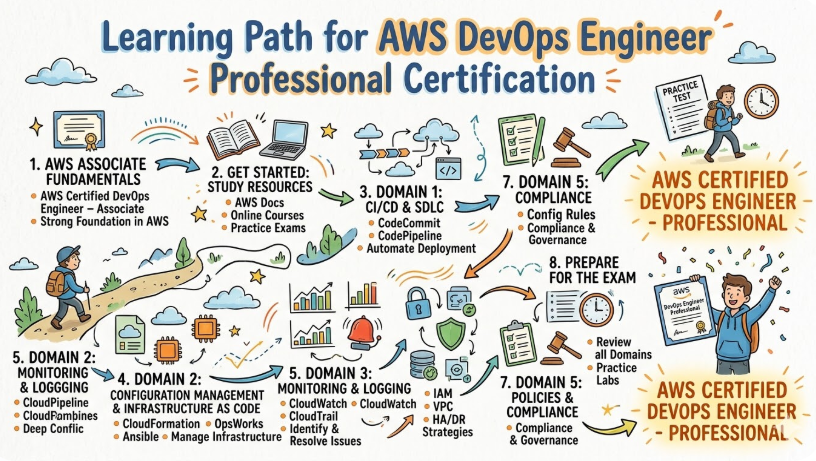
A thirty-day preparation plan allows engineers to study certification topics more systematically. The learning schedule is usually divided into four structured phases.
During the first phase, core AWS services and infrastructure architecture are reviewed. Engineers revisit cloud networking, storage systems, compute services, and deployment patterns.
During the second phase, continuous integration and continuous delivery pipelines are explored. Engineers practice building automated pipelines and deployment workflows.
The third phase focuses on monitoring and observability systems. Logging frameworks, metrics analysis tools, and alerting systems are studied in detail.
The final phase involves reviewing architecture scenarios and practicing certification-style questions.
60 Day Preparation Plan
A sixty-day preparation plan is suitable for engineers who are newer to cloud DevOps concepts. This extended preparation period allows both theory and practical implementation to be studied carefully.
The first month is usually dedicated to understanding AWS services and infrastructure automation practices. Engineers practice building infrastructure environments and deployment pipelines.
The second month focuses on monitoring systems, troubleshooting workflows, and reliability engineering practices. Engineers analyze system failures, design recovery mechanisms, and practice real-world troubleshooting scenarios.
Common Mistakes to Avoid
While preparing for the AWS DevOps Engineer – Professional certification, certain mistakes are commonly observed. These mistakes can slow down learning progress and make certification preparation more difficult.
One mistake is focusing heavily on theoretical reading while avoiding hands-on experimentation. DevOps engineering is a practical discipline, and without implementing real pipelines and infrastructure environments, many concepts remain abstract.
Another mistake involves neglecting monitoring and observability topics. Monitoring frameworks are critical components of reliable cloud infrastructure, and ignoring these topics often leads to incomplete understanding.
Lack of practice with infrastructure automation tools is another challenge. DevOps engineers are expected to automate infrastructure provisioning and configuration, so hands-on practice with automation tools is essential.
Skipping architecture scenario analysis can also create difficulties during preparation. Many certification questions require engineers to analyze operational situations and recommend appropriate solutions.
Choose Your Learning Path
DevOps professionals often choose different specialization paths depending on their career interests. Each path focuses on a different area of cloud engineering and automation.
DevOps Path
The DevOps path focuses primarily on automation pipelines and continuous delivery systems. Engineers who follow this path work on improving software delivery speed while maintaining reliability and quality.
DevSecOps Path
The DevSecOps path integrates security practices into DevOps workflows. Engineers focus on automating vulnerability scanning, security testing, and compliance validation within CI/CD pipelines.
Site Reliability Engineering (SRE)
Site reliability engineering focuses on system reliability, incident management, and service availability. Engineers in this field work on designing systems that remain stable even during infrastructure failures.
AIOps / MLOps
The AIOps and MLOps path focuses on automation powered by artificial intelligence and machine learning systems. Engineers work on monitoring infrastructure using machine learning models and managing automated model deployment pipelines.
DataOps
DataOps focuses on automation of data pipelines and analytics workflows. Engineers build systems that ensure data reliability, quality, and efficient processing across analytics environments.
FinOps
FinOps focuses on cloud cost optimization and financial governance. Engineers and financial teams collaborate to monitor cloud resource usage and optimize infrastructure costs.
Role → Recommended Certifications Mapping
| Role | Recommended Certification |
|---|---|
| DevOps Engineer | AWS DevOps Engineer – Professional |
| Site Reliability Engineer | SRE Certifications |
| Platform Engineer | DevOps Architecture Certifications |
| Cloud Engineer | Cloud Automation Certifications |
| Security Engineer | DevSecOps Certifications |
| Data Engineer | DataOps Certifications |
| FinOps Practitioner | FinOps Certifications |
| Engineering Manager | DevOps Leadership Certifications |
Training & Certification Support Institutions
DevOpsSchool : provides structured training programs focused on DevOps automation, infrastructure management, and continuous delivery pipelines. Learning programs often include real engineering scenarios that help learners understand production environments.
Cotocus : provides technology consulting and training programs that help engineers understand cloud infrastructure and operational workflows. Practical implementation and system architecture understanding are usually emphasized.
ScmGalaxy : offers training programs focused on DevOps tools and automation technologies. Engineers often learn about pipeline implementation, deployment automation, and infrastructure management.
BestDevOps : provides certification programs designed to strengthen DevOps engineering capabilities. Training programs focus on automation practices, system monitoring, and infrastructure architecture.
DevSecOpsSchool : focuses on security integration within DevOps pipelines. Engineers learn how to automate security checks and protect infrastructure environments.
SRESchool : focuses on reliability engineering practices such as monitoring systems, service reliability, and incident management strategies.
AIOpsSchool : introduces engineers to artificial intelligence applications within IT operations environments.
DataOpsSchool : focuses on automated data pipeline development and analytics infrastructure management.
FinOpsSchool : focuses on financial governance practices for cloud infrastructure.
FAQs
- Is AWS DevOps Engineer – Professional considered an advanced certification?
Yes, it is considered one of the most advanced certifications in cloud DevOps. - Is AWS knowledge required before attempting this certification?
Yes, strong familiarity with AWS services is generally expected. - Can beginners prepare for this certification?
Beginners can prepare, but a longer preparation period is usually required. - Is DevOps experience required?
Experience with automation and deployment pipelines is helpful. - How long does preparation typically take?
Preparation time varies depending on prior experience. - Is hands-on practice necessary?
Hands-on practice is essential for understanding DevOps workflows. - Does this certification improve career opportunities?
Yes, DevOps certifications often strengthen career opportunities. - Is monitoring knowledge important for the exam?
Yes, monitoring and observability are major exam topics. - Are troubleshooting skills tested?
Yes, operational troubleshooting scenarios are included. - Can engineering managers benefit from this certification?
Yes, it helps managers understand DevOps operational workflows. - Are CI/CD pipelines included in the exam topics?
Yes, continuous delivery pipelines are a central topic. - Is automation knowledge required?
Yes, automation practices are fundamental to DevOps.
Specific FAQs About AWS DevOps Engineer – Professional
1. What is the AWS DevOps Engineer – Professional certification mainly focused on?
The AWS DevOps Engineer – Professional certification is focused on advanced DevOps practices in cloud environments. The certification evaluates the ability to automate infrastructure, design CI/CD pipelines, monitor cloud systems, and manage scalable applications using AWS services.
Engineers who pursue this certification are expected to understand how modern software systems are deployed, monitored, and maintained using automation tools.
2. What level of AWS knowledge is expected before preparing for this certification?
A strong understanding of AWS services is usually expected before attempting this certification. Knowledge of cloud computing concepts, infrastructure automation, and deployment pipelines is considered helpful.
Engineers who already work with AWS environments often find it easier to understand the certification topics.
3. What DevOps tools knowledge is useful for this certification?
Although the certification focuses on AWS services, knowledge of common DevOps tools can be helpful. Tools used for version control, CI/CD pipelines, monitoring systems, and infrastructure automation are often used in real DevOps environments.
Understanding automation workflows helps engineers interpret scenario-based questions more effectively.
4. How important are CI/CD pipelines in the AWS DevOps Engineer – Professional certification?
Continuous integration and continuous delivery pipelines are one of the most important topics covered in the certification. Engineers are expected to understand how automated pipelines are designed, monitored, and optimized.
Knowledge of deployment strategies, testing automation, and rollback mechanisms is also important.
5. Does the certification cover monitoring and logging systems?
Yes, monitoring and logging are major areas of focus in the certification. Engineers must understand how application performance, infrastructure metrics, and system logs are collected and analyzed.
These monitoring systems help teams detect failures early and maintain service reliability.
6. Is infrastructure automation required for this certification?
Infrastructure automation is one of the core areas of the certification. Engineers are expected to understand how infrastructure resources can be defined and managed through configuration files instead of manual configuration.
This approach helps maintain consistency across different cloud environments.
7. Does the certification include troubleshooting and operational scenarios?
Yes, troubleshooting scenarios are commonly included. Engineers are expected to analyze operational situations and identify the best solutions for maintaining system stability.
Understanding system logs, monitoring metrics, and deployment workflows helps engineers resolve operational problems effectively.
8. How does this certification help DevOps engineers in their careers?
The AWS DevOps Engineer – Professional certification strengthens the understanding of automation, reliability engineering, and cloud infrastructure management. These skills are highly valuable in modern cloud-based organizations.
Engineers who understand these practices are often able to contribute more effectively to software delivery pipelines and infrastructure operations.
Testimonials
Rahul
The certification preparation helped improve my understanding of DevOps automation workflows. Real deployment scenarios became much clearer after structured learning.
Anita
Many cloud automation concepts were understood more deeply. Confidence in managing CI/CD pipelines improved significantly.
Vikram
The learning path connected cloud infrastructure management with DevOps automation practices. Real operational workflows became easier to understand.
Sneha
Troubleshooting cloud environments became easier after studying monitoring and logging systems.
Arjun
The certification preparation helped connect development pipelines with infrastructure automation practices.
Conclusion
The AWS DevOps Engineer – Professional certification represents an important step for engineers who want to deepen their understanding of cloud automation, infrastructure management, and continuous delivery systems. Through structured learning and practical experimentation, engineers develop the ability to design automated deployment pipelines, manage infrastructure through code, and maintain reliable cloud environments.
In modern cloud-driven software development environments, automation and reliability are essential. Engineers who understand these practices are able to support faster software delivery while maintaining system stability.
When certification preparation is combined with hands-on project experience, engineers gain practical confidence in managing cloud infrastructure systems. Over time, these skills contribute to stronger career opportunities in DevOps, cloud engineering, reliability engineering, and platform architecture roles.
Strategic learning and continuous skill development remain essential for engineers who want to grow within modern cloud technology environments.