Introduction
The landscape of modern software development has shifted. It is no longer just about writing code; it is about how that code lives, breathes, and scales in the cloud. Google Cloud Platform (GCP) has emerged as a powerhouse for organizations that value data, speed, and reliability. Navigating this ecosystem requires more than just curiosity. It requires a structured validation of skills.
This guide is designed to walk through the journey of becoming a Google Cloud Professional Engineer. Whether a small team is being managed or a global infrastructure is being overseen, understanding the depth of this certification is a vital step in professional growth.
What is Google Cloud Professional Engineer
A Google Cloud Professional Engineer is a specialist who focuses on the operational side of the cloud. This role involves building and managing scalable, secure, and highly available systems. While many engineers can navigate a dashboard, a professional engineer understands the underlying architecture.
The focus here is not just on “making it work.” It is about making it work efficiently. This means using automation, managing incidents, and ensuring that every deployment is repeatable and safe. It is a bridge between development and operations, rooted in the best practices of Google’s own engineering culture.
Why it Matters in Today’s Ecosystem
We are living in an era of automation and intelligent systems. The days of manual server configuration are behind us. Companies today need engineers who can handle massive data loads and complex microservices without breaking a sweat.
Google Cloud is often the preferred choice for high-performance computing and data-driven projects. By mastering this platform, a position is secured at the forefront of the cloud revolution. It allows for a move away from firefighting and toward building resilient systems that can self-heal and scale automatically.
Why Certifications are Important for Engineers and Managers
For an engineer, a certification is a personal benchmark. Gaps in knowledge that daily work might miss are forced to be filled. The process of preparing for a certification ensures that a well-rounded professional is developed.
For managers, certifications provide a level of trust. When a team is certified, it means there is a common language and a shared set of standards. The risk of architectural mistakes is reduced and industry-recognized patterns are followed. It is a signal to clients and stakeholders that the project is in capable hands.
Why Choose DevOpsSchool?
Selecting the right partner for the learning journey is as important as the certification itself. DevOpsSchool is chosen by many because of its deep focus on practical, hands-on experience. Instead of just focusing on passing an exam, the emphasis is placed on understanding the “why” behind every cloud service.
The training is delivered by mentors who have spent years in the trenches of production environments. This real-world perspective helps students relate theoretical concepts to the actual problems faced at work. With a robust support system and a community of like-minded learners, the environment needed to master complex cloud engineering is provided.
Certification Deep-Dive: Google Cloud Professional Engineer
What is this certification?
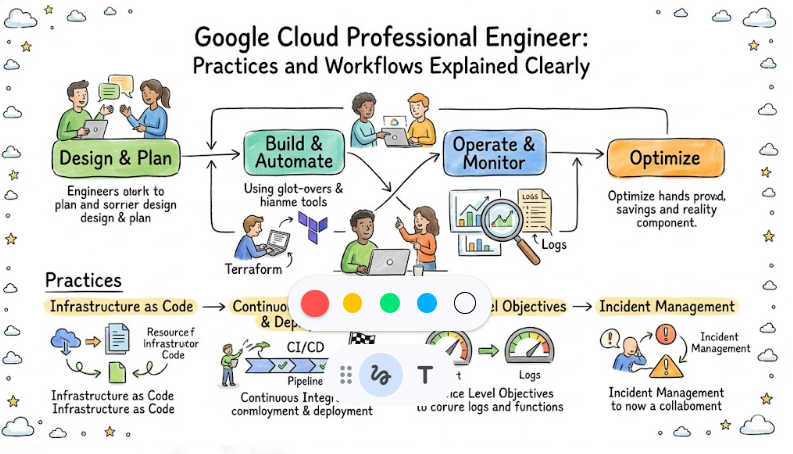
This certification validates the ability to implement a delivery pipeline, monitor services, and manage incidents. It focuses on using Google Cloud tools to ensure high-quality software delivery and operational excellence.
Who should take this certification?
This is designed for individuals who are responsible for the health and performance of cloud applications. It is ideal for DevOps engineers, SREs, and system administrators who want to prove their expertise in the Google Cloud ecosystem.
Certification Overview Table
| Track | Level | Who it’s for | Prerequisites | Skills Covered | Recommended Order |
| DevOps | Professional | Cloud Engineers | 3+ years industry exp | CI/CD, Monitoring, SRE | 1 |
| DevSecOps | Professional | Security Engineers | Cloud Fundamentals | Security Automation | 2 |
| SRE | Professional | Operations Leads | DevOps Experience | Reliability, Incident Mgmt | 1 |
| AIOps/MLOps | Professional | Data Engineers | ML Basics | Model Deployment | 3 |
| DataOps | Professional | Data Architects | SQL & BigQuery | Data Pipelines | 2 |
| FinOps | Professional | Finance/Cloud Leads | Cloud Billing | Cost Optimization | 3 |
Skills You Will Gain
- Designing and implementing continuous delivery pipelines.
- Managing and scaling infrastructure using Google Cloud tools.
- Implementing service monitoring and logging strategies.
- Handling incident response and post-mortem analysis.
- Optimizing service performance and cost-efficiency.
Real-World Projects You Should Be Able to Do
- Building a fully automated CI/CD pipeline for a multi-tier application.
- Setting up a global load balancer with auto-scaling groups.
- Creating a centralized logging and alerting system for microservices.
- Migrating a monolithic on-premise application to Google Kubernetes Engine (GKE).
Preparation Plan
7–14 Days Plan (The Quick Refresh)
- Days 1-4: Google Cloud documentation for GKE and Cloud Build is reviewed.
- Days 5-10: Practice exams are taken to identify weak areas.
- Days 11-14: Focus is placed on IAM roles and monitoring dashboards.
30 Days Plan (The Standard Approach)
- Week 1: A deep dive into networking, VPCs, and IAM is conducted.
- Week 2: Kubernetes and container orchestration on GCP are mastered.
- Week 3: Stackdriver (Operations Suite) and deployment strategies are learned.
- Week 4: Hands-on labs and mock exams are completed.
60 Days Plan (The Comprehensive Learning)
- Month 1: A full project is built from scratch on GCP to understand every service.
- Month 2: Focus is shifted to advanced SRE principles and exam-specific scenarios.
Common Mistakes to Avoid
- The Shared Responsibility Model of security is ignored.
- Only the GUI is focused on instead of learning the
gcloudCLI. - The importance of cost-management tools is overlooked.
- Real-world incident response scenarios are not practiced.
Best Next Certification After This
- Same Track: Google Cloud Professional Cloud Architect.
- Cross-Track: Professional Cloud Security Engineer.
- Leadership / Management: Google Cloud Digital Leader.
Choose Your Learning Path
DevOps Path
This path is best for those who want to automate the software development lifecycle. It focuses on speed, quality, and the seamless movement of code from a laptop to a production environment.
DevSecOps Path
Ideal for security-conscious engineers. It involves integrating security checks into the DevOps pipeline, ensuring that every piece of code is scanned and safe before it goes live.
Site Reliability Engineering (SRE) Path
Best for those who love stability. It applies software engineering mindsets to operations problems. The goal here is to create ultra-reliable systems that require minimal human intervention.
AIOps / MLOps Path
Designed for engineers working with data science teams. It focuses on the operational challenges of deploying and maintaining machine learning models at scale.
DataOps Path
Perfect for data engineers. This path ensures that data flows through an organization reliably and securely, treating data pipelines with the same rigor as application code.
FinOps Path
Best for managers and architects who need to balance performance with cost. It teaches how to get the most value out of every dollar spent in the cloud.
Role → Recommended Certifications Mapping
| Role | Recommended Certification |
| DevOps Engineer | Google Cloud Professional DevOps Engineer |
| Site Reliability Engineer | Professional Cloud DevOps Engineer |
| Platform Engineer | Professional Cloud Architect |
| Cloud Engineer | Associate Cloud Engineer |
| Security Engineer | Professional Cloud Security Engineer |
| Data Engineer | Professional Data Engineer |
| FinOps Practitioner | Cloud Digital Leader + FinOps Certified |
| Engineering Manager | Professional Cloud Architect |
Next Certifications to Take
For the DevOps Learner
- One same-track: Certified Kubernetes Administrator (CKA).
- One cross-track: Professional Cloud Security Engineer.
- One leadership-focused: TOGAF for Enterprise Architecture.
For the SRE Learner
- One same-track: Advanced Networking Specialization.
- One cross-track: Professional Data Engineer.
- One leadership-focused: ITIL Foundation.
Training & Certification Support Institutions
DevOpsSchool
This institution is known for its extensive library of technical content and mentor-led programs. Deeply technical training is provided for all cloud and DevOps tracks. A strong emphasis is placed on career-ready skills.
Cotocus
A specialized consulting and training firm that focuses on high-end tech stacks. Tailored solutions are offered to both individuals and corporate teams. It is highly regarded for its practical implementation labs.
ScmGalaxy
One of the oldest communities and resource hubs for SCM and DevOps professionals. A vast range of tutorials and study materials is maintained here. It serves as a reliable knowledge base for engineers.
BestDevOps
This platform focuses on providing curated learning paths for aspiring DevOps professionals. Simple and effective training modules are created to help students master tools quickly. It is ideal for those looking for structured growth.
devsecopsschool.com
This institution is dedicated to the integration of security at every stage of the software development lifecycle. It focuses on automating vulnerability scans and compliance checks within the delivery pipeline. The goal is to ensure that speed does not compromise the safety of the application.
sreschool.com
A specialized focus is placed here on applying a software engineering mindset to infrastructure and operations. The curriculum covers essential reliability principles such as managing error budgets and setting service level objectives. It is designed to help engineers build systems that are ultra-stable and highly scalable.
aiopsschool.com
This platform serves as a hub for learning how artificial intelligence and machine learning can automate IT operations. It teaches how to use data-driven insights to predict system outages and perform rapid root-cause analysis. It is ideal for managing the massive data loads found in modern cloud environments.
dataopsschool.com
Training is provided here for the automated and collaborative management of data pipelines across an organization. The focus is placed on improving data quality and reducing the time it takes to deliver analytics to the business. It treats data flow with the same rigor and automation as traditional software code.
finopsschool.com
This school concentrates on the financial accountability and cost optimization of cloud infrastructure. It teaches engineers and managers how to balance performance with budget to ensure maximum business value. Strategies are provided to monitor, analyze, and reduce cloud spend without affecting service quality.
FAQs Section
- How does this certification change a typical workday?
Operations become more proactive. Automated self-healing systems are implemented to handle issues before they reach the user. - Is it possible to pass without deep coding skills?
A solid understanding of Python or Shell scripting is essential. The ability to read and edit YAML files is mandatory. - What is the learning curve for someone from an on-premise background?
The transition is significant. The focus shifts from physical hardware management to virtualized resource orchestration. - How long should a working professional study each day?
A consistent commitment of 1 to 2 hours daily is usually enough to make steady progress. - Does the certification help in getting remote job opportunities?
Yes, cloud expertise is highly sought-after for remote roles as it proves global infrastructure can be managed from any location. - What is the most challenging part of the curriculum?
The Site Reliability Engineering (SRE) logic, specifically calculating error budgets and SLOs, is often considered the most complex area. - Are there any hidden costs involved in preparation?
Small costs may be incurred for hands-on lab environments, though most cloud providers offer a free tier. - How does this credential impact salary negotiations?
It serves as strong leverage. Certified professionals often see a noticeable increase in offer packages. - Can a fresh graduate jump straight into this?
It is possible, but starting with an associate-level cert is recommended to gain necessary context. - Is the exam available in languages other than English?
Yes, the exam is offered in several languages including Japanese and Spanish. - What happens if the exam is not cleared on the first try?
A retake can be scheduled after a waiting period. This time is used to focus on feedback from the exam report. - How does this certification stay relevant?
The exam content is updated periodically. Recertification every two years ensures that skills remain current.
Google Cloud Professional Engineer Specific FAQs
- Which GCP tool is most critical for this exam?
Google Kubernetes Engine (GKE) is the centerpiece for deploying and managing containers. - How are incident response skills evaluated?
Failure scenarios are presented and the best tool or process to restore service is asked for. - Does the exam cover legacy system migration?
Yes, knowledge on moving applications from older environments into GCP is tested. - How much focus is placed on binary authorization?
Security is woven throughout, specifically ensuring only trusted code is deployed. - Is there a heavy emphasis on BigQuery?
Reliability of data-driven services and monitoring data pipelines must be understood. - Are Terraform or Ansible mentioned?
Concepts of Infrastructure as Code (IaC) are fundamental, even if GCP-native tools are primary. - How does Google’s “Operations Suite” fit into the test?
It is a major pillar used to diagnose performance bottlenecks and set up logging. - What is the best way to simulate the exam environment?
Official practice sets and timed hands-on labs are the most effective preparation methods.
Testimonials
Arjun
The depth of knowledge gained during this certification was incredible. It moved me from just running scripts to actually understanding how to manage global services effectively. My confidence in handling production outages has grown.
Anjali
The math behind reliability was finally understood. Learning about SLOs and error budgets changed the way our team talks about uptime. Real-world clarity was provided to help me excel in my role.
Karthik
The project-based approach helped bridge the gap between theory and practice. A new CI/CD pipeline was able to be implemented at my job within weeks of finishing the training. It was a career-defining move.
Priya
Seeing how security fits into the delivery pipeline was a lightbulb moment. The tools to collaborate better with our dev teams without compromising on safety were provided by this certification.
Siddharth
I took this to better support my team. The technical vocabulary and the strategic insight needed to plan our cloud migration were gained. It is a must-have for anyone leading technical teams today.
Conclusion
The Google Cloud Professional Engineer certification is more than just a piece of paper. It is a rigorous validation of the ability to manage the complexities of modern cloud environments. By following this path, a mindset of reliability, automation, and excellence is adopted.
Long-term career benefits include higher salary potential, access to leadership roles, and the ability to solve challenging technical problems. Strategic learning is the key to staying relevant. The plan is started today, the path is chosen, and the future of engineering is stepped into.