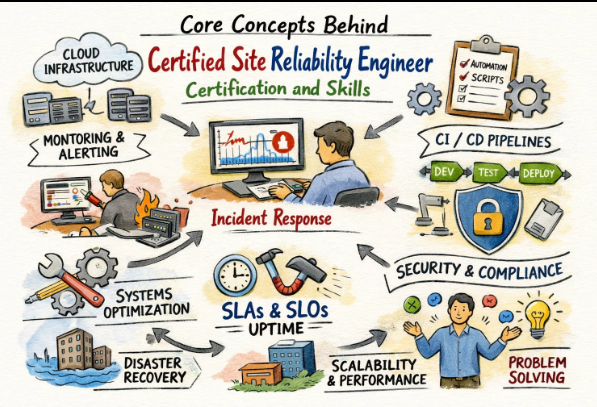
Introduction
The technology landscape has undergone a massive transformation. In the past, the creation of software and the management of servers were handled by two separate teams. This separation often resulted in delays and system instability. To solve these challenges, the principles of Site Reliability Engineering were introduced.
Reliability is now viewed as the most critical feature of any application. If a system is not reachable, its value is reduced to zero. The Certified Site Reliability Engineer program is designed to equip engineers with the mindset and tools needed to build systems that are both fast and stable. This guide is intended for those who wish to master these skills and advance their careers in the global market.
What is Certified Site Reliability Engineer?
A Certified Site Reliability Engineer is a professional whose expertise in balancing system stability with the speed of software delivery has been validated. This certification is focused on the application of software engineering practices to infrastructure and operations problems. It is not merely about keeping the lights on; it is about building automated systems that can manage themselves.
Why it matters today?
In the current economy, scale is everything. Systems are no longer managed in dozens, but in thousands of instances. Manual labor is considered a bottleneck that prevents businesses from growing. High-performance organizations require engineers who can write code to automate away repetitive tasks.
Furthermore, user expectations have never been higher. A slow response or a brief outage can drive users away to competitors instantly. For platforms dealing with financial data, reliability is the foundation of the entire business model. The ability to guarantee uptime while deploying new features frequently is a skill that is currently in high demand across the globe.
Why Certified Site Reliability Engineer certifications are important?
Certifications are used by the industry as a benchmark for technical competence. They provide a standardized way to measure an individual’s understanding of complex concepts like Error Budgets, Service Level Objectives (SLOs), and Incident Management.
For a professional, being certified means that a structured learning path has been completed. It ensures that the core pillars of SRE are understood not just in theory, but in practical application. In a competitive job market, this certification serves as a signal to employers that an engineer is prepared to handle the pressures of managing production environments at scale.
Why choose SRESchool?
When a career in reliability engineering is pursued, the source of learning is of great importance. SRESchool is chosen because it is an institution dedicated exclusively to the discipline of site reliability. A curriculum is provided that is deeply rooted in real-world scenarios and the latest industry standards.
At SRESchool, a focus is placed on the practical aspects of the SRE role. The training is delivered by experts who have managed some of the world’s most complex distributed systems. A supportive environment is created where learners can experiment with automation, chaos engineering, and observability tools. By choosing SRESchool, a professional is guaranteed a deep dive into the specific methodologies that make systems truly resilient.
Certification Deep-Dive
What is this certification?
The Certified Site Reliability Engineer is a professional credential that confirms an individual’s ability to implement SRE principles. It is focused on the balance between feature development and system stability through engineering and automation.
Who should take this certification?
This certification should be taken by software developers, system administrators, and cloud engineers who wish to specialize in system uptime. It is also highly recommended for team leads who are responsible for the performance of production systems.
Certification Overview Table
| Track | Level | Who it’s for | Prerequisites | Skills Covered | Recommended Order |
| DevOps | Associate | Beginners | Basic Linux | CI/CD, Scripting | 1 |
| SRE | Specialist | Cloud Engineers | DevOps Basics | SLOs, Error Budgets | 2 |
| DevSecOps | Professional | Security Ops | SRE Basics | Security Automation | 3 |
| AIOps/MLOps | Specialist | ML Engineers | Python, DevOps | AI Monitoring | 4 |
| DataOps | Specialist | Data Engineers | SQL, Big Data | Data Reliability | 5 |
| FinOps | Management | Finance/Tech | Cloud Basics | Cost Governance | 6 |
Skills you will gain
- Measuring Reliability: The ability to define and monitor SLIs and SLOs is gained.
- Managing Error Budgets: A clear understanding of how to balance risk and innovation is developed.
- Toil Reduction: Techniques for identifying and automating repetitive manual tasks are learned.
- Observability: Expertise in gaining deep visibility into system performance is acquired.
- Incident Management: Methods for handling outages and conducting blameless post-mortems are mastered.
Real-world projects you should be able to do after this certification
- Automated Reliability Dashboard: A dashboard is created to track the health and error budgets of multiple services.
- Self-Healing Infrastructure: A system is built that can automatically restart or replace failing components without human intervention.
- Chaos Engineering Suite: A set of experiments is designed to test how a system handles unexpected failures.
- Alerting Pipeline: A sophisticated alerting system is implemented to reduce noise and focus on critical issues.
Preparation Plan
7–14 Days Plan
- First Half: The core concepts of the SRE philosophy and SLOs are studied.
- Second Half: Practice tests are completed and the focus is placed on incident response scenarios.
30 Days Plan
- Week 1: Introduction to SRE culture and the role of automation is covered.
- Week 2: Deep dive into monitoring, observability, and alerting strategies is performed.
- Week 3: Hands-on labs involving toil reduction and scripting are completed.
- Week 4: Final revision and mock exams are conducted to ensure readiness.
60 Days Plan
- Month 1: A solid foundation in cloud infrastructure and distributed systems is built.
- Month 2: Advanced topics such as chaos engineering and cost optimization are explored through long-term projects.
Common mistakes to avoid
- Over-complicating SLOs: Too many metrics are often tracked, which leads to confusion.
- Manual fixes: Relying on manual intervention instead of building automated solutions is a common pitfall.
- Blaming individuals: A culture of blame during post-mortems is avoided to encourage honest learning.
Best next certification after this
Same Track: Advanced SRE Specialist
Cross-Track: Certified DevSecOps Professional
Leadership: Certified Cloud Architect
Choose Your Learning Path
- DevOps Path: This path is best for those who want to master the speed of software delivery. A focus is placed on the CI/CD pipeline and automation.
- DevSecOps Path: This is designed for engineers who believe that security must be part of the reliability equation. Security is integrated into every stage of the lifecycle.
- Site Reliability Engineering (SRE) Path: This path is chosen by those who want to ensure that large-scale systems remain available and performant at all times.
- AIOps / MLOps Path: This is best for specialists who use artificial intelligence to predict and prevent system failures before they occur.
- DataOps Path: This is intended for data professionals who need to ensure the accuracy and reliability of information across complex pipelines.
- FinOps Path: This path is ideal for those who want to combine engineering skills with financial management to optimize cloud spending.
Role → Recommended Certifications Mapping
| Current Role | Recommended Certification | Primary Benefit |
| DevOps Engineer | Certified SRE | Reliability is integrated into the delivery process. |
| SRE | Certified FinOps | Costs are managed without compromising uptime. |
| Platform Engineer | Certified DevSecOps | Security is built into the internal platforms. |
| Cloud Engineer | Certified SRE | Infrastructure is evolved into a reliable service. |
| Security Engineer | Certified DevSecOps | Security practices are automated and scaled. |
| Data Engineer | Certified DataOps | Data delivery is made consistent and reliable. |
| FinOps Practitioner | Certified SRE | A technical grasp of system performance is gained. |
| Engineering Manager | Certified SRE | Teams are led with a focus on measurable reliability. |
Next Certifications to Take
Same Track: SRE Master
The SRE Master program is considered the next natural step for a Certified Site Reliability Engineer. In this advanced level, deep knowledge of large-scale system management and global traffic is provided. The skills needed for designing “self-healing” infrastructure are fully mastered through hands-on practice.
Cross-Track: Certified DevSecOps Professional
Security is integrated into the core of the reliability framework within the Certified DevSecOps Professional track. Automated security audits and vulnerability scanning are learned to ensure systems are protected from the start. A holistic approach is taken by a Certified Site Reliability Engineer to balance speed with safety.
Leadership: Digital Transformation Leader
Strategic leadership and the evolution of organizational culture are taught in the Digital Transformation Leader certification. Methods for aligning technical goals with business outcomes are explored for those moving into management roles. Entire departments are guided through complex digital changes by a Certified Site Reliability Engineer with this credential.
Training & Certification Support Institutions
- DevOpsSchool: A wide array of training programs is offered here. A strong community is maintained to help students learn the latest trends in automation and delivery.
- Cotocus: Expert consulting and training services are provided for cloud-native technologies. A focus is placed on helping organizations transition to modern engineering practices.
- ScmGalaxy: A massive library of community-generated content and technical blogs is hosted. It is used as a primary resource for self-paced learners globally.
- BestDevOps: High-impact training sessions are delivered to both individuals and corporate teams. The curriculum is kept up-to-date with the latest industry shifts.
- devsecopsschool.com: Specialized education is provided for those looking to merge security with operations. The automation of security testing is a key focus area.
- sreschool.com: This is the leading destination for reliability-focused certifications. A structured curriculum is provided to help engineers master the art of system uptime.
- aiopsschool.com: Training is provided for the next generation of operations powered by AI. How to use machine learning for proactive monitoring is taught here.
- dataopsschool.com: Education is focused on the reliability of data systems. How to manage data as code is explored through practical workshops.
- finopsschool.com: A platform for learning cloud financial management is provided. Engineers are taught how to drive cost accountability within their organizations.
FAQs Section
General Career FAQs
- Is the Certified SRE exam considered difficult?
The difficulty is considered moderate, provided that a solid understanding of cloud principles is possessed. - How is the ROI of this certification measured?
It is measured through access to high-paying roles and the ability to reduce operational costs for employers. - What is the minimum preparation time required?
A minimum of 30 days is typically recommended for a thorough understanding of the material. - How is the career trajectory shifted after certification?
A move from generalist roles to specialized, high-impact reliability engineering positions is often seen. - Are there any prerequisites for the exam?
A basic knowledge of Linux and at least one scripting language is generally expected. - Can the exam be attempted without formal training?
- While possible, formal training is advised to ensure all industry-standard practices are covered.
- What is the validity period of the certification?
The certification is usually valid for two to three years, after which a renewal is suggested. - How does this certification impact job security in the financial sector?
Job security is significantly increased as reliability is a top priority for financial institutions. - Are remote learning options available?
Yes, comprehensive online training is offered by most supporting institutions. - Is the focus on tools or methodology?
A strong focus is placed on methodology, although common industry tools are also utilized. - How does SRE differ from traditional DevOps?
SRE is a specific way of doing DevOps that focuses heavily on reliability through software engineering. - Is this certification valuable for global markets?
Yes, the principles taught are universal and are applied by tech companies worldwide.
Certified Site Reliability Engineer FAQs
- How is the success of an SRE measured?
Success is measured by the stability of the system and the achievement of SLOs. - Is coding a major part of the CSRE role?
Yes, coding is used to automate infrastructure and eliminate manual toil. - What is the focus of the CSRE exam?
The focus is placed on automation, monitoring, and the strategic management of risk. - Are post-mortems included in the study material?
Yes, the ability to analyze failures without casting blame is a key part of the curriculum. - How is the error budget utilized in a real-world scenario?
It is used to decide whether new features can be launched or if stability work must be prioritized. - Does the certification cover multi-cloud environments?
The principles are applicable to any cloud environment, including AWS, Azure, and GCP. - What is the most important skill for a CSRE?
The ability to approach operational problems with an engineering mindset is considered most important. - How are labs conducted during the training?
Labs are conducted in live cloud environments to simulate real production issues.
Testimonials
- Ishaan: A significant improvement in technical confidence was experienced. The methodology for managing complex systems was clearly understood and applied.
- Ananya: The transition from a developer role to an SRE role was made much easier. The practical projects provided a solid foundation for real-world tasks.
- Kabir: A new way of thinking about system failure was gained. The focus on blameless culture has changed how the entire team operates.
- Zoya: The career path is now much more structured and clear. The skills learned have already led to more responsibilities and growth within the company.
- Vihaan: The importance of automation was truly realized during this program. Repetitive tasks have been eliminated, allowing for more focus on innovation.
Conclusion
The importance of becoming a Certified Site Reliability Engineer is underscored by the increasing complexity of today’s digital systems. For any professional looking to secure a future in the technology industry, the shift toward reliability engineering is essential. Long-term career benefits are attained when a commitment to continuous learning and structured certification is made. By following the paths outlined in this guide and leveraging the support of specialized institutions like SRESchool, a high level of professional mastery is achieved.