Introduction
The way software is built, managed, and deployed has been completely transformed over the last few years. Cloud technology is now the standard for businesses of all sizes, and at the heart of this massive shift sits Kubernetes. Among the various ways to prove one’s skills in this complex area, the Certified Kubernetes Application Developer (CKAD) stands out as a critical milestone for any modern professional. This certification is not just a piece of paper or a multiple-choice test; it is a rigorous, hands-on performance exam that tests the actual ability to design, build, and configure cloud-native applications in a live environment.
In today’s fast-moving ecosystem, where automation and scalability are no longer optional, knowing how to handle containers is a fundamental requirement. For engineers, this certification serves as a badge of honor that proves complex problems can be solved in real-time under pressure. For managers, it provides a trusted benchmark to ensure the team is fully capable of handling modern infrastructure without constant supervision. Staying relevant in the tech industry requires constant learning, and getting certified is a clear, structured path to showing that expertise is being actively maintained and updated.
Certification Overview Table
| Track | Level | Who it’s for | Prerequisites | Skills Covered | Recommended Order |
| Cloud Native | Intermediate | Developers, Engineers | Basic Linux & Docker | Pods, Deployments, Network Policies | After CKA or as a First Step |
Why Choose DevOpsSchool?
Choosing the right place to learn is just as important as the exam itself, as the foundation of your knowledge depends on the quality of instruction. DevOpsSchool is chosen by thousands of learners because the focus is kept strictly on real-world skills rather than just passing the test. The training is delivered by seasoned industry experts who have spent many years managing large-scale production systems in various global sectors.
The curriculum is updated regularly to match current industry needs and changes in the Kubernetes ecosystem, ensuring that no outdated material is taught. Plenty of dedicated lab time is provided to each student to ensure that theoretical concepts are understood deeply through practice. It is widely considered a reliable partner for anyone looking to transition into high-level technical roles with confidence.
Certification Deep-Dive: CKAD
What is this certification?
The CKAD is a performance-based exam that tests the specific knowledge required to create, configure, and expose applications on Kubernetes. It focuses heavily on the operational side of application development, ensuring that developers can navigate a containerized world efficiently.
Who should take this certification?
This is ideal for software developers, cloud engineers, and platform engineers who want to demonstrate their ability to work with Kubernetes clusters. It is also highly beneficial for system administrators moving into DevOps roles who need to understand how applications behave inside a cluster.
Skills you will gain
- The ability to design and build optimized container images for various environments.
- Mastery in managing Kubernetes objects like Pods, Services, and Ingress controllers.
- Expertise in configuring application security, resource limits, and environment variables.
- Advanced skills in troubleshooting application deployments and fixing runtime errors within a cluster.
- Practical knowledge in implementing persistent storage to ensure data is not lost when containers restart.
Real-world projects you should be able to do
- Migrating a traditional monolithic application into a modern microservices architecture using containers.
- Setting up a zero-downtime deployment pipeline that uses rolling updates to keep services online.
- Configuring automated health checks and resource quotas to maintain production-grade application stability.
- Securing sensitive data such as API keys and passwords using Kubernetes Secrets and ConfigMaps.
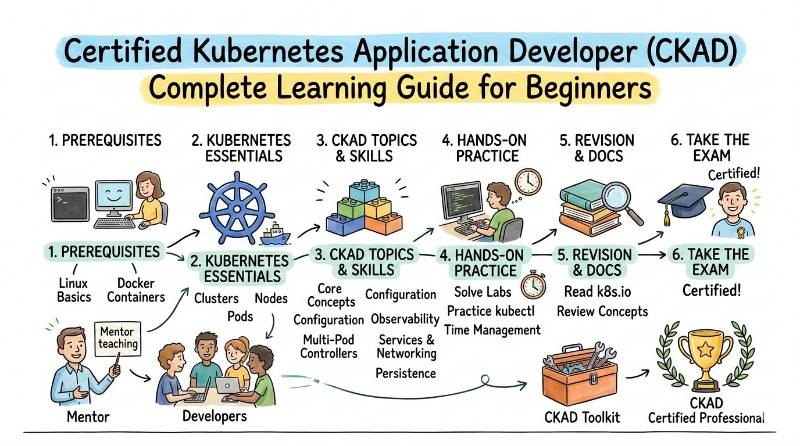
Preparation plan
- 7–14 days plan: A heavy focus is placed on the official curriculum and the mastery of basic
kubectlcommands. At least 4 hours should be spent daily practicing imperative commands to save time during the exam. - 30 days plan: A full training course is completed during this time. Every topic is practiced at least twice, and mock exams are solved under strictly timed conditions to build speed.
- 60 days plan: The official Kubernetes documentation is read thoroughly to understand where information is located. A personal project is built on a local cluster like Minikube, and focus is shifted entirely toward 100% accuracy and speed.
Common mistakes to avoid
- Too much time is often wasted writing YAML files from scratch; the use of imperative commands is highly encouraged.
- The importance of time management is often ignored, leading to unfinished questions even if the knowledge is present.
- Not being familiar with the layout of the official Kubernetes documentation can lead to panic when a specific syntax is forgotten.
Best next certification after this
- Same track: Certified Kubernetes Administrator (CKA).
- Cross-track: Certified Kubernetes Security Specialist (CKS).
- Leadership / management: Certified FinOps Associate.
Choose Your Learning Path
1. DevOps Path
This path is best for those who want to bridge the gap between development and operations teams. It focuses on building seamless CI/CD pipelines, total automation of tasks, and treating infrastructure as code to ensure consistency across environments.
2. DevSecOps Path
This is perfect for security-minded engineers who believe that protection should not be an afterthought. It layers security protocols into every single step of the development lifecycle, ensuring that applications are safe by design from the very first line of code.
3. Site Reliability Engineering (SRE) Path
This is best for those interested in the science of system stability and high performance. It emphasizes deep monitoring, rapid incident response, and the use of software engineering principles to solve traditional operations problems.
4. AIOps / MLOps Path
This path is designed specifically for data science and AI professionals. It focuses on the unique challenges of deploying machine learning models at scale and using artificial intelligence to improve and automate IT operations.
5. DataOps Path
This is best for data engineers who need to manage large volumes of information. It ensures that data flows smoothly from the source to the final consumer, focusing on the quality, speed, and reliability of complex data pipelines.
6. FinOps Path
Ideal for finance and cloud professionals who want to understand the cost of innovation. It focuses on the business value of the cloud, helping organizations manage, track, and optimize their cloud spending to avoid waste.
Role → Recommended Certifications Mapping
- DevOps Engineer: CKAD, CKA, and a Jenkins Certification are recommended.
- Site Reliability Engineer (SRE): CKAD, Prometheus Monitoring, and CKA are prioritized.
- Platform Engineer: CKAD, Terraform Associate, and CKS are the focus.
- Cloud Engineer: CKAD along with AWS, Azure, or GCP Architect levels are suggested.
- Security Engineer: CKAD, CKS, and Vault Certified status are essential.
- Data Engineer: CKAD, Spark Certification, and Kafka Certification are highly valued.
- FinOps Practitioner: CKAD and the FinOps Certified Practitioner exam are recommended.
- Engineering Manager: CKAD is taken for technical awareness, alongside Leadership Training and FinOps.
Next Certifications to Take
- For the DevOps Learner:
- Same-track: CKA (Certified Kubernetes Administrator)
- Cross-track: CKS (Certified Kubernetes Security Specialist)
- Leadership: DevOps Leader (DOL)
- For the SRE Learner:
- Same-track: Professional SRE Certification
- Cross-track: AIOps Certification
- Leadership: Site Reliability Manager
Training & Certification Support Institutions
DevOpsSchool
Comprehensive training programs are offered here for all modern tech stacks. A very strong emphasis is placed on practical labs and one-on-one career mentorship to help students successfully land high-paying roles in the industry.
Cotocus
Specialized consulting and training services are provided by this firm to various organizations. They focus on helping large companies adopt DevOps practices through hands-on workshops and expert guidance from senior consultants.
ScmGalaxy
This is a vast community resource and training platform that has been active for many years. It is widely known for providing deep technical content and free tutorials that help engineers master complex tools like Kubernetes and Git.
BestDevOps
Practical and result-oriented courses are the hallmark of this training institution. A clear, step-by-step roadmap is provided for both beginners and seasoned professionals to upgrade their skills in the cloud domain effectively.
devsecopsschool.com
This platform is focused entirely on the intersection of security and DevOps. Specialized training is provided to ensure that security measures are integrated into the automated pipeline from the very beginning of the project.
sreschool.com
This site is dedicated to the core principles of Site Reliability Engineering. Detailed courses are offered that cover error budgets, the reduction of operational toil, and the design of high-availability systems.
aiopsschool.com
Specialized training in using Artificial Intelligence for IT operations is provided by this platform. It is designed for those looking to automate complex monitoring tasks and predict system failures before they occur.
dataopsschool.com
This is a niche training center created specifically for data professionals. The curriculum focuses on bringing DevOps-like agility and speed to the world of data management and advanced analytics.
finopsschool.com
Training is provided here to help bridge the gap between cloud engineering and corporate finance. It helps professionals learn how to optimize cloud costs effectively without sacrificing application performance.
FAQs Section
- Is the CKAD exam difficult?
It is considered moderate to difficult because it is 100% practical and a strict time limit is enforced. - How much time is needed for preparation?
Generally, 1 to 2 months is sufficient if at least 2 hours are dedicated to practice every day. - Are there any prerequisites?
No formal requirements exist, but a basic understanding of Linux and Docker is highly helpful. - What is the exam format?
It is a performance-based test where tasks are completed in a live command-line environment. - How long is the certification valid? The certification is valid for a period of three years from the date it is successfully earned.
- Can the exam be retaken?
Yes, one free retake is usually included by the provider with the initial exam purchase. - Is it worth it for a Manager?
Yes, it helps immensely in understanding the technical challenges and workflows faced by the engineering team. - What is the passing score?
A score of 66% or higher is required to be officially certified. - Which is better, CKA or CKAD?
CKAD is better for those focused on development, while CKA is better for those focused on cluster administration. - Do I need to know coding?
Only basic scripting and a general understanding of how application logic works are needed for this exam. - Is the exam proctored?
Yes, the exam is monitored remotely via a webcam and screen sharing by a live proctor. - What language is used in the exam?
The exam is currently available in English, Simplified Chinese, and Japanese.
CKAD Specific FAQs
- What version of Kubernetes is used?
The exam environment is updated regularly to match the current stable version of Kubernetes. - Can I use notes during the exam?
No personal notes are allowed, but the official Kubernetes documentation can be accessed in one browser tab. - Does the exam cover Helm?
Basic knowledge of how to use Helm to deploy applications might be required for some tasks. - Is networking a big part of CKAD?
Yes, a clear understanding of how Services and Network Policies function is crucial for success. - How many questions are there?
Usually, between 15 and 20 specific technical tasks must be completed within the time limit. - Can I use a notepad during the exam?
An online notepad tool is provided within the secure exam environment for taking quick notes. - What is the focus of CKAD vs CKS?
CKAD focuses on application deployment, while CKS focuses on the overall security of the entire cluster. - Is CKAD helpful for cloud-native roles?
Yes, it is widely recognized as one of the most respected and valuable certifications in the cloud-native space.
Testimonials
Aarav
The training provided a deep understanding of how different Pods interact within a cluster. My confidence in handling production-level issues has grown significantly since this certification was achieved.
Meera
A clear path for my career transition was found through this comprehensive program. The real-world labs ensured that even the most difficult concepts felt very simple and logical to me.
Siddharth
Significant skill improvement was noticed immediately by my team members. I am now able to manage our complex cloud deployments with much more precision and technical speed than before.
Ananya
Cloud security was always a bit of a mystery until I took this specific course. The hands-on approach ensured that every concept learned could be applied directly to our ongoing company projects.
Vikram
As a manager, leading by example was important to me. This certification provided the technical clarity needed to make better architectural decisions for my entire department.
Conclusion
The Certified Kubernetes Application Developer (CKAD) certification is a vital asset for anyone working in the field of modern software development. It provides the undeniable proof of skill needed to excel in a highly competitive global market. By following a structured learning path and choosing a reliable training partner, long-term career benefits can be secured. Strategic planning, consistent effort, and a focus on hands-on practice will ensure that this milestone is achieved, leading to better job roles, higher salaries, and increased professional confidence.