Introduction
Building a career in the technology sector requires a constant shift in mindset. It is no longer enough to just be a good coder or a reliable system administrator. If you have been working in the software industry for a significant amount of time, you have likely noticed a massive gap between simply building a feature and building an entire system. Most engineers spend their day-to-day lives fixing small bugs, writing isolated pieces of code, or managing individual servers. However, there comes a specific point in every professional’s career where the desire to do more becomes overwhelming. You want to be the person who sits at the table and decides how every single piece of the puzzle fits together.
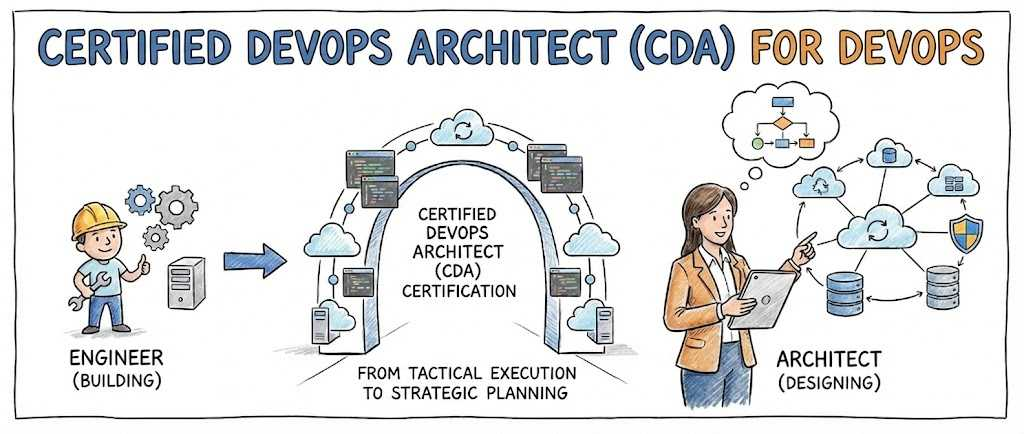
This important shift from “building” to “designing” is exactly what defines the role of a DevOps Architect. It is a transition from tactical execution to strategic planning. This role is not just about having a few tools in your belt like Jenkins or Terraform. It is about possessing a clear, long-term vision for how software should be delivered with maximum safety, extreme speed, and at a massive scale. The Certified DevOps Architect (CDA) program is specifically designed to be the path that leads you toward that level of technical leadership and professional authority.
This comprehensive guide is written to look at the CDA program through the lens of long-term career growth. We will explore the immense value of moving beyond the role of an individual contributor and becoming a true technical leader who can shape the future of an organization.
Understanding the Path to Architecture
What exactly is the Certified DevOps Architect (CDA)?
The Certified DevOps Architect (CDA) is an advanced level of professional training specifically created for individuals who are ready to lead technical teams and drive innovation. It is important to understand that this is not a beginner’s course for those just starting their IT journey. Instead, it is a deep dive into the very blueprint of modern software delivery and infrastructure management. It challenges you to stop looking at individual tasks and start looking at the entire ecosystem of an organization.
When you pursue the CDA certification, you are essentially learning the art and science of “platform engineering.” You are no longer just a person who knows how to operate a tool like Jenkins, Docker, or Ansible. Instead, you become the primary person who designs the entire environment and framework so that hundreds of other developers can perform their work without any friction or delays. It is about looking at the big picture and ensuring that every single part of the system is robust, secure, and built on a foundation that can withstand the pressures of a modern business environment.
The Role of an Architect in the Modern Cloud World
In the traditional software world of the past, developers would write their code and then literally “hand it off” to a completely different operations team to run and maintain it. Those days are long gone. Today, the cloud moves far too quickly for that kind of slow, siloed approach. Companies now require systems that are intelligent and resilient—systems that can update themselves, fix their own errors, and grow automatically when thousands of new users suddenly show up on the platform.
A DevOps Architect is the visionary who makes this complex reality possible. They are responsible for creating the “guardrails” that keep the company safe while allowing for high-speed innovation. These architects ensure that even if a team decides to release new code ten times a day, the overall system remains stable and the customer experience is never interrupted. Without a skilled architect at the helm, a company’s cloud setup can quickly devolve into a chaotic mess that costs too much money, carries too much risk, and breaks far too often.
The True Value of Holding a High-Level Certification
You might wonder why a senior engineer or an experienced manager should care about getting a certificate at this stage of their career. The answer is simple: it comes down to trust, authority, and industry standards. In a competitive global market, employers and stakeholders need to know for a fact that you understand the best and most efficient ways to build complex systems. They need proof that you are not just making things up as you go along.
A professional certification like the Certified DevOps Architect (CDA) serves as physical proof that you have been trained on a specific, high-level set of skills. It demonstrates to the world that you don’t just “know things” in a general sense, but that you know how to apply that knowledge in a way that meets rigorous industry standards. For managers, seeing this certification on a resume or a profile means they can trust you with the most critical and expensive parts of their business infrastructure without hesitation.
A Quick Look at the Certification Details
| Track | Level | Ideal Candidate | Knowledge Needed | Key Learning Areas | Suggested Path |
| Architecting DevOps | Master Level | Lead Engineers & Tech Managers | 3+ Years in Software or Ops | System Design, Security, Cloud | Foundation → Professional → CDA |
Provider: devopsschool
Why Choose DevOpsSchool?
Selecting the right place to learn is just as important as the subject you are choosing to study. DevOpsSchool stands out in a crowded market because they focus heavily on the “how,” rather than just the “what.” They understand that in a real-world job, things are often messy, complicated, and unpredictable. They do not just hand you a textbook and expect you to memorize definitions. Instead, they provide you with the mental framework and practical experience needed to solve real, high-stakes problems.
The instructors at DevOpsSchool are not just teachers; they are veterans who have spent decades in the industry trenches. During the sessions, they share invaluable stories of what went wrong in massive projects and, more importantly, exactly how they fixed those issues. This kind of “tribal knowledge” is something that you simply cannot find in a standard, pre-recorded online course. When you choose DevOpsSchool, you are joining a professional community that will support your growth long after you have passed your final exam.
A Closer Look at the CDA Program
Defining the CDA Certification
This program is essentially a masterclass in the world of platform engineering and architectural design. The primary focus of the curriculum is to teach you how to build a comprehensive, self-service system where developers can get exactly what they need—servers, databases, or pipelines—without having to wait for manual approval from another person. It covers the deep logic of automation, the high-level design of multi-cloud environments, and the governance required to keep everything running smoothly.
Who is this for?
- Senior Developers who are ready to stop writing individual features and want to start designing entire technical ecosystems.
- Operations Leads who want to master the art of cloud-native systems and transition into a more strategic role.
- Engineering Managers who need to lead major technical shifts within their company and want the technical depth to guide their teams.
- Platform Engineers who are currently building internal tools and want to ensure their designs follow global best practices.
Core Skills You Will Master
- Platform Design: You will learn how to create systems that are incredibly easy for other teams to use, reducing the overall workload for everyone.
- Infrastructure Automation: You will master the use of code to build and manage complex networks, servers, and storage systems.
- Cloud Strategy: You will gain the ability to look at various cloud providers and decide which specific services fit your business goals and budget.
- Governance: You will learn how to set strict rules and automated checks for how code is tested, verified, and eventually deployed to customers.
- Resiliency: You will learn the secrets to making sure a system can survive major hardware or software failures without the end-user ever noticing a problem.
Practical Projects for Your Portfolio
- Designing a “one-click” automated environment that allows developer teams to start working on a new project in minutes rather than days.
- Building a security-focused deployment pipeline that automatically scans every single line of code for vulnerabilities before it is ever published.
- Managing the migration of a large, legacy application into a modern, container-based system like Kubernetes.
- Setting up a comprehensive monitoring and observability dashboard that gives executives a real-time view of the health of the entire company’s tech stack.
Study Roadmap
The 14-Day Sprint (For the Experienced Professional)
- First Half (Days 1-7): Dedicate your time to studying the core pillars of the DevOps philosophy and the specific responsibilities of an architect.
- Second Half (Days 8-14): Focus entirely on the primary tools used for automation—like Docker, Kubernetes, and Terraform—and learn exactly how they connect to form a cohesive system.
The 30-Day Steady Path (For the Balanced Learner)
- Weeks 1-2: Spend these weeks focusing on the fundamental building blocks, including Linux administration, advanced networking, and Version Control with Git.
- Weeks 3-4: Move into the practical side by building small, test pipelines and focusing on container logic. During the final few days, take several practice tests to identify any gaps in your knowledge.
The 60-Day Deep Mastery (For the Future Expert)
- Month 1: This month should be dedicated entirely to hands-on labs. You should build, break, and fix complex systems repeatedly until the process feels like second nature.
- Month 2: Shift your focus toward the “Architecture” mindset. Study high-level design patterns, cost-optimization strategies, and advanced security. Use the final two weeks for intense review and taking multiple mock exams to ensure you are ready for the real thing.
Mistakes to Stay Away From
- Only learning the names of tools: Do not fall into the trap of just memorizing tool names or basic commands. You must understand the underlying problem that each tool is designed to solve.
- Ignoring the business side of tech: A great architect must understand economics. Do not build a technically perfect system that is so expensive that it bankrupts the company.
- Trying to work in a vacuum: DevOps is built on the foundation of teamwork and communication. Make sure you learn how to lead people and how to clearly explain your complex designs to non-technical stakeholders.
What Should You Take Next?
- In the same field: Consider moving into a Master in Machine Learning Operations (MLOps) to stay on the cutting edge of AI.
- In a different field: Expand your security knowledge by taking the Certified DevSecOps Professional course.
- For Leadership: If your goal is to lead a department or become a CTO, the Certified DevOps Manager program is the natural next step.
Selecting Your Career Track
The world of modern technology offers many different ways to grow and specialize. Depending on your personal interests, here are six distinct paths you can take:
- General DevOps: This is the perfect path for those who enjoy being generalists and want to know a little bit of everything regarding automation and delivery.
- DevSecOps: This is the best choice for professionals who have a passion for security and want to be the primary shield that keeps a company safe from hackers.
- SRE (Site Reliability): This track is ideal for people who love the challenge of making massive systems run perfectly and stay online 24 hours a day, 7 days a week.
- AIOps / MLOps: This is the path of the future. It is best for engineers who want to work at the intersection of artificial intelligence, data science, and automation.
- DataOps: A specialized and highly valuable path for those who focus on making sure massive amounts of data move quickly and remain clean for the business to use.
- FinOps: This is a rapidly rising field that focuses on the “money” side of the cloud. It is for engineers who want to master cloud costs and manage large budgets effectively.
Matching Your Current Role to the Right Training
Knowing where you stand right now is the best way to plan where you are going next. Here is how your current role maps to the best training:
- DevOps Engineer: If you are currently an engineer, you should aim for the Certified DevOps Architect (CDA) immediately to prove you are ready for a senior lead or architect role.
- SRE: You should focus on the specific Practitioner and Architect levels of SRE training to master the art of system stability.
- Platform Engineer: The CDA is the perfect match for your daily work, as it gives you the formal framework for building the internal platforms your company relies on.
- Cloud Specialist: You should combine the CDA certification with a master’s level course in a specific cloud provider like AWS, Azure, or Google Cloud.
- Security Pro: If you come from a security background, moving toward the DevSecOps Professional path will help you integrate your skills into the modern dev lifecycle.
- Data Professional: You should look closely at DataOps and Big Data master programs to handle the unique challenges of data at scale.
- Manager: For those in management, the CDA will give you the technical “weight” and authority you need to lead your engineers through complex projects more effectively.
Planning Your Future Learning
In the world of technology, professional growth should never truly stop. Once you have successfully completed your Certified DevOps Architect (CDA), you should start thinking about your next move to stay ahead of the competition:
- Vertical Growth: This involves deepening your technical skills even further by mastering specific technologies like Kubernetes, Service Mesh, or advanced Terraform.
- Horizontal Growth: This means expanding your range of skills. You can learn the security side of things by taking a Certified DevSecOps Professional course to become a more well-rounded leader.
- Leadership Growth: If your ultimate goal is to run a whole department or a company, looking at the Certified DevOps Manager program will help you learn the “people” and “business” side of tech.
Expert research shows that having a balanced mix of deep architectural knowledge and strong leadership skills is the fastest and most reliable way to reach the very top of the professional pay scale.
Trusted Places for Training and Support
If you are ready to start this journey, you need a partner you can trust. These institutions are recognized as some of the best in the business for providing high-quality support:
- DevOpsSchool: They are a recognized world leader in providing deep, hands-on, and practical training for those looking to reach Architect and Leadership roles.
- Cotocus: This institution specializes in helping both companies and individual engineers master advanced technologies through expert-led consulting and training.
- ScmGalaxy: This is one of the top resources in the world for learning the intricate details of software configuration, build management, and CI/CD.
- BestDevOps: They focus on providing very clear, simple, and job-ready training programs that help people transition into the field and get hired quickly.
- devsecopsschool.com: This is the number one destination for learning exactly how to bake security into your automated delivery pipelines from day one.
- sreschool.com: This school provides the most detailed and effective training for anyone who wants to master the role of a Site Reliability Engineer.
- aiopsschool.com: This is where you go to learn how to use the latest AI and machine learning tools to manage and monitor modern IT systems.
- dataopsschool.com: A dedicated institution designed specifically for those who need to manage complex and massive data pipelines with DevOps principles.
- finopsschool.com: This is the primary place to learn the “financial” side of the cloud, teaching you how to save your company millions through better cost management.
Frequently Asked Questions
Career and General Questions
- Is this certification recognized globally?
Yes, absolutely. The principles and frameworks taught in the CDA program are used by major tech companies and startups all over the world, making your skills highly portable. - How much time should I spend studying each day?
For most working professionals, dedicating 1 to 2 hours of focused study each day is usually enough to stay on track and finish the program in a reasonable amount of time. - Do I need to be a world-class expert at coding?
No, you do not. However, you should be comfortable reading code and writing simple scripts. Architecture is much more about logic, design patterns, and process flow than it is about writing complex algorithms. - How exactly will this help me get a promotion?
This certification acts as a signal to your employer that you have moved beyond the “doing” phase and are ready for “designing.” it proves you can take on more responsibility and lead high-level projects. - Is the exam done online?
Yes, for your convenience, most providers allow you to take the exam from the comfort of your own home or office through a secure, proctored system. - What if I am currently a manager and not a hands-on engineer?
The CDA is actually very valuable for managers. It provides you with the technical foundation needed to understand exactly what your team is building so you can make much better business and hiring decisions. - Is there a lot of difficult math involved?
Not at all. The focus of the program is on systems thinking, logic, automation, and the flow of information through a system. - Will this certification help me specifically in the Indian market?
Yes, there is currently a massive and growing demand in India for skilled architects who can lead large-scale digital transformation projects for global clients. - What is the minimum passing score for the exam?
The passing score can vary slightly, but generally, you need to demonstrate a very strong and clear understanding of all the core architectural pillars. - Do I get a certificate I can actually put on my LinkedIn profile?
Yes, upon passing, you receive a professional digital certificate and a badge that you can proudly share with your professional network and recruiters. - Are the practical labs very difficult to complete?
The labs are designed to be challenging because that is how you learn. However, they come with a high level of support and documentation to ensure you can successfully work through them. - Is there a community I can join to ask questions later?
Yes, institutions like DevOpsSchool have massive, active communities where you can continue to ask questions and network with other professionals long after your course is over.
Specific Questions for CDA
- What is the single most important goal of the CDA program?
The primary goal is to teach you how to design a complete, fully automated, and secure software delivery platform that can serve an entire enterprise. - Does the curriculum cover Kubernetes in detail?
Yes, Kubernetes is the heart of modern cloud-native architecture, and the CDA program covers it extensively, from basic setup to advanced orchestration. - Do I learn about specific clouds like AWS, Azure, or GCP?
The course focuses on universal principles that work on any cloud. However, the hands-on labs typically use the most popular providers to give you practical experience. - How long does the actual certification exam take?
The exam usually lasts for a couple of hours and is designed to test your ability to make the right architectural decisions in real-world scenarios. - Is there a focus on cost and financial efficiency?
Yes, part of being a great architect is learning how to build efficient systems. You will learn how to design setups that are powerful but not unnecessarily expensive. - Will I learn about Infrastructure as Code (IaC) tools like Terraform?
Yes, mastering IaC is a core requirement for any CDA, as it is the foundation of modern, repeatable system design. - Can I take this course if I am a total beginner in IT?
It is generally recommended that you have some foundational experience first. If you are new, it is often better to take a Foundation or Professional course before jumping into the Architect level. - Does the CDA program cover monitoring and observability?
Yes, learning how to properly monitor a system so you can see and fix problems before they affect the user is a critical part of the architectural training.
Stories from the Field & Final Thoughts
What Others Are Saying
“I spent nearly ten years working as a senior system administrator, but I felt like my career had hit a wall. Getting the Certified DevOps Architect (CDA) was the key that unlocked the next level. It helped me change my title to Platform Lead and resulted in a significant salary increase. I finally feel like I am in total control of the technical roadmap at my company.”
— Rohan, Platform Lead
“The most valuable part of the training for me was the real-world, hands-on labs. They weren’t just academic exercises. In fact, I used a specific strategy I learned during a lab to fix a major scaling and performance issue at my company the very next week after finishing the course. It paid for itself almost instantly.”
— Sarah, Senior SRE
“As an engineering manager, I was often overwhelmed by the technical jargon my team used. I needed to understand the ‘how’ and the ‘why’ behind our massive move to the cloud. This certification gave me the technical authority and the confidence I needed to lead my team through a major organizational change without feeling lost.”
— Amit, Engineering Manager
“The CDA program helped me stop guessing and start designing with intent. Before this, I was just trying different tools to see what worked. Now, I have a structured and proven way to think about automation and system design that has made me much more valuable to my organization.”
— Priyanshu, DevOps Specialist
“Adding the word ‘Certified’ to my LinkedIn profile changed everything. Suddenly, the type of recruiters calling me changed. I went from getting calls for junior and mid-level roles to getting inquiries for Lead and Architect positions at some of the biggest tech companies in the country.”
— Elena, Cloud Architect
Final Conclusion
The technology world is moving faster than ever, and it does not wait for anyone to catch up. To truly stay ahead and protect your career for the long term, you must make the leap from being a “worker” who follows instructions to a “leader” who creates the instructions. The Certified DevOps Architect (CDA) is the bridge that will take you across that gap. It provides you with the skills to design the future of your company and the professional confidence to lead the most important projects in the industry.
Whether your goal is to earn a much higher salary, secure a more prestigious job title, or simply gain the personal satisfaction of being a true master of your craft, a structured learning path is the only reliable answer. Do not just work in the cloud—become the person who designs it.