Introduction
In the current world of digital business, software reliability is considered a top priority. When systems fail, money is lost, and trust is broken. To prevent these issues, the discipline of Site Reliability Engineering was created. This guide is written to provide a detailed look at the SRE Certified Professional (Training & Certification) program. This certification is designed to help professionals master the art of keeping systems stable and efficient.
The SRE Certified Professional program is recognized as a key training path for anyone involved in modern software operations. It is often described as what happens when a software engineer is asked to design an operations function. In this program, the focus is shifted from manual work to automated solutions.
Why the SRE Certification is Essential
In today’s cloud-heavy ecosystem, automation is no longer an option; it is a necessity. High-scale systems are managed more effectively when SRE principles are applied. For engineers, this certification is used to prove that a deep understanding of system health and performance has been gained. For managers, it is seen as a way to build teams that can handle large-scale traffic without constant manual intervention. By following this path, a bridge is built between the development of new features and the stability of the production environment.
Certification Overview Table
| Track | Level | Who it’s for | Prerequisites | Skills Covered | Recommended Order |
| Site Reliability | Professional | Developers, SREs, Managers | Basic Linux and Cloud | SLOs, SLIs, Error Budgets, Automation | After Foundation |
Why Choose DevOpsSchool?
When a training provider is selected, several factors are usually considered. This institution is chosen by many because a practical approach to learning is maintained. Instead of just theory, real-world industry problems are shared with the students. The curriculum is designed by mentors who have spent years handling complex infrastructures.
The support provided is not limited to just video lessons. Hands-on labs are offered so that tools can be practiced in a safe environment. Additionally, a community of learners is provided, where ideas and solutions are exchanged. This helps in building a network that is useful long after the certification is completed. The focus is always kept on career growth and the actual application of SRE skills in a job setting.
Certification Deep-Dive: SRE Certified Professional
What is this certification?
This certification is a professional-level validation of SRE skills. It is centered on the idea that operational tasks should be treated as software problems. The core philosophy of balancing the need for fast changes with the need for system stability is taught.
Who should take this certification?
- Software Engineers who are interested in infrastructure.
- DevOps Engineers who want to specialize in reliability.
- System Administrators who want to move away from manual ticketing.
- Technical Leads who manage cloud-based products.
Skills you will gain
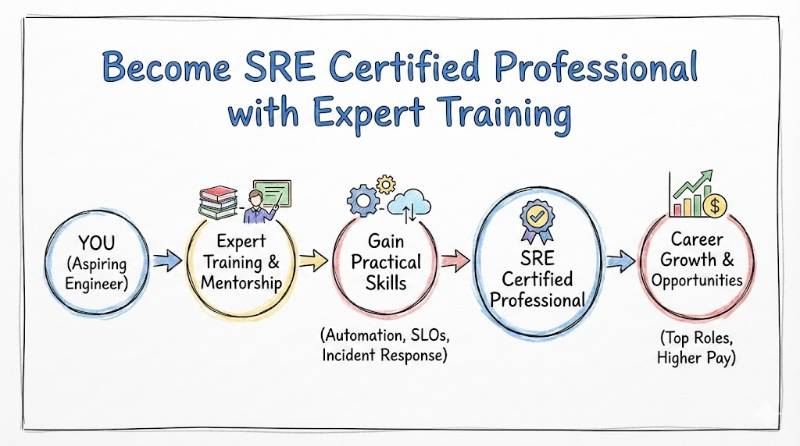
- Defining Service Level Objectives (SLOs): How to set clear goals for system uptime is learned.
- Monitoring Service Level Indicators (SLIs): The correct metrics for measuring success are identified.
- Managing Error Budgets: A method for deciding when to stop new features and focus on stability is mastered.
- Toil Reduction: Techniques for identifying and automating repetitive manual tasks are developed.
- Incident Management: The process of responding to failures and conducting blameless post-mortems is practiced.
- Capacity Planning: How to ensure a system has enough resources for future growth is understood.
Real-world projects you should be able to do
- Reliability Dashboard Construction: A centralized dashboard for tracking SLOs and SLIs is built.
- Auto-Remediation Scripts: Scripts that automatically fix common server issues are created.
- Load Testing Frameworks: A system for testing how much traffic a website can handle before it breaks is implemented.
- Automated Alerting Systems: A system that only alerts engineers for real problems, reducing “alert fatigue,” is designed.
Preparation plan
7–14 days plan:
The fundamental concepts are reviewed. The official syllabus is read carefully. Simple definitions of SRE terms are memorized. The difference between SRE and traditional DevOps is studied.
30 days plan:
Practical labs are started. One hour each day is dedicated to practicing monitoring tools. Case studies of how large companies handle downtime are read. Practice questions are used to check progress.
60 days plan:
Complex automation projects are completed. Mock exams are taken under timed conditions. Any weak areas identified in the mock exams are revisited. A full review of all technical modules is performed before the final test.
Common mistakes to avoid
- Ignoring the Culture: SRE is as much about mindset as it is about tools. The cultural shift must not be ignored.
- Over-Complicating SLOs: Too many goals can lead to confusion. A focus on the most important metrics is recommended.
- Neglecting Coding: A strong grasp of at least one scripting language is required for success.
Best next certification after this
- Same track: Advanced SRE Architecture and Design.
- Cross-track: DevSecOps Professional Certification.
- Leadership / management: IT Director or Engineering Manager Certification.
Choose Your Learning Path
To help in career planning, six structured paths are explained below:
1. DevOps Path
This path is designed for those who want to improve the speed of software delivery. It is focused on CI/CD pipelines and team collaboration. It is best for engineers who enjoy the entire lifecycle of a product.
2. DevSecOps Path
In this path, security is integrated into every step of the process. It is ideal for those who want to protect systems from threats without slowing down the development team.
3. Site Reliability Engineering (SRE) Path
The focus here is entirely on uptime, performance, and scalability. This is the best choice for engineers who like solving deep technical puzzles and building highly resilient systems.
4. AIOps / MLOps Path
This path involves the use of machine learning to improve IT operations. It is intended for forward-thinking professionals who want to use data to predict and prevent system failures.
5. DataOps Path
The principles of DevOps are applied to data science and data engineering here. It is perfect for those who manage large data pipelines and want to ensure data quality and speed.
6. FinOps Path
This is a newer path that focuses on cloud cost management. It is best for professionals who want to ensure that cloud infrastructure is not only fast but also cost-effective.
Role → Recommended Certifications Mapping
The following mapping is provided to help choose the right certifications based on a current job role:
- DevOps Engineer: DevOps Master and SRE Certified Professional are recommended.
- Site Reliability Engineer (SRE): SRE Certified Professional and AIOps Specialist are suggested.
- Platform Engineer: Kubernetes Expert and SRE Certified Professional are advised.
- Cloud Engineer: Cloud Architect and SRE Professional are useful.
- Security Engineer: DevSecOps Certified and SRE Professional are a great combination.
- Data Engineer: DataOps Professional and Big Data Certification are recommended.
- FinOps Practitioner: FinOps Certified and Cloud Cost Management are essential.
- Engineering Manager: Leadership in Tech and SRE for Managers are advised.
Next Certifications to Take
Strategic planning for the next step is encouraged. Based on current trends, the following are suggested:
For the DevOps Learner
- Same-track: DevSecOps Engineering.
- Cross-track: Cloud Native Architecture.
- Leadership: Digital Transformation Leader.
For the SRE Learner
- Same-track: Infrastructure as Code (IaC) Specialist.
- Cross-track: MLOps Professional.
- Leadership: SRE Management Certification.
Training & Certification Support Institutions
Several institutions are available to provide support for these certifications. A brief overview is provided below:
- DevOpsSchool: Wide-ranging training is offered for all major DevOps and SRE tracks. The focus is kept on making sure students are ready for the industry.
- Cotocus: Expertise in cloud and container technologies is shared here. It is highly regarded for deep technical dives into Kubernetes.
- ScmGalaxy: This is a community-driven platform where resources for source code management and CI/CD are provided.
- BestDevOps: Curated programs are found here that focus on the latest best practices in the world of DevOps.
- devsecopsschool.com: A dedicated site where the focus is placed entirely on the security aspect of the development lifecycle.
- sreschool.com: All resources needed to become a reliability expert are gathered here.
- aiopsschool.com: Specialized training for using artificial intelligence in operations is provided on this platform.
- dataopsschool.com: Education on managing data pipelines with a DevOps mindset is found here.
- finopsschool.com: The financial side of cloud computing is taught, helping teams save money while maintaining performance.
FAQs Section
General Career FAQs
- Is SRE a good career choice?
Yes, it is one of the highest-paying and most respected roles in modern tech. - What is the main difference between DevOps and SRE?
DevOps is a philosophy, while SRE is a specific way of implementing that philosophy using engineering practices. - How much time is needed for the SRE Professional exam?
About 40 to 60 hours of study time is usually sufficient for most candidates. - Are there many job openings for SREs?
Yes, almost every large cloud-based company is looking for reliability experts. - Does this certification expire?
It is generally recommended to refresh the certification every two years to stay updated. - Can someone with no coding experience take this?
It is possible, but learning basic scripting first is highly recommended. - Is the certification recognized in India?
Yes, it is highly valued by both Indian IT firms and global companies. - What is an error budget?
It is a tool used to measure how much downtime a system can afford before it affects the users. - Are the exams difficult?
They are designed to be challenging but fair for those who have completed the training. - Is there any age limit for this certification?
No, it is open to any professional regardless of their age or career stage. - Will I get help with my resume?
Many training providers like DevOpsSchool offer career support and resume guidance. - What tools are most important for SRE?
Monitoring tools like Prometheus and automation tools like Terraform or Ansible are key.
SRE Certified Professional Specific FAQs
- What is the focus of the SRE Professional course?
The focus is placed on the practical application of reliability principles in a cloud environment. - Is the exam based on multiple-choice questions?
Yes, the assessment usually consists of multiple-choice questions focused on scenarios. - Are there prerequisites for the SRE Professional level?
A basic understanding of DevOps and cloud is expected. - Will I learn about “Toil”?
Yes, a major part of the course is dedicated to identifying and eliminating manual work. - How is the certification delivered?
A digital certificate is provided upon successful completion of the exam. - Are there group discounts for teams?Most institutions provide special pricing for corporate teams.
- Is cloud-native SRE covered?
Yes, reliability in environments like AWS, Azure, and Google Cloud is a core topic. - Can the training be accessed recorded?
Yes, self-paced learning options are usually available for busy professionals.
Testimonials
Arjun S.
“A clear path to understanding reliability was provided by this course. The section on error budgets was especially helpful for my current project.”
Deepa K.
“The transition into an SRE role felt much smoother after this certification. The labs were very realistic and helped me solve a real issue at my job.”
Vikram P.
“The automation techniques taught here have saved me hours of manual work every week. I highly recommend it to any DevOps engineer.”
Meera J.
“As a manager, I found the common language provided by this training to be very useful for my team. We now handle outages much more calmly.”
Rohan B.
“The focus on practical scenarios rather than just theory made all the difference. I feel much more confident in managing large-scale systems now.”
Conclusion
The SRE Certified Professional (Training & Certification) is a major milestone for any technical career. It provides a structured way to learn the most important skills in the industry today. By focusing on reliability, a long-term advantage is gained in the job market. It is recommended that a clear plan be made and the right training partner be chosen to begin this journey. With the right effort, the role of a reliability expert can be mastered, leading to a successful and stable career.