Introduction
The world of software development is being reshaped by the rapid growth of intelligence-driven applications. For a long time, the industry focused on the “Dev” and the “Ops” of traditional code. However, the introduction of machine learning into software products has created a new set of challenges. These models require constant care, fresh data, and massive computing power. The MLOps Certified Professional (MLOCP) program is designed to address these exact needs. It provides a bridge between the experimental world of data science and the stable world of IT operations.
What is MLOps Certified Professional (MLOCP)?
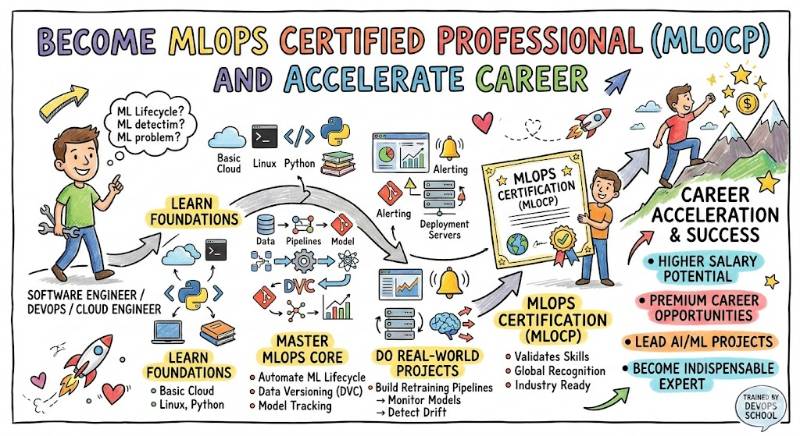
The MLOps Certified Professional (MLOCP) is a rigorous training and certification path that focuses on the lifecycle management of machine learning models. It is more than just a course on tools; it is a mindset shift. In traditional software, the code is static until a human changes it. In machine learning, the “logic” is derived from data, which is always changing. This certification teaches you how to build systems that can handle this fluidity. You are taught how to treat a machine learning model as a first-class citizen in the software delivery pipeline, ensuring it is tested, deployed, and monitored with the same discipline as any other mission-critical service.
Why it matters in today’s software, cloud, and automation ecosystem
In the modern cloud ecosystem, AI is no longer a luxury; it is a necessity. Companies are using AI to optimize supply chains, personalize user experiences, and automate security responses. However, many of these projects fail because they lack a proper operational framework. Without a structured approach like the one taught in the MLOps Certified Professional (MLOCP) program, models “rot” as new data comes in, leading to poor business decisions.
By mastering MLOps, you ensure that automation is applied to the retraining and redeployment of models. This reduces the manual burden on engineers and allows companies to scale their AI efforts from one model to thousands. In an era where cloud costs are rising, the ability to run these models efficiently is a high-value skill that every modern organization is looking for.
Why certifications are important for engineers and managers
For the individual engineer, a certification serves as a professional milestone. It proves that you have the discipline to follow a structured learning path and have mastered a specific set of industry-standard skills. It acts as a “trust signal” to recruiters and peers, especially in a field as new and complex as MLOps. It helps you stand out in global markets where competition is high and specialized skills are in short supply.
For the engineering manager, certifications provide a way to standardize the team’s capabilities. When everyone on the team holds an MLOps Certified Professional (MLOCP) credential, the manager can be confident that a baseline level of expertise exists. It makes project planning easier because the manager knows the team follows a shared methodology. This leads to fewer errors in production, more predictable delivery timelines, and a higher overall quality of work.
Certification Overview Table
| Track | Level | Who it’s for | Prerequisites | Skills Covered | Recommended Order |
| MLOps | Professional | Engineers & Managers | Basic Linux & Cloud | CI/CD, Monitoring, DVC | Core Level |
Why Choose DevOpsSchool?
Selecting the right training partner is a critical decision for your career growth. DevOpsSchool is chosen by thousands of professionals because of its deep roots in the DevOps and SRE communities. The training is delivered by experts who have spent decades solving complex infrastructure problems for global enterprises.
The curriculum is designed to be practical, moving beyond theory into real-world lab environments. Students are given the chance to work on actual problems that reflect the challenges faced in the industry. Furthermore, the support system provided by the mentors ensures that no student is left behind. Whether you are in India or working for a global firm, the global recognition of this platform helps in opening doors to premium career opportunities.
Certification Deep-Dive: MLOps Certified Professional (MLOCP)
What is this certification?
The MLOps Certified Professional (MLOCP) is a specialized credential that validates an individual’s ability to manage the operational aspects of machine learning. It covers the end-to-end process of taking a model from a development notebook to a high-scale production environment while ensuring reliability and security.
Who should take this certification?
- Software Engineers who want to build the next generation of AI-powered applications.
- DevOps Professionals who are looking to expand their automation skills into the data science domain.
- Data Engineers who need to understand how their data pipelines impact model performance.
- IT Managers who are responsible for overseeing AI and machine learning projects within their organizations.
Skills you will gain
- Automated Model Training: You will learn how to set up triggers that start the training process whenever new data is available or when model performance drops.
- Continuous Integration for ML: Understanding how to run automated tests on both the code and the data to catch errors before they reach production.
- Model Versioning and Tracking: Learning how to use tools to keep track of every experiment, making it easy to roll back to a previous version if a new model fails.
- Production Monitoring: Setting up advanced dashboards that track not just system health (CPU/RAM) but also model health (accuracy, precision, and bias).
- Infrastructure as Code (IaC) for AI: Using tools to automatically provision the GPUs and high-performance clusters needed for modern AI workloads.
Real-world projects you should be able to do
- End-to-End Pipeline Construction: You will build a system that takes raw data, cleans it, trains a model, and deploys it as a web service without any manual intervention.
- Drift Detection System: Creating an automated alert system that detects when the “real world” data has changed so much that the model is no longer accurate.
- A/B Testing for Models: Setting up an environment where two different versions of a model can be tested simultaneously to see which one performs better for users.
- Resource Optimization: Building a scaling policy that automatically shuts down expensive AI hardware when it is not being used, saving the company significant cloud costs.
Preparation Plan
7–14 Days Plan (The Sprint)
- Days 1-4: Focus on the core vocabulary of MLOps and the differences between standard DevOps and ML workflows.
- Days 5-10: Study the specific architecture of popular MLOps tools and how they integrate with cloud providers.
- Days 11-14: Solve practice questions and review the documentation for the MLOCP exam.
30 Days Plan (The Balanced Path)
- Week 1: Deep dive into the data lifecycle, including collection, cleaning, and versioning.
- Week 2: Hands-on experience with containerization (Docker) and orchestration (Kubernetes) for ML models.
- Week 3: Focus on CI/CD pipelines and automated testing for machine learning models.
- Week 4: Mock exams, review of the core syllabus, and final preparation for the certification test.
60 Days Plan (The Deep Dive)
- Phase 1 (Days 1-20): Learn the basics of data science and how models are built so you can speak the language of data scientists.
- Phase 2 (Days 21-40): Build full-scale automation projects from scratch using industry-standard tools.
- Phase 3 (Days 41-60): Study advanced topics like security, cost optimization, and multi-cloud strategies for AI.
Common mistakes to avoid
- Neglecting Data Privacy: Always ensure that sensitive data is masked or encrypted within your pipelines.
- Manual Deployments: Avoid the temptation to manually “push” a model to production; always rely on your automated pipeline.
- Ignoring Model Bias: Be aware that models can become biased over time, and your monitoring systems should look for this.
- Lack of Documentation: Ensure every step of your MLOps process is documented so that other team members can follow your work.
Best next certification after this
- Same track: Advanced AI Infrastructure Specialist.
- Cross-track: DevSecOps Certified Professional.
- Leadership / management: Certified Engineering Manager in AI.
Choose Your Learning Path
1. The DevOps Path
Designed for the traditional infrastructure expert. This path builds on your knowledge of Jenkins and Terraform. You will learn how to adapt these tools to handle the unique artifacts of machine learning, such as large model files and massive datasets.
2. The DevSecOps Path
This is for the security-conscious professional. You will focus on how to secure the entire ML pipeline. This includes scanning for vulnerabilities in the code and ensuring that the data used for training is not being tampered with.
3. The Site Reliability Engineering (SRE) Path
Best for those who care about system stability. You will focus on the “Gold Signals” of MLOps: Latency, Traffic, Errors, and Saturation. You will learn how to make AI systems resilient to failures.
4. The AIOps / MLOps Path
This is the most direct route. It covers the entire spectrum of machine learning operations. It is best for professionals who want to lead the AI transformation within their companies.
5. The DataOps Path
For the data enthusiasts. This path teaches you how to manage the “pipelines of data” that feed the models. You will learn about data quality, governance, and how to deliver clean data to the machine learning team.
6. The FinOps Path
For those interested in the business of the cloud. AI can be incredibly expensive. In this path, you learn how to track the cost of every training job and ensure that the AI projects are actually profitable for the company.
Role → Recommended Certifications Mapping
- DevOps Engineer: MLOps Certified Professional (MLOCP) + Cloud Automation Specialist.
- Site Reliability Engineer (SRE): SRE Certified Professional + MLOCP.
- Platform Engineer: Kubernetes Architect + MLOCP.
- Cloud Engineer: Cloud Solutions Architect + MLOCP.
- Security Engineer: DevSecOps Specialist + MLOCP.
- Data Engineer: DataOps Certified Professional + MLOCP.
- FinOps Practitioner: Cloud Financial Management + MLOCP.
- Engineering Manager: Strategic Leadership in Tech + MLOCP.
Next Certifications to Take
For the MLOps Learner:
- Same-track: Advanced Machine Learning Architect.
- Cross-track: Cloud Security Professional.
- Leadership: Tech Lead Certification.
For the SRE Learner:
- Same-track: Observability Specialist.
- Cross-track: MLOps Certified Professional.
- Leadership: Operations Manager Certification.
For the Security Learner:
- Same-track: Cloud Security Expert.
- Cross-track: Data Governance Professional.
- Leadership: CISO Training Program.
Training & Certification Support Institutions
DevOpsSchool
This institution is recognized for providing high-impact training that is aligned with current industry trends. They offer a deep repository of resources, including video tutorials and expert-led sessions. Their support for the MLOCP certification is considered a gold standard for working professionals.
Cotocus
A specialized consulting firm that brings real-world experience into the classroom. Their training programs are designed to solve the actual business problems that companies face today. It is highly recommended for those looking for a practical, hands-on approach.
ScmGalaxy
One of the oldest and largest communities for software configuration and DevOps. It serves as a knowledge hub where professionals can learn about the latest tools and share their experiences with peers across the globe.
BestDevOps
This platform is focused on helping engineers reach the peak of their careers. It offers curated learning paths that are designed to be efficient and highly effective, helping you achieve certification in the shortest time possible.
devsecopsschool.com
The premier destination for learning how to secure the automated world. Their courses focus on integrating security into every step of the lifecycle, ensuring that your AI and cloud applications are protected from the start.
sreschool.com
A dedicated platform for mastering the art of system reliability. They teach the frameworks used by the world’s largest tech companies to keep their services running 24/7, regardless of the scale.
aiopsschool.com
This institution focuses on the future of operations. They teach you how to use AI to manage IT systems, helping you automate incident responses and predict system failures before they happen.
dataopsschool.com
Focuses on the critical foundation of any AI project: the data. Their training covers how to manage data at scale, ensuring that the information reaching your models is accurate, timely, and secure.
finopsschool.com
Specializes in the financial management of the cloud. This school is essential for anyone who wants to ensure that their tech stack is not only efficient but also cost-effective and profitable.
FAQs Section
1. How long does it take to become a MLOps Certified Professional (MLOCP)?
While it varies by individual, most people with a tech background can complete the preparation within one to two months of dedicated study.
2. Is there a demand for MLOCP certified professionals in India?
Yes, the demand in India is growing rapidly as many global tech hubs are located there. Companies are actively looking for certified experts to lead their AI initiatives.
3. What is the difficulty level of the exam?
The exam is rated as “Intermediate to Advanced.” It tests your ability to apply concepts to real-world scenarios rather than just memorizing definitions.
4. Do I need a background in Data Science?
No, you only need to understand the basic concepts of how models are used. The MLOCP is focused on the operations side, not the math side.
5. What is the career growth after this certification?
You can expect to move into high-level roles such as MLOps Architect or Lead Platform Engineer. The salary growth for these roles is significantly higher than for general DevOps roles.
6. Is recertification required?
The industry changes quickly, so it is recommended to refresh your knowledge every few years, though the core certification provides a strong long-term foundation.
7. Can a junior engineer take this course?
Yes, but it is recommended that they first understand the basics of Linux and cloud computing to get the most out of the labs.
8. Are the labs included in the training?
Yes, top institutions like DevOpsSchool provide extensive lab environments where you can practice without worrying about setting up your own servers.
9. How does this differ from a Kubernetes certification?
A Kubernetes certification focuses on managing containers. The MLOCP focuses on the specific workflow of machine learning that runs inside those containers.
10. Is this certification valid for all cloud providers?
Yes, the principles of MLOps are universal. Whether you use AWS, Azure, or Google Cloud, the skills you gain will be applicable.
11. Does the certification cover Python?
It covers Python from an automation perspective. You will learn how to run Python scripts within your pipelines and manage Python environments.
12. Will this help me transition from a non-tech role?
It is a great tool for a transition, but it should be combined with basic coding and cloud training for the best results.
MLOps Certified Professional (MLOCP) Specific FAQs
13. What is the primary tool used in the MLOCP track?
While many tools are covered, there is a strong focus on platforms like MLflow and Kubeflow for managing the model lifecycle.
14. Does the MLOCP focus on “Big Data”?
Yes, part of the training involves understanding how to manage the large volumes of data that are required to train high-quality machine learning models.
15. How does MLOCP address “Model Drift”?
You are taught how to build automated monitoring systems that detect when a model’s performance begins to degrade in the real world.
16. Is CI/CD different for machine learning?
Yes, it is often called CT (Continuous Training). In addition to testing code, you must also test the data and the model’s accuracy.
17. What are the benefits for an Engineering Manager?
It allows a manager to set realistic expectations for AI projects and ensures the team is using modern, scalable practices.
18. Can MLOps be done on-premise?
While most training uses the cloud, the principles can be applied to local data centers using tools like Kubernetes.
19. How does MLOps handle security?
Security is integrated into the pipeline, focusing on protecting data privacy and ensuring that the model cannot be “poisoned” by bad data.
20. What is the “secret sauce” of a successful MLOCP?
It is the ability to automate the boring parts of the job so that data scientists can focus on building better models.
Testimonials
Karthik
“The skill improvement I experienced was immediate. I went from manually moving files to building a fully automated pipeline. My confidence in handling AI projects has grown tremendously.”
Rajesh
“This certification provided the career clarity I was looking for. I now have a clear path from a Senior Engineer to an Architect role. The real-world application of the labs was the best part.”
Suman
“After completing the program, I was able to lead our team’s transition to a more stable machine learning environment. Our models are now deployed with much higher reliability.”
Deepak
“I finally feel like I am at the cutting edge of tech. The training was simple to follow, yet it covered very complex topics that I use every day in my current role as a Cloud Engineer.”
Sunita
“As a manager, I now have a much better understanding of how to support my team. We have seen a significant improvement in our deployment speed and overall team morale.”
Conclusion
The MLOps Certified Professional (MLOCP) is a vital asset for any modern tech professional. It bridges the gap between different engineering disciplines and provides a clear path to career success in the AI-driven world. By focusing on automation, monitoring, and scaling, you become an indispensable part of any organization. Strategic planning of your learning and obtaining this certification will provide long-term benefits that will serve you throughout your professional life.