Introduction
The world of software development has shifted. It is no longer just about writing code; it is about how that code is delivered, secured, and managed at scale. For anyone looking to master these processes on the Microsoft stack, the Azure DevOps Engineer Expert (AZ-400) certification is the gold standard.
What is Azure DevOps Engineer Expert (AZ-400)?
The AZ-400 is a professional certification designed for those who bridge the gap between development and operations. It validates your ability to design and implement strategies for collaboration, code, infrastructure, source control, security, compliance, continuous integration, testing, delivery, monitoring, and feedback. It is not just a test of technical clicks; it is a test of your ability to architect a delivery ecosystem.
Why It Matters in Today’s Ecosystem
In the current landscape of automation and cloud-native apps, businesses need speed without sacrificing quality. Azure DevOps provides the tools to achieve this. Holding this certification proves that you understand how to use these tools to create a seamless pipeline. It shows you can handle complex automation and keep the “gears” of a company running smoothly.
The Importance of Certifications
For engineers, a certification like the AZ-400 acts as a structured learning path. It forces you to learn parts of the platform you might not use in your daily job. For managers, it serves as a benchmark for technical competence. In a competitive global market, especially in tech hubs like India and the US, having a verified expert status helps in securing high-impact roles and leading digital transformation projects.
Certification Overview Table
| Track | Level | Who it’s for | Prerequisites | Skills Covered | Recommended Order |
| DevOps | Expert | SREs, DevOps Engineers, Developers | AZ-104 or AZ-204 | CI/CD, Instrumentation, Site Reliability, Security | After Administrator or Developer Assoc. |
Why Choose DevOpsSchool?
Choosing the right training partner is vital for a certification this deep. DevOpsSchool is chosen by many because the focus is kept on real-world application rather than just passing the exam. The instructors bring years of field experience into the virtual classroom. Concepts are explained through practical scenarios that reflect actual industry challenges. This hands-on approach ensures that when the certificate is earned, the knowledge is ready to be used on the job.
Certification Deep-Dive: Azure DevOps Engineer Expert (AZ-400)
What is this certification?
This is an expert-level credential that confirms your mastery in combining people, processes, and technologies to deliver continuous value. It focuses heavily on the “how” of automation and culture.
Who should take this certification?
This should be taken by software developers or IT professionals who already have a solid foundation in Azure administration or development and want to move into a leadership or specialist DevOps role.
Skills you will gain
- Designing a strategy for logging and telemetry.
- Implementing Site Reliability Engineering (SRE) strategies.
- Developing a dynamic source control system.
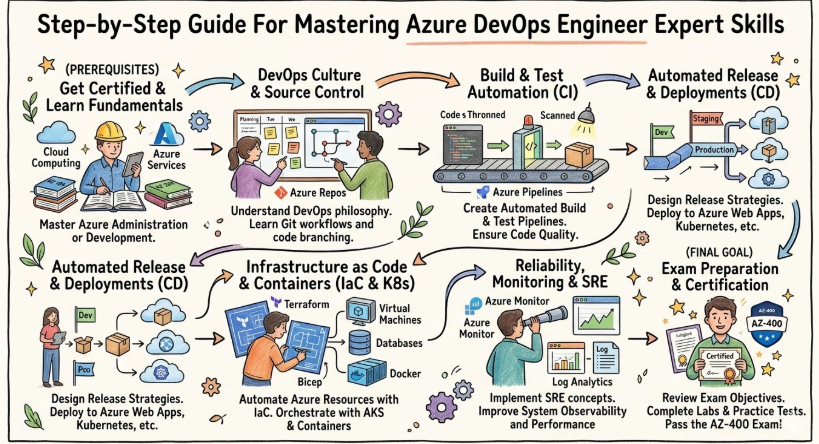
- Creating and managing build and release pipelines (CI/CD).
- Implementing security and compliance in the pipeline (DevSecOps).
- Managing code quality and security policies.
Real-world projects you should be able to do
- Setting up a fully automated multi-stage pipeline for a microservices app.
- Automating infrastructure deployment using Terraform or Bicep within Azure DevOps.
- Integrating third-party security scanning tools into a release workflow.
- Implementing a “Blue-Green” or “Canary” deployment strategy to reduce downtime.
Preparation Plan
- 7–14 Days Plan: This is for those already working daily with Azure DevOps. Focus is placed on the official exam objectives, reviewing weak areas like SRE or Compliance.
- 30 Days Plan: A balanced approach. Two hours a day are dedicated to hands-on labs and reading documentation. One week is spent on each major domain of the exam.
- 60 Days Plan: Best for beginners. The first month is spent mastering the prerequisites (AZ-104 or AZ-204). The second month is focused entirely on the AZ-400 syllabus and practice exams.
Common mistakes to avoid
- Skipping the prerequisites.
- Focusing only on the tools and ignoring the “DevOps Culture” questions.
- Not practicing with YAML-based pipelines.
- Ignoring the security and compliance sections of the exam.
Best next certification after this
- Same Track: Azure Security Engineer Associate (AZ-500).
- Cross-Track: Azure Solutions Architect Expert (AZ-305).
- Leadership / Management: ITIL 4 Foundation or PMP.
Choose Your Learning Path
1. DevOps Path
This is designed for those who want to master the end-to-end lifecycle of software. It is best for Software Engineers and System Administrators who want to automate everything from code to production.
2. DevSecOps Path
This is for the security-conscious engineer. It focuses on shifting security to the left. It is best for Security Analysts who want to learn how to bake compliance into the automation process.
3. Site Reliability Engineering (SRE) Path
This path is focused on the stability and scalability of systems. It is best for those who enjoy troubleshooting, monitoring, and ensuring that “the site stays up” under heavy load.
4. AIOps / MLOps Path
This is for the data-driven engineer. It involves using AI to improve operations and managing the lifecycle of machine learning models. It is best for Data Scientists and Data Engineers.
5. DataOps Path
This focuses on the delivery of data and analytics. It ensures that data pipelines are as robust as software pipelines. It is best for Database Administrators and Big Data professionals.
6. FinOps Path
This is a newer path focused on cloud financial management. It is best for Cloud Architects and Managers who need to optimize costs and ensure every dollar spent on the cloud is justified.
Role → Recommended Certifications Mapping
- DevOps Engineer: AZ-400 (Azure DevOps), AZ-104 (Administrator).
- Site Reliability Engineer (SRE): AZ-400, CKA (Certified Kubernetes Administrator).
- Platform Engineer: AZ-400, HashiCorp Terraform Associate.
- Cloud Engineer: AZ-104, AZ-305 (Architect).
- Security Engineer: AZ-500 (Security), AZ-400.
- Data Engineer: DP-203 (Data Engineering), AZ-400.
- FinOps Practitioner: FinOps Certified Practitioner, AZ-104.
- Engineering Manager: AZ-900 (Fundamentals), AZ-400 (for technical oversight).
Next Certifications to Take
For the DevOps Learner
- Same-track: Kubernetes (CKA).
- Cross-track: AWS Certified DevOps Engineer – Professional.
- Leadership: Certified Agile Leadership (CAL).
For the Security Learner
- Same-track: Certified Information Systems Security Professional (CISSP).
- Cross-track: Azure Network Engineer Associate (AZ-700).
- Leadership: CISM (Certified Information Security Manager).
Training & Certification Support Institutions
DevOpsSchool
Complete support for the AZ-400 is provided here through live sessions and recorded content. A heavy emphasis is placed on lab-based learning and industry projects. Career coaching is often bundled with the technical training.
Cotocus
This institution is known for its focused bootcamps and specialized training programs. Technical deep-dives into specific tools like Jenkins or Docker are offered alongside the main Azure track. It is a good choice for fast-track learners.
ScmGalaxy
A vast community resource that provides tutorials, blogs, and technical guides. It acts as a knowledge hub for those who prefer self-paced learning supported by a strong community of experts.
BestDevOps
Practical training is delivered with a focus on modern SRE and DevOps practices. The curriculum is designed to match current job market requirements, making it easier for students to transition into new roles.
devsecopsschool.com
Specialized training for integrating security into the DevOps pipeline is provided here. It is an excellent resource for those looking to master the “Sec” in DevSecOps.
sreschool.com
This platform focuses strictly on reliability engineering. Lessons are taught on monitoring, observability, and incident management, which are core parts of the AZ-400 exam.
aiopsschool.com
Training on the intersection of AI and Operations is offered here. It helps engineers understand how to use machine learning to automate complex IT tasks.
dataopsschool.com
Courses are provided that bridge the gap between data engineering and DevOps. It is ideal for those managing large-scale data platforms on Azure.
finopsschool.com
Education on cloud cost optimization is the primary focus. It teaches engineers how to build cost-efficient architectures on the cloud.
FAQs Section
1. Is the AZ-400 exam difficult?
Yes, it is considered an expert-level exam. It requires a deep understanding of both tools and processes.
2. How much time is required to prepare?
For someone with experience, 30 to 45 days is common. Beginners may need 3 to 4 months.
3. What are the prerequisites?
You must first earn either the Azure Administrator Associate (AZ-104) or the Azure Developer Associate (AZ-204) certification.
4. In what sequence should I take the exams?
Take AZ-104 first to understand the infrastructure, then take AZ-400 to learn how to automate it.
5. Does this certification help in getting a job?
It is highly valued by recruiters for DevOps, SRE, and Cloud Architect roles.
6. What is the career growth after AZ-400?
Many professionals move into Senior DevOps Engineer, Platform Architect, or Engineering Manager roles.
7. Is coding required for AZ-400?
A basic understanding of scripting (PowerShell/Bash) and YAML is necessary.
8. How long is the certification valid?
Microsoft certifications are typically valid for one year and can be renewed for free online.
9. Can I take this exam if I only know AWS?
You can, but you will need to learn the specific Azure tools like Azure Boards, Repos, and Pipelines.
10. Is the exam multiple-choice?
It includes multiple-choice questions, drag-and-drop, and sometimes lab-based scenarios.
11. What is the passing score?
A score of 700 out of 1000 is required to pass.
12. Is the AZ-400 still relevant in 2026?
Yes, Azure DevOps is a core tool for thousands of enterprises globally.
Azure DevOps Engineer Expert (AZ-400) Specific FAQs
1. Does AZ-400 cover GitHub?
Yes, integration between GitHub and Azure DevOps is a significant part of the current syllabus.
2. Are Docker and Kubernetes part of the exam?
Yes, you are expected to know how to deploy containerized apps using pipelines.
3. How much does the exam cost?
The price varies by region, but it is typically around $165 USD.
4. Are there labs in the exam?
Microsoft occasionally includes active labs, so hands-on practice is essential.
5. What is the most important topic in AZ-400?
CI/CD pipeline configuration (Release Management) is usually the most weighted section.
6. Can I use a Mac to practice for AZ-400?
Yes, Azure DevOps is a web-based platform, and most tools are cross-platform.
7. Does it cover Infrastructure as Code (IaC)?
Yes, you must understand tools like ARM templates, Bicep, and Terraform.
8. Is SRE a big part of the exam?
Yes, implementing instrumentation and SRE strategies is a key domain.
Testimonials
Aarav
The clarity I gained on CI/CD pipelines was incredible. I was able to automate our entire release process at work immediately after finishing my training.
Priya
The focus on real-world projects helped me understand how SRE works in a production environment. I feel much more confident in my daily stand-ups now.
Aniket
Switching from a traditional admin role to DevOps was made much easier. The learning path provided a clear map of what I needed to master.
Sanya
Security in the pipeline was always a mystery to me. This certification journey helped me understand how to automate compliance checks without slowing down the team.
Vikram
As a manager, this gave me the technical vocabulary to lead my team through a cloud migration. It is an essential step for anyone in engineering leadership.
Conclusion
The Azure DevOps Engineer Expert (AZ-400) certification is more than just a piece of paper. It is a comprehensive validation of your ability to lead in a modern tech environment. By mastering the topics covered in this guide, you position yourself as a high-value asset in any organization.
Whether you are in India or working for a global firm, the demand for experts who can automate, secure, and stabilize systems is only growing. Strategic planning of your learning path is the best investment you can make for your career longevity.