Introduction
A significant transformation in the world of software development is currently being witnessed. The traditional boundaries between development, operations, and security are being dismantled. In this evolving landscape, the role of security is no longer viewed as a final hurdle before a product is released. Instead, security is being integrated into every single stage of the software lifecycle. This cultural and technical shift is known as DevSecOps.
The demand for professionals who can navigate this integrated environment is growing rapidly. It is recognized that software must not only be functional and scalable but also inherently secure from the very first line of code. To meet this demand, specialized knowledge is required. This guide is designed to provide a comprehensive look at how expertise in this field can be validated and why such validation is essential for a successful career in modern technology.
What is Certified DevSecOps Professional?
The Certified DevSecOps Professional is a specialized designation awarded to individuals who demonstrate a deep understanding of security integration within the DevOps pipeline. It is an industry-recognized credential that signifies a person’s ability to use automated tools and cultural practices to secure software continuously.
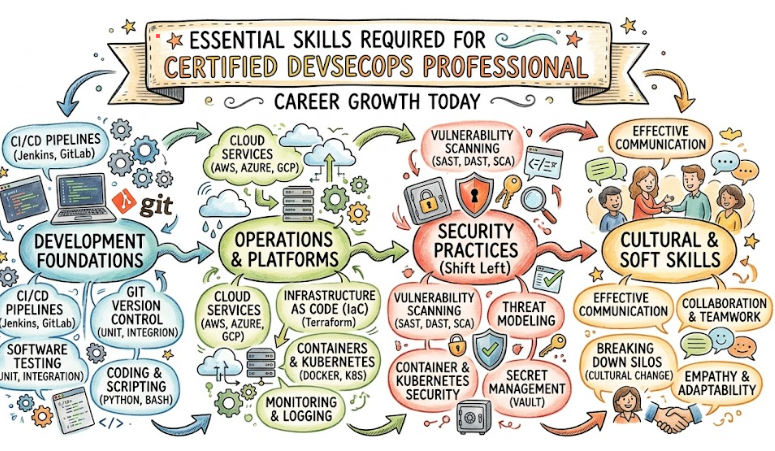
A focus is placed on the “Shift Left” philosophy, where security testing is performed early and often. By holding this certification, a professional is acknowledged as being capable of managing vulnerabilities, securing containerized environments, and ensuring that compliance is maintained throughout the automated deployment process. It is a badge of technical proficiency that is respected by employers globally.
Why it matters today?
In an era where data breaches and cyber threats are frequent, the cost of security failures is higher than ever before. Traditional security methods are often found to be too slow for the fast-paced nature of continuous delivery. This is why DevSecOps has become a critical priority for organizations.
A “security-first” mindset is now required to protect sensitive user data and maintain the reputation of a brand. Companies are searching for engineers who do not just understand how to build systems, but who also know how to protect them. The ability to identify a flaw in a pipeline before it reaches production is considered a vital skill. Consequently, individuals who can bridge the gap between development speed and robust security are seen as indispensable assets to any engineering team.
Why Certified DevSecOps Professional certifications are important?
Certifications serve as a bridge between theoretical knowledge and practical application. While experience is valuable, a formal certification provides a structured path for learning that ensures no critical gaps are left in a professional’s skillset.
- Standardization of Skills: A common language and set of best practices are established through this certification, allowing teams to work more cohesively.
- Career Advancement: Better job opportunities and higher salary brackets are often unlocked when a professional is certified.
- Validation of Expertise: Confidence is built within an organization when its engineers hold credentials from reputable institutions.
- Staying Current: The latest tools and methodologies are covered in the certification curriculum, ensuring that the professional remains relevant in a fast-changing market.
Why Choose DevSecOpsSchool?
When a specialized career path in automated security is pursued, the choice of a training partner becomes the most critical decision. DevSecOpsSchool is recognized as a premier institution because the curriculum is built by practitioners who work in the trenches of cybersecurity and software operations every day.
A primary reason this platform is selected is its focus on the “Real-World Lab” ecosystem. It is understood that reading about security is not the same as defending a pipeline against a simulated attack. At DevSecOpsSchool, learners are given hands-on access to the exact tools used by top-tier tech companies. Furthermore, the transition from a traditional role to a security-first role is made easier through structured mentorship.
The community and support provided are also major factors. A global network of professionals is available to ensure that no learner is left behind when a technical hurdle is encountered. By choosing this institution, a commitment is made to high-quality, practical education that is directly aligned with what the modern job market demands. Whether it is mastering container security or learning compliance automation, the most relevant skills are gained here.
Certification Deep-Dive
What is this certification?
The Certified DevSecOps Professional certification is a program designed to master the art of securing DevOps workflows. It is focused on the practical application of security tools within CI/CD pipelines to ensure safe software delivery.
Who should take this certification?
This program is ideal for software engineers, DevOps practitioners, and security analysts who wish to specialize in automated security. It is also highly recommended for engineering managers who oversee cloud-native projects and want to understand the technical depth of secure delivery.
Certification Overview Table
| Track | Level | Who it’s for | Prerequisites | Skills Covered | Recommended Order |
| DevOps | Intermediate | Software Engineers | Basic Linux/Cloud | CI/CD, Scripting | 1 |
| DevSecOps | Advanced | Security/Ops | DevOps Knowledge | SAST, DAST, SCA | 2 |
| SRE | Advanced | Reliability Eng | Admin Experience | Monitoring, SLIs | 3 |
| AIOps/MLOps | Expert | Data Scientists | Python, DevOps | Model Security | 4 |
| DataOps | Intermediate | Data Engineers | SQL, Pipelines | Data Privacy | 5 |
| FinOps | Intermediate | Managers | Cloud Billing | Cost Optimization | 6 |
Skills you will gain
- Automated Security Testing: Static and dynamic analysis tools are mastered.
- Vulnerability Management: Techniques for identifying and fixing security flaws are learned.
- Container Security: Methods for securing Docker and Kubernetes environments are explored.
- Compliance as Code: Processes for automating regulatory checks are implemented.
- Infrastructure Security: Secure configuration of cloud resources is practiced.
- Secret Management: Best practices for handling API keys and passwords are adopted.
Real-world projects you should be able to do after this certification
- Secure Pipeline Construction: A full CI/CD pipeline with integrated security gates is built.
- Image Scanning Implementation: Automated scanning for container images is configured to block insecure deployments.
- Compliance Dashboarding: A real-time dashboard for tracking security compliance across multiple projects is created.
- Cloud Hardening: Public cloud environments are audited and hardened against common attack vectors.
Preparation plan
7–14 days plan
Focus is placed on the core concepts and definitions. The official curriculum is reviewed, and basic tools like SonarQube or Snyk are explored in a local environment.
30 days plan
A deeper dive into tool integration is conducted. Labs are completed daily, and the focus shifts to understanding how different security tools interact within a Jenkins or GitLab pipeline.
60 days plan
Advanced topics like Kubernetes security and compliance automation are tackled. Mock exams are taken, and real-world project scenarios are simulated to ensure total readiness.
Common mistakes to avoid
- Ignoring the Culture: It is often forgotten that DevSecOps is as much about people as it is about tools.
- Over-Automating: Sometimes, too many security gates are added at once, which can frustrate development teams.
- Skipping Fundamentals: A solid understanding of basic Linux and networking is essential before moving to advanced security.
Best next certification after this
- Same track: Certified DevSecOps Expert
- Cross-track: Site Reliability Engineering (SRE) Professional
- Leadership / management: FinOps Certified Professional
Choose Your Learning Path
DevOps
This path is best for those who want to master the speed of delivery. It is focused on automation, cloud infrastructure, and the continuous integration of code. It is designed for engineers who want to streamline the path from development to production.
DevSecOps
This journey is intended for professionals who are passionate about security. It involves learning how to weave protection into the very fabric of the development process. This is the ideal path for those who want to be guardians of the software supply chain.
Site Reliability Engineering (SRE)
Reliability and performance are the primary concerns here. Suited for those who care about uptime, concepts like error budgets, incident response, and system resilience are emphasized.
AIOps / MLOps
This is created for data-driven individuals. The path explores how artificial intelligence can be used to manage IT operations and secure machine learning models in production environments.
DataOps
The focus here is on the seamless flow and security of data pipelines. It is perfect for data engineers who want to ensure that data is high-quality, accessible, and secure.
FinOps
This is recommended for those with a business mindset. It deals with the financial management of cloud resources, ensuring that cloud spend is optimized and waste is eliminated.
Role → Recommended Certifications Mapping
| Role | Primary Certification | Skill Focus |
| DevOps Engineer | Certified DevOps Professional | Pipeline Automation |
| Site Reliability Engineer | Certified SRE Professional | System Resilience |
| Platform Engineer | Certified Kubernetes Professional | Infrastructure Scaling |
| Cloud Engineer | Certified Cloud Professional | Resource Provisioning |
| Security Engineer | Certified DevSecOps Professional | Threat Mitigation |
| Data Engineer | Certified DataOps Professional | Data Pipeline Security |
| FinOps Practitioner | Certified FinOps Professional | Cost Governance |
| Engineering Manager | Certified DevSecOps Leader | Team Strategy |
Next Certifications to Take
Same Track
- Certified DevSecOps Expert: A deeper mastery of security automation and complex threat modeling is achieved through this program. It is designed for those who wish to become the ultimate technical authority in secure software delivery.
Cross-Track
- Certified SRE Professional: Knowledge is expanded into the domains of system reliability and performance engineering. A focus is placed on maintaining high uptime while ensuring that robust security measures are integrated into the operations.
Leadership & Management Track
- Certified Engineering Manager: Strategic oversight of teams, processes, and large-scale projects is developed. The transition from technical execution to people management and organizational leadership is facilitated through this path.
Training & Certification Support Institutions
DevOpsSchool
A wide range of technical certifications and hands-on training programs is provided by this institution. A strong emphasis is placed on career growth and practical skills for the global market. The curriculum is designed to help professionals stay competitive.
Cotocus
Specialized consulting and training services are offered for cloud-native technologies. Expertise in helping organizations transition to modern DevOps practices is shared. The focus is on providing high-impact learning experiences for technical teams.
ScmGalaxy
A massive repository of tutorials, community forums, and training materials is maintained here. It is a go-to resource for software configuration management and automation. It is widely used by engineers to solve real-world technical problems.
BestDevOps
A curated selection of the best training programs and certification paths is presented by this group. The focus is on quality and the individual success of each learner. It is recognized for its simple and effective teaching methods.
devsecopsschool.com
A dedicated focus on weaving security into every automated step of the development pipeline is maintained here. The skills required to defend modern software ecosystems against evolving threats are developed through this platform.
sreschool.com
Expertise in building resilient, high-performance systems and managing error budgets is gained by practitioners. Reliability and system uptime are prioritized to ensure a seamless user experience across all digital platforms.
aiopsschool.com
The integration of machine learning into IT operations is explored to automate complex incident responses and system maintenance. Intelligent systems for proactive monitoring and predictive analysis are built using these advanced resources.
dataopsschool.com
The entire lifecycle of data is managed with a strong focus on speed, quality, and security throughout the pipeline. Efficient systems for large-scale data processing and real-time analytics are mastered by learners on this site.
finopsschool.com
Cloud spending is optimized through the implementation of financial accountability and resource transparency across the organization. Significant cost savings and maximum value from cloud investments are achieved by following these recognized standards.
FAQs Section
- What is the difficulty level of this certification?
It is considered an intermediate to advanced level program that requires a solid grasp of DevOps concepts. - How much time is required to prepare?
Between 30 to 60 days are usually sufficient for someone with a technical background. - Are there any prerequisites?
Basic knowledge of Linux, cloud computing, and the software development lifecycle is recommended. - In what sequence should certifications be taken?
It is often suggested to start with DevOps and then move into DevSecOps for a better foundation. - What is the career value of being certified?
Increased visibility to recruiters and a higher potential for leadership roles are common outcomes. - Which job roles can be applied for?
Roles such as DevSecOps Engineer, Security Architect, and Cloud Security Specialist are often pursued. - Is the certification recognized globally?
Yes, the standards taught are applicable in markets across India, the US, Europe, and beyond. - Does this help with salary growth?
A significant increase in compensation is frequently reported by certified professionals. - Are lab environments provided?
Interactive labs are a core part of the training offered by the providers. - How long is the certification valid?
Validity periods vary, but continuous learning is always encouraged to maintain the credential. - Can an engineering manager benefit from this?
Yes, a better understanding of technical security risks is gained by managers. - Is there community support available?
Forums and alumni networks are provided for ongoing professional development.
FAQs specifically focused on Certified DevSecOps Professional
- Does this certification cover Kubernetes security?
Yes, the security of container orchestration is a major component of the curriculum. - Are specific tools like Jenkins and SonarQube taught?
The integration of these popular tools into a secure pipeline is explained in detail. - How is “Shift Left” explained in the course?
The concept is taught through practical exercises where security is moved to the earliest stages. - Is cloud security for AWS and Azure included?
Security best practices for the major cloud providers are explored. - What is the format of the exam?
The exam usually consists of scenario-based questions that test practical knowledge. - Are real-world projects included in the assessment?
Proof of ability to implement a secure pipeline is often required for completion. - Is compliance automation covered?
Yes, tools for auditing and maintaining regulatory standards are discussed. - How often is the content updated?
The curriculum is reviewed frequently to include new security threats and tool versions.
Testimonials
Aarav Gupta
A complete change in how security is perceived was experienced after this program. The labs were incredibly helpful for understanding real-world attacks and defenses.
Sanya Malhotra
Great clarity regarding the DevSecOps career path was gained. The transition from a traditional security role to an automated one was made much smoother.
Vikram Singh
The ability to secure a cloud environment was significantly improved. My confidence in handling large-scale deployments has grown immensely since completion.
Meera Iyer
Practical skills that could be applied immediately at work were provided. The focus on automation saved our team countless hours of manual work.
Rohan Deshmukh
A strategic view of engineering management was developed. Understanding the technical depth of security helped in better project planning and team leadership.
Conclusion
The Certified DevSecOps Professional certification is more than just a credential; it is a gateway to the future of software engineering. As the industry continues to prioritize speed without sacrificing safety, the role of the DevSecOps expert will only become more vital.
Long-term career benefits include not only job security and financial rewards but also the satisfaction of building resilient and trustworthy systems. A strategic approach to learning is encouraged for all software professionals. By choosing the right certification and the right training partner, a professional journey can be transformed into a story of continuous growth and success.